Narabāhan pushed Phālguna’s hand away and said, “You are a disgrace to fatherhood. Aren’t you ashamed? Out of greed for power, you are throwing your daughter into a crocodile’s mouth!”
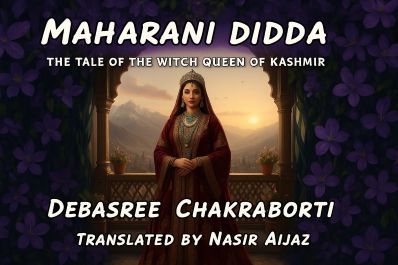
Maharani Didda: Witch Queen of Kashmir
By Debasree Chakraborti
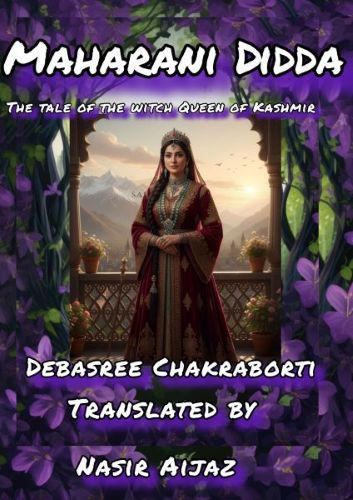 After several days of intense snowfall, at last today a full moon has risen in the sky like a round silver platter. The moonlight, reflected on the white sheet of snow spread across the valley, is scattering in all directions, making it seem as if diamonds and rubies are strewn everywhere. On this full-moon night, Chandralekha and King Kṣhemagupta’s wedding chamber has been prepared. The capital, Srinagar, is adorned with pink and white roses. The royal palace has been decorated with green leaves and pale yellow roses.
Chandralekha is dressed in a silver-colored bridal attire. The garment is embroidered with silver threads and emeralds; her veil is red, embellished with diamonds and gold threadwork. This veil was touched to the feet of Mother Kṣīrabhavanī for blessing and brought back after morning worship on the wedding day. The royal priest himself went to perform this ritual. Chandralekha has no close girlfriends; the maids are adorning her and preparing her as a bride. Within a few moments, she will have her first meeting with Kṣhemagupta. To imagine that moment of first encounter, she is currently immersed in Kālidāsa. On the eve of her wedding, she quietly imagines the tender love between King Agnimitra of the Śuṅga dynasty and Mālavikā from Kālidāsa’s play Mālavikāgnimitram.
Chandralekha’s long tresses fall all the way to the ground—like the dense dark monsoon clouds of Āṣāḍha. The maids braid her hair and wrap a garland of jasmine buds into it. Today Chandralekha is wearing ornaments of diamonds and ruby enamel; the maids place a garland of roses around her neck. The soft strains of the shehnai fill the palace with a heavy, expectant air, and the fragrance of beautiful flowers permeates the surroundings. Time seems unwilling to move forward; Chandralekha keeps counting the moments, waiting for that supreme instant.

In another wing of the royal palace lies King Kṣhemagupta’s quarters. The traces of last night’s indulgence in women and liquor remain clearly visible on him—both physically and mentally. Narabāhan has been with the royal physician since morning in these quarters.

The royal physician is trying various herbal remedies to dispel the king’s intoxication. Since morning, the situation has improved considerably. When Narabāhan arrived here in the morning, Kṣhemagupta had been unable even to stand on his own feet. Many attempts were made to make him sit upright, but he could not get up from the bed. The royal physician kept preparing mixtures and administering them to the king, and gradually his condition became somewhat stable. Around noon, the king managed to stand without anyone’s support. Then Narabāhan arranged the turmeric-anointing ceremony for him. Now the moon has risen, and in a short while the king must proceed to the wedding pavilion; thus preparations are being made.
 The king is dressed in a silver ceremonial costume and wears a red turban. A diamond piece set in the turban reflects the light of the torches, dazzling everyone’s eyes. Yet he is still not fully in his senses. A night of excessive drinking has left visible distortions in the king’s temperament. While Prime Minister Phālguna supervises every aspect of the wedding night arrangements, Narabāhan is working to make the king fit enough to be taken to the wedding altar. In the evening, Narabāhan meets Phālguna outside the king’s quarters. Upon seeing Phālguna, Narabāhan… Disgust was clearly visible on his face, which Phālguna noticed. Stepping forward, he said, “Narabāhan, I don’t think I am such an object of hatred.” Then moving closer, he adjusted the garland near Narabāhan’s chest and added, “Remember, I am the father-in-law of the king.”
Narabāhan pushed Phālguna’s hand away and said, “You are a disgrace to fatherhood. Aren’t you ashamed? Out of greed for power, you are throwing your daughter into a crocodile’s mouth!”
That same mysterious, slight smile appeared on Phālguna’s face. Narabāhan felt there was a terrible self-satisfaction concealed within that smile. He stepped aside and walked away, for the very sight of Phālguna made him feel sick. Phālguna stood for a few moments watching Narabāhan depart, then grew momentarily pensive before regaining his composure and entering the king’s quarters again.
Standing outside Chandralekha’s chambers, Narabāhan asked the maids whether she was ready to come to the wedding pavilion. The maids informed him that she had already completed her preparations and was growing restless to proceed to the pavilion, awaiting only the summons.
Narabāhan understood that Chandralekha knew nothing about the debauched nature of the king. The young girl had developed a deep attachment to her future husband and to the idea of marriage, something that would now have to be accepted as the destiny written by Providence. Narabāhan instructed the maids to bring Chandralekha to the pavilion in a short while; he himself would escort the king.
The wedding pavilion had been decorated with white and light pink roses. A path strewn with rose petals had been laid from Chandralekha’s chambers to the pavilion. The two sides of this pathway were adorned with roses and silver veils, interspersed with pine leaves and fruits for added embellishment.
Along this path Chandralekha began walking toward the pavilion, her maids following behind her. Ahead stood the wedding canopy, where King Kṣhemagupta awaited the arrival of a beautiful female form. From a distance, Chandralekha’s radiance spread in all directions. The king gazed in that direction with mesmerized eyes. Seeing Chandralekha for the first time…Seeing her, the king became intoxicated with a new kind of ecstasy. While King Kṣhemagupta was absorbed in the physical beauty of Chandralekha, she felt as if the path leading to the pavilion would never end. Seeing the king from afar, a verse from Kālidāsa’s Ṛtusaṁhāra surfaced in her mind. Amidst this snow-covered landscape, she felt the arrival of spring—she imagined herself walking through a forest carpeted with the fallen golden leaves of spring. Cuckoos called from branch to branch. And within her mind echoed Kālidāsa’s verse:
“The earth, adorned in diverse forms,
the beloved who is half of her beloved—
the mirror of the seasons is revealed to me,
in passion dwells the dark-limbed beauty.”
In the distance, King Kṣhemagupta stood waiting in the pavilion. To Chandralekha, he now seemed like the great poet Kālidāsa himself—the one for whom she had waited all this time, the source of inspiration for every verse he had ever written, a bond stretching across lifetimes. This Kālidāsa-like Kṣhemagupta seemed to say, “Your arrival is auspicious, beloved—welcome.”
From the wedding night of Chandralekha and the king, the course of Kashmir’s history began to shift. King Kṣhemagupta plunged into a new intoxication—Chandralekha. Day and night blended together, yet this intoxication would not wear off.
Just as Kālidāsa had written in Ṛtusaṁhāra, Chandralekha saw its living manifestation before her eyes. Reaching the pavilion, the moment of auspicious sight took place, garlands were exchanged. The wedding ceremony was then completed beautifully. Everyone present—including Narabāhan—felt that the bride and the king seemed like old acquaintances reunited.
From the wedding night of Chandralekha and the king, the course of Kashmir’s history began to shift. King Kṣhemagupta plunged into a new intoxication—Chandralekha. Day and night blended together, yet this intoxication would not wear off. Chandralekha too, on receiving her husband in the form of Kālidāsa, was deeply moved; immersed in the sweetness and grace of marital love, she wandered into a new realm of imagination—a world where her husband’s love blended the real and the imagined.
Kṣhemagupta’s fondness for many women diminished somewhat after Chandralekha entered his life, but he could not rid himself of his addiction to alcohol. Chandralekha accepted her husband’s drinking as part of a royal man’s daily habits.
Meanwhile, Prime Minister Phālguna, after handing over his daughter to King Kṣhemagupta, became the kingdom’s unspoken sovereign. Everything he desired came to pass. And thus, in Chandralekha’s life began the unfolding of a real-life Kumārasambhava—the wheel of destiny set in motion. (Continues)
Click here for Part-1, Part-2, Part-3, Part-4, Part-5, Part-6, Part-7, Part-8,
___________________
 Debasree Chakraborti is a renowned novel writer of Bengali language. Based in Kolkata, West Bengal, India, she has done Master’s in Modern History from the Kolkata University, and authored some thirty books, mostly the novels, with historical perspective and themes. Her novel is ‘Maharaja Dahir’ that covers the history of Sindh from 662, the year of first attack on Sindh by the Arab armies till date, was published last year and translated by Nasir Aijaz into Sindhi language.