A historical and socio-political analysis of the Hur resistance movement in Sindh under British rule.
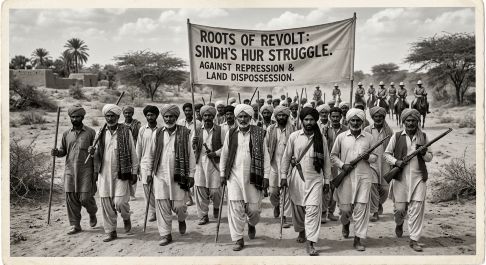
Moving beyond colonial labels like “criminal tribes,” author examines the underlying governance failures, economic disenfranchisement, discriminatory land-allocation policies, and harsh state repression that drove the agrarian disciples of Pir Pagaro to revolt.
Mohammad Zafar Wassan
The people residing in the southeastern part of Sindh have a unique history of resistance against socio-economic deprivation, state atrocities, and injustices. A substantial body of literary work on this subject exists, authored both by fiction writers and documented in official Sindhi archives.
The term Hur was first used in official administrative records to describe the disciples of Pir Pagaro, most notably in the Gazetteer of Sindh by Aitken, which classified them as a “criminal tribe.” Later, H. T. Lambrick authored a novel titled Terrorist, published in the 1950s, which drew upon his personal memoirs from his administrative posting. Lambrick presented a grim picture of Sindh’s law and order, depicting a region consumed by anarchy and widespread governance failures. According to his account, the populations of the Sanghar, Sinjhoro, and Khipro talukas suffered severe lawlessness.
To understand these events, it is necessary to analyze the Hur revolutionary activities through an objective historical lens and examine the complex governance failures that sparked turmoil in eastern Sindh. The Hur movement was essentially an anti-colonial revolt against British policies in Sindh. At the time, the people of Sanghar and Thar Parkar were systematically denied their basic political rights. Unlike modern democratic societies, the British colonial administration refused to engage meaningfully with local populations. Access to power was strictly limited to a select, loyal elite. Consequently, local communities were excluded from policy decision-making, public service delivery, and regional legislation.
This political exclusion paralyzed local economic activity, plunging farming communities deeper into poverty. Historically, the British expedition into Sindh was sponsored by Seth Naon Mal, a prominent Hindu merchant with extensive East India Company trading connections. Naon Mal openly admitted his role in inviting and aiding the Company. As a result, the local merchant class—comprising mostly local Hindu businessmen—served as key intelligence networks and advisors for colonial officials. Their political analyses and administrative recommendations carried significant weight with the new British rulers.
In contrast, the Talpurs—the predecessors to British rule—were familiar with local customs, culture, and social structures, maintaining a relatively cooperative relationship with local communities. However, as colonial rule expanded, the Mirs of Khairpur served as administrative advisors to help manage the population. The Talpurs of Khairpur had long experienced friction with Pir Pagaro and his followers. During the final years of Talpur rule, Sindh was divided into three administrative regions; Mir Murad Ali Khan governed Khairpur and Upper Sindh, while his co-rulers governed Lower Sindh. Internal rivalries led Mir Murad Ali Khan to view Pir Pagaro and the eastern Hur communities with suspicion, fearing that Pir Pagaro’s massive spiritual influence could challenge his authority.
The vast majority of Pir Pagaro’s followers were agricultural peasants whose livelihoods depended on seasonal weather and unpredictable crop yields. Unable to secure political favor with the British administration, these agrarian communities lost ground to wealthy Mahajan moneylenders, whose interests were protected by colonial legislation. At the same time, an opportunistic, sycophantic landed elite—rewarded with vast agricultural estates in exchange for shifting loyalties—misrepresented the grievances of the Hur communities to the administration. This fueled growing mistrust between British authorities and Pir Pagaro’s disciples.
The critical turning point came with the development of the Sukkur Barrage, the inland canal system, and the subsequent allotment of newly irrigated agricultural land. Colonial land-grant policies systematically favored outside settlers with guaranteed water access while completely ignoring the local population. This blatant discrimination, combined with a total lack of state investment in local education, healthcare, and infrastructure, deeply alienated the Hur community.
Stripped of their rights and treated not as citizens but as hostile subjects, the Hurs were driven to armed revolt against British rule. The colonial response was swift and brutal: thousands were imprisoned or executed without fair trial, and large segments of the Hur population were rounded up into concentration-style internment camps. Even after the end of British rule, many remained detained. It was not until the early 1950s that the state finally issued orders to release these long-held political prisoners. Today, having secured formal political representation, the descendants of the Hur movement actively participate in the country’s democratic process.
Read: Politics, not civil service, needs reforms
_____________
 Mohammad Zafar Wassan is a freelance writer and former public official who served in various senior administrative positions.