Some love stories end in marriage, while others linger quietly in the form of a stolen laboratory glass and a faded photograph. This is the story of Kamran, an engineering student who learned that the most beautiful journeys are sometimes the ones left unfinished.
By Abdullah Usman Morai | Sweden
Kamran had always been a competent student.
From primary school to university, his report cards rarely gave his parents a reason to worry. Teachers knew him as the kind of student who submitted assignments on time, grasped difficult subjects quickly, and somehow managed to look innocent even when something was clearly going on.
Then he entered engineering university.
Suddenly, Kamran discovered that some subjects weren’t taught in any textbook.
One of them was called love.
He was three years younger than Nazia, a senior student at the university. He had never spoken to her. She probably did not even know his name. Yet Kamran had developed a perfectly respectable, completely one-sided crush on her.
In his imagination, however, they had already had several conversations.
In reality, they had not even exchanged a “hello.”
That is the strange mathematics of a university crush: the less you know someone, the more space your imagination has to complete the missing information.
Nazia was simply Nazia.
She walked through the university corridors, attended classes, talked to her friends, and went about her life. Kamran, meanwhile, had quietly promoted her to a very important position in his private imagination.
Then one ordinary day, something happened that Kamran apparently considered a historic event.
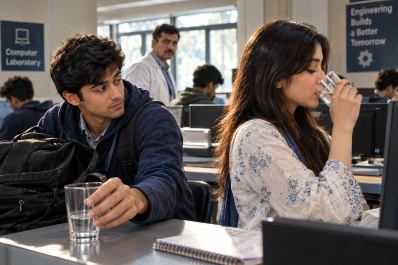
He saw Nazia drinking water in the computer laboratory.
She finished drinking and put the glass down.
Kamran looked at the glass.
Then at Nazia.
Then at the glass again.
A normal student would have walked away.
Kamran was not operating under normal circumstances.
He picked up the glass and put it into his bag.
He did not drink from it.
He simply wanted to keep it.
Unfortunately, or perhaps fortunately, the laboratory assistant saw the entire operation.
The assistant said nothing.
Perhaps he thought, this boy is studying engineering. Let him solve his own problems.
A few days later, one of the professors called Kamran aside.
“Kamran,” he said, “you are a competent student. But I didn’t know you were a thief.”
Kamran smiled.
“Yes, sir.”
The professor looked surprised.
Kamran continued, completely seriously:
“But I’m a thief of hearts. And this particular glass I am not going to return.”
The professor probably wondered whether engineering education had begun producing a new category of criminals.
Kamran then did something that somehow made the whole story even funnier.
He bought a dozen identical glasses and left them in the laboratory.
Perhaps it was his way of paying compensation to the university.
Or perhaps he wanted to make sure nobody could say that one glass had been stolen and the laboratory had been left short.
From then on, Kamran occasionally drank water from that glass.
For him, it was no longer just a glass.
It had become a tiny souvenir of a feeling that had never become a relationship.
Nazia eventually left the university after another year.
There was no dramatic farewell.
No confession.
No proposal.
No movie-style scene at the university gate.
She simply graduated and moved on.
Kamran kept the glass.
And life continued.
Then came Nadia.
Unlike Nazia, Nadia was his batch-mate.
This time the crush was sudden.
And there was a problem.
Nadia already had her own glass.
So Kamran could not repeat his previous achievement.
There was no opportunity to steal the glass, and apparently Kamran had learned that university laboratories were not exactly the ideal place to build a romantic collection.
But Kamran was an engineer.
Engineers find solutions.
He approached a university clerk and asked if he could get Nadia’s photograph, the one attached to her admission form.
The clerk immediately understood.
There are some situations in life that require no explanation.
The clerk looked at Kamran.
Kamran looked at the clerk.
The clerk probably thought, another one.
He agreed to provide the photograph, but naturally, there was a small unofficial fee involved.
Kamran agreed.
When the photograph finally arrived, Kamran paid him.
Not the agreed amount.
Five times more.
Perhaps Kamran was generous.
Perhaps he was embarrassed.
Or perhaps he simply understood that some investments are impossible to calculate in money.
For a while, things with Nadia became serious.
Unlike the Nazia story, this time there were conversations.
There was mutual understanding.
There was even talk of involving families and moving towards a proper engagement.
For a young man who had previously stolen a drinking glass, this was considerable progress.
But life has its own timetable.
The engagement never happened.
And once again, Kamran was left with a memory instead of a relationship.
Years passed.
Nazia got married.
Nadia got married.
Both had children.
Life moved forward for them in the ordinary, beautiful way life does.
And Kamran?
Kamran remained Kamran.
He had a few more crushes along the way.
Some lasted a week.
Some lasted longer.
Some perhaps existed only in his imagination.
But he was happy.
He eventually came to understand something that nobody teaches at university:
Sometimes getting what you want changes the very thing you wanted.
A crush can be beautiful partly because it is incomplete.
You imagine the person.
You imagine conversations.
You imagine possibilities.
You see only the beautiful parts because reality has not yet arrived to introduce the bills, disagreements, responsibilities, habits, families, expectations, and ordinary Tuesdays.
Perhaps that is why Kamran eventually began to believe that the journey could be more interesting than the destination.
And sometimes, when you finally get the destination, you discover that you have lost the very mystery that made the journey exciting.
Years later, Kamran occasionally came across the old glass.
And sometimes he saw Nadia’s photograph.
He would smile.
Not because he regretted what happened.
Not because he wanted to go back.
Simply because those objects carried pieces of a younger version of himself.
A young man who had once believed that a drinking glass could preserve a feeling.
A young man who had paid five times the price for a photograph.
A young man who could fall in love without knowing whether love would ever answer him back.
Perhaps somewhere in his belongings there were other small reminders too: some forgotten photograph, a note, an old university paper, or some other harmless evidence of a crush that had long disappeared.
Each object was a little time machine.
And each one said:
“You were young once.”
But there was another side to Kamran’s story.
As he grew older, he began to understand why some of those relationships had not become marriages.
He had come from a village family.
His responsibilities did not end with himself.
His parents, relatives, and family members back home were part of his life. He knew that marriage was not simply about two people. In his circumstances, it could also mean bringing together two families, two lifestyles, and sometimes two very different worlds.
The girls he had fallen for were from cities.
Kamran sometimes wondered whether their lives and expectations would fit comfortably into his village family environment.
Would they understand his responsibilities?
Would he still be able to support his family back home?
Would the differences between urban and rural life eventually create a distance between the people he loved?
These were not easy questions.
And perhaps there were no perfect answers.
So time made some decisions for him before he could.
And maybe that is one of life’s strangest gifts.
We spend years thinking that we are deciding our future, only to discover later that circumstances, responsibilities, geography, family, timing, and fate have quietly been making decisions alongside us.
Yet Kamran did not consider himself unlucky.
Far from it.
He completed his engineering degree with a gold medal.
The same boy who had once been caught stealing a glass graduated as one of the university’s outstanding students.
Perhaps the laboratory assistant was right not to report him.
After all, the boy had bigger things to steal from life: knowledge, memories, experiences, and perhaps a few hearts.
Kamran never stole anyone’s heart permanently.
And nobody stole his.
Maybe that was the point.
Some people enter our lives to stay.
Others enter simply to leave behind a story.
Nazia left behind a glass.
Nadia left behind a photograph.
Others left behind memories that may not have had physical objects attached to them.
And Kamran carried all of them quietly into adulthood.
Sometimes we think a successful life means getting everything we once wanted.
But perhaps success is also learning how to smile at the things we did not get.
Kamran could have spent his life asking, why didn’t it happen?
Instead, he learned to ask, wasn’t it beautiful while it lasted?
That changed everything.
Because not every love story needs a wedding.
Not every crush needs a confession.
Not every beginning needs a conclusion.
Some stories are meant to remain unfinished.
And perhaps that is why, whenever Kamran sees that old glass or Nadia’s photograph, he smiles.
For a few seconds, the gold medal disappears.
The years disappear.
The responsibilities disappear.
He becomes that young engineering student again the boy standing in a laboratory, looking at a glass and thinking that perhaps love could be kept inside it.
And then he laughs.
Because he knows better now.
You cannot keep love in a glass.
You cannot keep it in a photograph either.
You can only keep the memory of how it made you feel.
And sometimes, that memory is more valuable than possession itself.
Perhaps Kamran’s greatest lesson was not about love at all.
It was about life:
Some people are destinations. Some are journeys. Some are lessons. And some are simply beautiful memories we carry without ever needing to possess them.
And if you are lucky, years later, you can look back at all of them and smile not with regret, but with gratitude.
After all, Kamran had learned the most important lesson of engineering:
Not every structure is meant to be built. Some are simply meant to be admired.
Read: Quiet Power of Ordinary Voters
_____________
 Abdullah Soomro, penname Abdullah Usman Morai, hailing from Moro town of Sindh, province of Pakistan, is based in Stockholm Sweden. Currently he is working as Groundwater Engineer in Stockholm Sweden. He did BE (Agriculture) from Sindh Agriculture University Tando Jam and MSc water systems technology from KTH Stockholm Sweden as well as MSc Management from Stockholm University. Beside this he also did masters in journalism and economics from Shah Abdul Latif University Khairpur Mirs, Sindh. He is author of a travelogue book named ‘Musafatoon’. His second book is in process. He writes articles from time to time. A frequent traveler, he also does podcast on YouTube with channel name: VASJE Podcast.