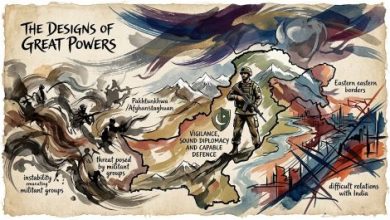
America’s recent domineering strategy with regards to reclaiming Bagram can visibly disrupt regional stability alongside dragging Pakistan into another regional quagmire.
Momina Khan
Bagram Airbase, the once US stronghold and epicenter of American presence in Afghanistan has once again gained prominence after President Trump publicly demanded the return of the base from the Taliban regime. The Bagram Airbase, located in the Parwan province was initially built by the Russians in the 1950’s and was later on run by Washington during its war in Afghanistan. The base was eventually vacated in 2021 as a part of the US withdrawal strategy. This abandoned military airbase, which was home to approximately thousands of soldiers alongside being the largest American base in Afghanistan features well preserved concrete runways, hangars, control tower and a hospital. President Trump now seems to be interested in retaking control of the well-equipped airbase, where millions of dollars were spent on advanced infrastructure and logistical capabilities.

During a joint conference with the British Premier, President Trump reiterated his call of reestablishing US presence at the strategically significant Bagram airbase by stating, “That could be a little breaking news. We’re trying to get it back because they need things from us. We want the base back.”
President Trump had suspended the funding for humanitarian assistance in Afghanistan back in January 2025 which has negatively impacted the lives of millions of vulnerable Afghans across the country. The Taliban regime has been appealing for economic and diplomatic normalization and might be looking for a breakthrough, which President Trump has hinted in his statement.
Bagram Airbase, a stark reminder of US power is far too significant to be abandoned. Located in the Parwan province, it is well connected to key cities and has been of vital strategic importance throughout history. Modern day Bagram was initially conquered by the Persian Empire and later on Alexander the Great ended up settling there while looking for a strong base at the foothills of the Hindu Kush.
During Alexander’s time, the city was named after him and was called “Alexandria of the Caucasus”.Bagram also served as the summer capital of the Kushan dynasty, thus promoting elaborate interaction of art and religion. Hence, since ancient times Bagram’s control was considered crucial for commercial and military dominance in the region.
The 2021 chaotic American withdrawal from Afghanistan is the repetition of a tactical miscalculation leading to strategic and economic vacuum in Afghanistan, thus replaying discordant notes of the past. The previous US disengagement from Afghanistan after the Soviets left had led to an internal civil war amongst various Mujahideen groups. The Taliban later on emerged from these groups and seized control of the country eventually supplying a training base for Osama bin Laden.

In 2021 President Trump voiced his worry on China’s increasing engagement in Afghanistan during an interview with Fox News. He registered his concerns by stating that China would “take over Bagram.”After the recent Taliban takeover, Beijing has formed a multi-pronged policy with the Afghan government, prioritizing its security interests and has obtained security guarantees from the Taliban regime. While the American withdrawal was in process in 2021, a Taliban delegation met the Chinese foreign minister in Tianjin where, “the delegation assured China that they will not allow anyone to use Afghan soil against China.”

One of China’s primary security concerns tends to be from East Turkmenistan Islamic movement whose main is to liberate the Xinjiang province from the Chinese. Furthermore China is interested in a relatively stable Afghanistan which would thus enable the protection of its economic interests. At the same time China also hopes to work with international and regional powers to ensure peace and stability across the region. With respect to the American decision to reestablish the US presence at the Bagram Airbase, the Chinese foreign ministry spokesperson Lin Jian responded by saying that, “The future of Afghanistan should be in the hands of Afghan people.” He further stressed that, “stirring up tension and confrontation in the region will not be supported.”
America’s recent domineering strategy with regards to reclaiming Bagram can visibly disrupt regional stability alongside dragging Pakistan into another regional quagmire. Mired in turmoil and political strife, Pakistan is already grappling with security challenges related to insurgency movements and terrorism. Frequent disputes at Pak Afghan border along with domestic terrorist acts by Tehrik-e-Taliban and Baluch insurgents are obvious obstacles to Pakistan’s security. While dealing with these security threats, mere implementation of military strategies have not yet yielded desired results and amidst this instability, any foreign intervention in Afghanistan could create further complications for the Pakistani state. Being already riddled with security threats, Pakistan has limited capacity to handle additional geopolitical dilemmas and any misadventure across Afghan border could deteriorate its precarious security scenario.
Read: Ripple effect of Israeli attack on Doha
_____________________
The writer is a freelance journalist focusing on politics, international relations and tourism.