Stories of Karachi’s Taxi Drivers from 1993 to 2000
Zaffar Junejo
[Author’s Note: I joined a non-government organization in mid-1993. In those days, we were frequent travelers to other Asian countries, and during that period I maintained a diary. I once showed the notes to Muhammad Ibrahim Joyo — the legendary scholar, translator, and intellectual giant of the Sindhi world — who suggested categorizing the entries by theme and getting them published. He recalled that long ago, perhaps in 1955, the Sindhi journal Mehran had launched a similar idea titled ‘Hik Deenh Ji Ghaleh’ (The Story of a Day), even offering a prize for it. He himself had submitted the first story, he told me with a smile, just to set a standard for other writers. Later, Maulana Ghulam Muhammad Girami, a scholar of high standing and journalist; Shamsher ul Haidri, a distinguished Sindhi poet, journalist, and playwright; and Siraj ul Haq Memon, an iconic novelist, linguist, and journalist, all contributed their observations of a single day. These writings were published until 1968.
I agreed with Joyo Sahib that I would group the write-ups by subject and get them published, but I failed to do so. Recently, I sat down to organize my notes. I found various entries about the taxi drivers of Karachi city. Some were very brief and incomplete; others were short but held a finished truth. I have chosen five stories from each year, all of them gathered from the drivers of those cars. In total, there will be thirty-five stories covering the period from 1993 to 2000.
On the surface, these pieces appear to be simple narratives. However, beneath the prose, they depict the complex socio-political and cultural landscape of Karachi during those turbulent days. They are the echoes of a city in motion. I present here the first instalment, which includes two stories: ‘Death’s Color is Black’ and ‘Yellow and the Bullet-Proof Amulet.’]
Death’s Color is Black and Yellow
It was dark. It was midnight. The sun was far from rising. My Casio watch confirmed it was 11:30 pm. I left my flat in Defence Extension, Phase II. In those days, I worked for the NGO Resource Centre under the Aga Khan Foundation. I had a flight to catch — a Sri Lankan flight. The office did not have its own vehicle then.
I walked to the main road and stood opposite where the National Hospital now stands. I waited. There were no taxis. I felt worry in my chest. I did not want to miss the flight. I did not like standing there. The city was dangerous then. The killing was ethnic. It ran deep in the roots of the streets. Standing in one place for even a few minutes was dangerous. You could be taken for a target, or you could simply be murdered.
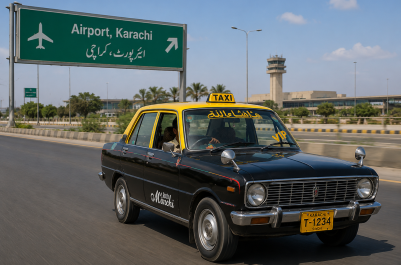
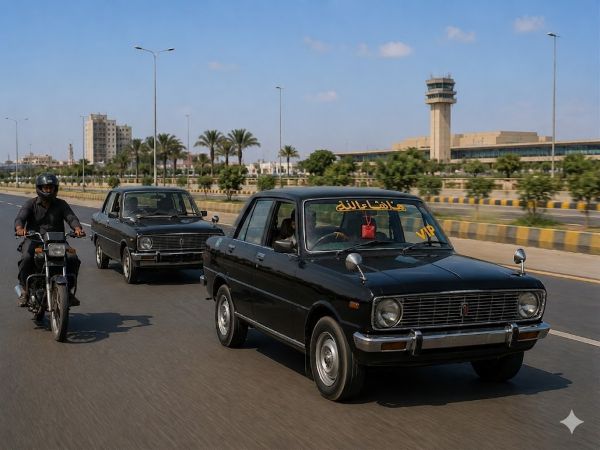
I shifted my position. I saw a car heading toward me. It was old. It was painted yellow and black. They called them “Kali Taxis.” The driver stopped. He agreed to go to the airport.
“Six hundred rupees,” he said.
It was too much. I did not bargain. I was anxious about the time. I threw my bag into the back seat and sat in the front.
We were silent as we drove past the Finance and Trade Centre. Then he began to talk. It was a monologue.
“The color,” he said. “The black and yellow means the driver is Pathan.”
He paused. He watched the road ahead.
“The MQM boys see it. They target us. In one month, eleven taxis have been attacked. Four drivers are dead.”
He showed me his fingers as he counted the dead. He had two options, he said. Paint the taxi a new color, or sell it and buy another. To keep the color was to court death.
We crossed the airport bridge. I saw the lights of the terminal — many different colors. I had been too silent. I thought perhaps my silence had offended him.
“Will you stay at the airport?” I asked. “Or leave?”
“I will leave,” he said.
He looked at me. “Are you going to Saudi Arabia? For Umrah?”
“No,” I said. “Sri Lanka.”
We reached the terminal. I had a thought then. In Karachi, in these days, black and yellow had become the colors of death. I was not sure of much else. I got out.
***
The Bullet-Proof Amulet
I walked out of the NGO Resource Centre. It stood in Clifton near the shrine of Abdullah Shah Ghazi, where the air was always thick with the scent of rose petals and incense. I crossed the street and waited on 26th Street. A taxi pulled over almost immediately. I asked the driver if he would take me to Defence Phase II. He agreed. We settled the fare, and I sat in the front seat beside him.
“What is your name?” I asked.
“Imtiaz,” he said. He told me he lived with his brother at Jamali Pul. He heard my diction and knew my roots.
“Ap ke log bhi wahan rehte hain,” he said. He meant the Sindhis.
He drove through Punjab Colony. As we crossed the roundabout, he reached up to adjust his rear-view mirror. An oversized taveez — an amulet — hung there. It was heavy, wrapped tightly, swinging with the motion of the car.
“Why have you tied that taveez there?” I asked him. “Does it not bother you when you look back?”
“Na, Saeen,” he replied, his tongue shifting comfortably into Seraiki.
“Why do you keep it?”
“Saeen, yeh qatil ko andha kar dega” — it blinds the killer, he said.
“What?”
“If someone fires at the driver, he will go blind. He will miss the mark.”
“Toh, yeh goli-rok taveez hai?” So, this amulet stops bullets? I asked.
“Han ji,” he said.
I looked at the small, swinging weight. “Is it for a pistol, a revolver, rifle, or a shotgun?”
“Bandooq ke liye nahi hai” — not for a shotgun, he said firmly.
“Are you sure?”
“Mera khayal hai” — I think, he said. “Bandooq ka Karachi mein kya kaam?” What business does a shotgun have in Karachi?
I asked him where he found such a thing. Imtiaz told me that a year ago, on a Juma-rat, a family from Jamali Pul hired him for a trip to the tombs of Makli. There were four of them: two men and two women. The younger woman looked pale and sick.
It was his first long trip. They told him they would stay until Friday evening, so he dropped them at a tomb where a mela was in full swing. With time to kill, he drank tea and wandered through the rows of makeshift shops. Vendors had spread thick chadars on the dusty ground, displaying sweets and trinkets under the dim lights.
We passed the College of Physicians and Surgeons Pakistan. The car was moving fast. I wanted him to finish the story before we reached my flat.
“Then?” I asked.
“There was a stall,” he said. “A man was selling oils extracted from sando — the spiny-tailed lizard — for virility. Yet alongside the oils, his stand was draped with various taveezs. The stall owner looked at me and guessed I was from Multan. I told him I was a taxi driver and that Karachi ke halat theek nahi hain — the situation in Karachi is not good.”
The stall owner showed him this specific amulet and told him of its karamat — its miracle. Imtiaz bought it then and there. He hung it on the mirror to keep death away.
We were near the Navy Masjid now. My destination was only five minutes away.
“Have you ever checked the taveez’s karamat?” I asked.
“No,” he said.
“If you fire at the taveez from close distance, what happens?”
“The windscreen will break, driver…” He halted his sentence. He spoke innocently, without irony. He knew how glass worked, but he believed in something else.
“Then?”
“Bas, Saeen. Asra hai. Imaan hai.”
I asked him to stop. I paid him and quickly crossed the road to my block of flats. I watched him drive away into the Karachi night. He had his amulet and he had his faith.
In those uncertain days, a man lived in Karachi needed both.
Read: Once Home, Now Memory: Hyderabad for Kewalram Ratanmal Malkani
________________
 Dr. Zaffar Junejo has a Ph.D in History from the University of Malaya. His areas of interest are post-colonial history, social history and peasants’ history. He may be reached at junejozi@gmail.com