People often measure a lifetime by years, but in truth, life is shaped by change
Sarvinoz Bakhtiyorova
People often measure a lifetime by years, but in truth, life is shaped by change. One such change was quietly approaching the young man who lived in our neighborhood. He was strong, lively, about twenty years old. Yet whenever someone mentioned faith, prayer, or worship, he would laugh it off. During Ramadan, he even mocked those who fasted. To him, all of it seemed unnecessary, even pointless. Sometimes he would eat in front of those who were fasting, or try to tempt the younger boys to break their fast.
No matter how many times the elders of our mahalla warned him, he ignored their advice. Because he mocked our religion, we children called him “the Unbelieving Boy.” He thought the elders’ words were old-fashioned, yet we often saw him sitting with them, listening to their conversations.
In the bitter cold of winter, he would frequently visit my grandfather. He said he enjoyed listening to his advice. Once, I asked him, “If you like hearing his advice so much, why you don’t act on it?” He didn’t answer. He simply said goodbye and left.
That evening, my grandfather taught me what the Qur’an says about treating those who are not Muslim. The truth is, my thinking changed that night. I suddenly wanted to help guide that young man toward faith. But Grandfather said:
“No one can be forced into religion.”
When spring came, the boy stopped visiting us. At first, I didn’t pay much attention. But then I realized we no longer heard his laughter, nor his teasing. It was as if he were slowly fading from our lives.
As Ramadan approached, we children went door to door reciting ramazon aytish. When it was his house’s turn, some kids peeked through the window, screamed, and ran away. No one had seen him for so long—his hair and beard were overgrown, his clothes were worn. He sat alone inside, playing a soft, sorrowful melody on the piano. When he noticed me, he looked up with a tired, careless glance.
After the iftar that evening, Grandfather spoke about him.
“The neighbor boy… he has been diagnosed with cancer,” said Grandfather, exhaling heavily.
Hearing that, darkness washed over my vision. Even though he had mocked us, we had grown attached to him. In that moment, I understood how life can turn even the brightest smile into silent suffering. Sometimes the happiest faces hide the deepest pain.
From that day on, I began to see him differently. Though he was not a believer, his heart felt strangely pure to me.
The next evening, Grandfather invited him to iftar. I, too, was eager to talk to him.
When he entered our home, the lively, confident boy I once knew was gone. He had grown painfully thin, the brightness in his eyes dimmed. He greeted us quietly. Grandfather stood up and offered him a seat of honor.
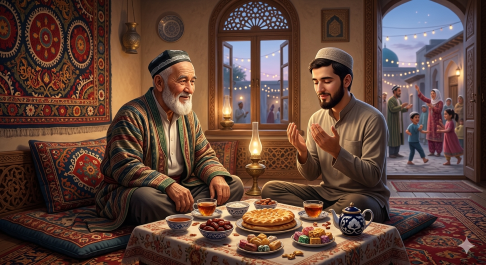
When the call to prayer began, Grandfather raised his hands for dua. After a moment of hesitation, the young man joined us. I immediately looked at my grandfather. With a soft smile, he continued his prayer. A sense of peace settled on the young man’s face.
Iftar began. He ate slowly, as if savoring every moment. After we finished, Grandfather turned to him gently.
“My son, hardship makes a person remember the Truth more quickly. But remember—God should be remembered not only in pain, but also in happiness.”
The young man lowered his gaze.
“I mocked religion… I mocked those who fast. Now I see it wasn’t them—I was the one making a fool of myself.”
Grandfather nodded.
“God does not look at your past, but at your heart today. Listen to your heart—it never lies.”
The young man lifted his eyes.
“If I repent today… will God accept me?”
Grandfather smiled warmly.
“My child, God forgives those who sincerely repent. Even if your sins were as vast as the foam on the sea, He would still forgive you.”
From that night on, the young man began to change. He fasted with sincerity, prayed regularly, and sought God’s pleasure in every word and action. A few weeks later, his health improved. Soon we learned he had defeated his cancer.
He was overjoyed, and began giving charity wherever he could.
And from that day, none of us called him “the Unbelieving Boy” again.
Read: Horror – A Short Story from Uzbekistan
______________________
 Hailing from Uzbekistan, Sarvinoz Bakhtiyorova, born in 2011, is studying at the Ogahiy Creative School, where she continues to work learning the art and intricacies of literature and creative writing.