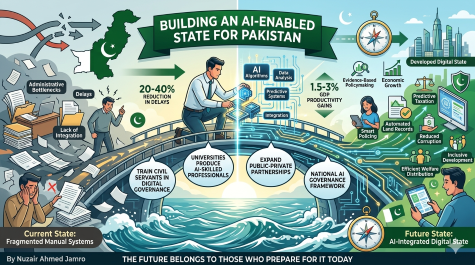
Civil servants should be trained in digital governance, universities must produce AI-skilled professionals and public-private partnerships should be expanded. Without capacity building, even the best systems remain underutilized.
By Nuzair Ahmed Jamro
It is true that Artificial Intelligence (AI) is no longer a distant technological promise; it is a present force reshaping how modern states function. Across the world, governments are steadily moving from manual, paper-heavy administration toward intelligent, data-driven systems capable of real-time decision-making. The question is no longer whether AI will transform governance, but whether countries like Pakistan will adapt before the gap becomes irreversible.
In fact, the Artificial Intelligence refers to computer systems capable of performing tasks traditionally requiring human intelligence such as analysis, prediction, and decision support. In public administration, AI is becoming the backbone of efficiency, transparency, and service delivery. As the saying goes, “necessity is the mother of invention,” and in today’s governance landscape, necessity is unmistakably digital.
Yet in Pakistan, administrative systems still rely heavily on manual processes, fragmented digital tools, and slow bureaucratic procedures. Citizens face delays in land records, taxation, pensions, and licensing. Files continue to move at a pace that belongs to a bygone era. In such a system, inefficiency is not accidental but structural.
However, the consequences are serious. Delays weaken institutional credibility, frustrate citizens, and create space for discretionary inefficiencies. As the proverb goes, “justice delayed is justice denied,” and in governance, service delayed is trust denied. Indeed, it remains the basic bone of contention between citizens and the state slow delivery versus rising expectations.
At last, Pakistan, developing state, is not without potential. With over 140 million internet users, expanding digital infrastructure, and a young population, the country possesses a strong foundation for transformation—if properly harnessed. Where there is a will, there is always a way; and in all walks of life, digital willpower determines developmental direction.
Global Evidence: AI as a Governance Imperative
International institutions have already established the governance value of Artificial Intelligence. As the World Bank (Digital Progress and Trends Report, 2025) highlights that AI and digital technologies significantly enhance public sector productivity, institutional performance, and service delivery, particularly in developing economies. It stresses that digital governance is now essential for economic transformation.
Similarly, the OECD (Governing with Artificial Intelligence, 2025) notes that AI improves efficiency by automating routine tasks, strengthening financial management, and enabling evidence-based policymaking while reducing administrative bottlenecks and increasing transparency.
Moreover, The UNDP (Digital Governance Report, 2024) emphasizes that digital transformation is critical for inclusive development, institutional resilience, and reducing inequality in developing countries. Further, UN Sustainable Development Goal 16 underscores that strong institutions, transparency, and accountability are only possible through modern governance systems supported by digital infrastructure. Although the World Bank Ease of Doing Business Index (2019–2021) is discontinued, its historical findings remain relevant: digitally advanced countries consistently achieved higher investor confidence, faster regulatory approvals, and stronger institutional performance. The global message is consistent and clear that AI is not optional; it is structural.
Fortunately, Countries that adopted AI early are already witnessing measurable transformation. A dramatic new development in global governance shows that digital states outperform traditional bureaucracies in both speed and transparency.
The United Arab Emirates has integrated AI under its national strategy, introducing paperless systems, smart policing, and automated public services, resulting in faster delivery and improved investor confidence.
Singapore uses AI in transport, taxation, and urban planning; creating a predictive governance model that adjusts policies in real time.
China has deployed AI in urban governance and infrastructure planning, improving administrative coordination and decision speed. On the other hand, India, through its Digital India initiative (2015 onward), has integrated AI-enabled systems in biometric identification, digital payments, and welfare distribution, significantly reducing leakages and improving transparency. The lesson is simple yet powerful: where governance is digitized, efficiency follows; where it is not, stagnation persists.
Pakistan’s Digital Transition: Progress without Integration
Pakistan, Struggling for Economic survival, has introduced digital reforms such as NADRA biometric systems, online tax filing, and e-governance portals. However, these remain isolated initiatives rather than part of an integrated governance ecosystem and there is more room for improvement.
As a result, governance remains fragmented. Decision-making is largely reactive rather than predictive. Apart from it, administrative inefficiencies continue to persist across institutions.
The issue is not absence of tools but absence of integration. It is, in fact, a law and order situation of governance itself effective systems exist, but coordination remains weak.
What AI Can Deliver: Evidence-Based Gains
As of the findings from the World Bank (2025), OECD (2025), and UNDP (2024), structured AI adoption can produce measurable improvements for Pakistan, Islamic State in following ways such as 20–40% reduction in administrative delays, 15–30% improvement in tax collection efficiency, 10–25% reduction in corruption-related inefficiencies, 1.5–3% annual GDP productivity gains not last but least, Improved investor confidence and regulatory efficiency. To cut to the chase, these are not theoretical claim but they are evidence-based global outcomes.
Core Challenge: Implementation, Not Technology
Pakistan’s real challenge is not technology but implementation. Policy inconsistency, weak coordination, and limited institutional capacity continue to hinder reform. As the saying goes, “a chain is only as strong as its weakest link.” In Pakistan’s case, the weakest link is governance capacity. Consequently, even well-designed systems often remain confined to paperwork rather than implementation in letter and spirit.
Way Forward for state: Building an AI-Enabled State
First, Pakistan must prioritize AI integration in taxation, policing, healthcare, education, and energy sectors directly affecting citizens. Second, civil service training must be modernized to include digital governance and data-driven decision-making.
Third, a National AI Governance Framework aligned with OECD (2025) and UNDP (2024) standards should be established to ensure policy continuity. Fourth, public-private partnerships must be strengthened to develop local AI solutions tailored to Pakistan’s needs.
Fifth, AI-based project management systems should be introduced in public development projects to ensure transparency and efficiency.
Conclusion: From Stagnation to Transformation
As of today, Pakistan, facing security threats, stands at a defining crossroads. It can either continue incremental reforms or move toward structural transformation through AI-driven governance. Drastic times call for drastic measures, and the situation facing the country calls for extraordinary institutional response.
It is high time that federal and provincial governments work in tandem, with empathy and with technology. The federal government must establish a central AI governance framework to ensure policy consistency, while provinces must focus on implementation through smart service delivery systems in revenue, policing, healthcare, and local governance.
Moreover, both levels of government must invest in human capital. Civil servants should be trained in digital governance, universities must produce AI-skilled professionals, and public-private partnerships should be expanded. Without capacity building, even the best systems remain underutilized.
It is imperative to recognize that, the expected benefits are substantial: faster service delivery, reduced corruption, improved tax collection, stronger investor confidence, and enhanced transparency. Economically, AI can increase productivity; socially, it can expand access to essential services; administratively, it can modernize governance. Despite the impending challenges, emerging economies like Pakistan cannot afford stagnation. Necessity is the mother of invention, and every crisis carries within it the seed of opportunity.
Beyond systems and statistics lies hope. Even the situation is bleak, every dark cloud has silver lining. With vision, coordination, and political will, the developing state like Pakistan can transition from a struggling developing structure toward a modern and eventually developed digital state. As history shows, nations are not defined by their limitations but by their ability to overcome them. As the final truth remains: “The future belongs to those who prepare for it today.”
Read: Artificial Intelligence: The Creative Void
___________________
 Nuzair Ahmed Jamro, hailing from Shikarpur, Sindh, is MS Research Fellow in Public Administration with a strong interest in governance reforms, digital transformation, and public policy analysis. He regularly contributes articles on administrative efficiency, economic development, and institutional reforms. He can be reached at: najamro@gmail.com