

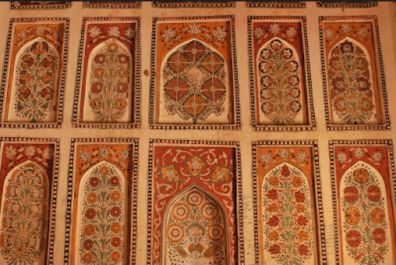
The practice of art of painting on walls of the tombs, mosques, temples and graves flourished from early Kalhora dynasty (1718- 1782 AD) under the influence of Mughals and this tradition continued up to British Period.
Aziz Kingrani
Religious Elements in paintings
Islam
Islam is a major world religion announced and preached by the Holy Prophet Hazrat Muhammad (Peace be upon him) in Arabian Peninsula in the early 7th century CE. Being Muslims, painters had painted many images mosques and other things related to mosques in many tombs of the necropolises from Shah Hassan, taluka Johi, taluka Mehar of District Dadu It is rare to find a tomb where images of mosques, religious persons and articles related to mosque are not depicted. The illustrations of mosques in the tombs clarify the religious aspect along with decorative purpose.
In the most of illustrations of mosques on walls of tombs throughout District Dadu, the related things, motifs and people to mosque and Islam are shown. Such as wooden stands (Rehals) for keeping the Holy Qur’an at the time of reciting, the Holy Qur’an wrapped with kerchief or piece of cloth , “Rosaries” (Tasbeeh), walking boot (Mozo) of holy Prophet Muhammad (S.A.S), Molvis or Mo’zans, saintly persons, Stick for Religious Sermon (Khutibo), earthen vessel like glass (Kupo) for pouring water, a water vessel of earthenware (Kaunro) used to keep water for ablution, earthen vessels (Matts or Mattees) used to keep water for purpose of ablution beside mosques and a wooden stand (Gharamanjees) for keeping earthenware utensils are painted as the principal images of mosques on walls of the tombs. These baked earthenware and mentioned wooden stands are still in use in Sindh. The mosques are mostly depicted on the western walls of the tombs and all the mosques are three domed, having pinnacles (Neels) showing glazed earthen wares. Below the domes, all mosques have generally three motifs or designs in which the figures of things related to mosque and Islam are portrayed.
 In Dadu District, in the graveyard of Qalanderani Laghari near Johi town towards north-west, pictures of mosques are painted on the inner walls of tombs of Umed Ali Laghari, Khuda Bux Laghari, Allah Bux Laghari and Haji Khan Laghari. In this graveyard, the principal images of mosques have deferent motifs in which the men having wooden tablets or little wooden sheets (Pattee) in their hands are painted. In past, the wooden tablet (Pharhi) was used for writing alphabet with ink by Molvi or a teacher for imparting primary religious education. Images of men on their way to mosque wearing waistcoat (Sadri) type shirts and baggy trousers are also painted. The usage of Sadri was quite common in Sindh and baggy trousers had remained common Balochi dress in Talpur period. In middle motifs, Molvis or religious persons are seated, mostly, holding rosaries (Tasbeeh) in their hands. In some paintings, Molvis or religious persons are shown reciting holy Qur’ans or depicted as calling for namaz. Mostly, the religious or saintly persons are robbed in loose dresses. In some images, earthenware pitchers on floor or wooden stands and other utensils are also decorated. The stick for religious sermon and holy Qur’ans on wooden stands are also festooned in some designs of main image of mosques.
The images of mosques are adorned on inner walls of tombs in graveyard of Muridani Jamalis-II. Muridani is sub caste of Jamali tribe and are descendant of Murid Khan Jamali-I who is buried at Murid Dero, Johi taluka of Dadu District. In the cemetery near Shah Inayat Dandu (Having large teeth), one tomb of Umed Ali and Fareed Laghari is sited. These were followers of Mian Naseer Muhammad. Except other paintings, a design of mosque is tinted on inner wall with same motifs but in one design the illustration of a man can be seen wearing green loose dress who has a topknot of hair which proves the old tradition of hair style of people of Kachho.
Mian Naseer Muhammad Kalhoro’s graveyard is one of the largest graveyards in Sindh. It is dotted with tombs and spread over area of more than 20 acres. Mian Naseer Mohammad Kalhoro was a great leader of Mianwal Movement who had strengthened and organized the movement with high degree of sagacity. Leading the movement from 1656-57 AD to 1692 AD, he rose as powerful as ruler in Kachho and later his strengthen movement became a base of Kalhora dynasty in Sindh. He died different and was buried in 1692 AD in graveyard near village Garhi, district Dadu. The types of constructed tobms and graves show the different eras. Probably this graveyard existed before Mian Naseer Mohammad. After burial of Mian Naseer, the graveyard was called and became famous with his name. In this burial ground, on the inner walls of tombs, including above mentioned themes related to mosque, a prayer mat (Musilo) and a hand fan (Punkho) are painted in designed mosque.
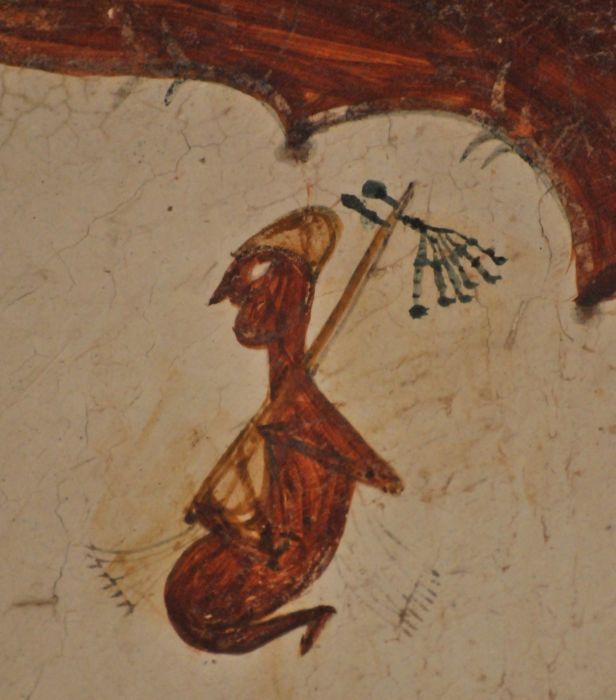 In Lashkar Khan Laghari’s cemetery near Rajo Dero taluka Johi, the picture of mosque on wall of tomb has one design under the domes. Lashkar Khan Laghari was related to Mianwal Movement. In necropolis of Jangu Jamali, near village Haleli, taluka Johi, the tomb of Jangu Khan Jamali has also depiction of mosque on its wall with same subjects and motifs. Sakhi Bakhar Khan Jamali was saintly person and a staunch supporter of Mianwal Movement. The image of mosque in his tomb on the wall is depicted with same concept as it is embellished on the walls of the tombs in other graveyards. In the chief image of mosque, a walking boot (Mozo) of holy prophet Muhammad (S.A.S) is highlighted on walls of tombs in necropolis of Mir Allahyar Khan-I Talpur who was a strong and brave warrior of Mianwal Movement. A title of “Salar-e-Jang” was given to him by Kalhoras that means leader of the war. He died in 1729 AD (10) and was buried here. The graveyard near Drigh Baala is now famous after his name which is situated at a distance of about four kilometers from Drigh, taluka Johi, District Dadu; on the bank of old flow of Nai Sole or Shole. Later, this stream of Nai Shole or Sole was named as Nai Gaaj after constructing the diversion embankment locally called Teer-Bhitt, in British period. Here, Mir Suleman alias Mir Kako, Mir Manik, Mir Chhutto together with their family members and other generals are laid to rest.
Rawat Fakir was pious person and supporter of Mianwal Movement. Thus, he became famous as Fakir. The burial ground of Rawat Fakir Laghari is situated at a distance of two kilometers from village Haji Khan Laghari towards north. On the walls of tombs in the graveyard of Rawat Fakir Laghari, mosques are wonderfully decorated. The sides of pictures are decorated with brilliant floral and geometrical designs. The other items like holy Qur’ans, earthenware utensils and wooden stands are depicted similarly as in other tombs in this region. The picture of mosque on wall of tomb in a graveyard near village Hairo Khan is painted very skillfully. Whether the colours of all other designs are worn-out or nothing was depicted in the motifs of the image of mosque. Only the colourful lines of sketch of mosque have survived.
The graveyard of Shahan Fakir is also a large burial place in this area. Shahan Fakir was disciple of Mian Naseer Muhammad Kalhoro. The graveyard seems the most ancient, sited on top of a hill. When Shahan Fakir was buried here, cemetery became famous after his name. The images of mosques, here on walls of tombs are patterned with same idea. The renovation of tomb of Shahan Fakir has devastated all the illustrations.
The graveyard of village Ali Murad Shahani is situated between village Ali Murad Shahani and Bahleel Shah on the hilltop. Ali Murad Shahani was related to Mianwal Movement and he was tribal chief of Shahani clan. Probably he died during reign of Mian Deen Muhammad Kalhoro. His son Haibat Khan also remained associated with Kalhoas but for further details, history is silent about him. The dome of the tomb of Ali Murad Shahani has completely collapsed. Therefore, all the paintings are damaged due to rains and scorching heat. The depictions including mosque on wall of tomb of his son Haibat Khan Shahani are still nice looking. In the graveyard of Shahak Khan Shahani, near village Chhini, the image of mosque is illustrated on the wall of tomb of Sahib Fakir Shahani. Sahib Fakir was devotee of Mianwal Movement.
The necropolis of Ahdi Fakir is on hillock near Lake Manchhar. The colours of painted mosque on wall of tomb of Ahdi Fakir have become dim and marred by dust. The borders of main image are well decorated with red and black bold lines and floral designs. Below domes, the colours of illustrations of picture of mosque are disappeared. The figures of mosques are also beautifully decorated with same scheme as those on walls of tombs in a graveyard which is now commonly known as Paryani Pirs near Khanpur, taluka Khairpur Nathan Shah, District Dadu. Here, in one design, a name Sachal son of Muhammad Saleh and year 1812 AD are written with red colour. Probably, painter has written this for his own memorial and year declares Talpur period.
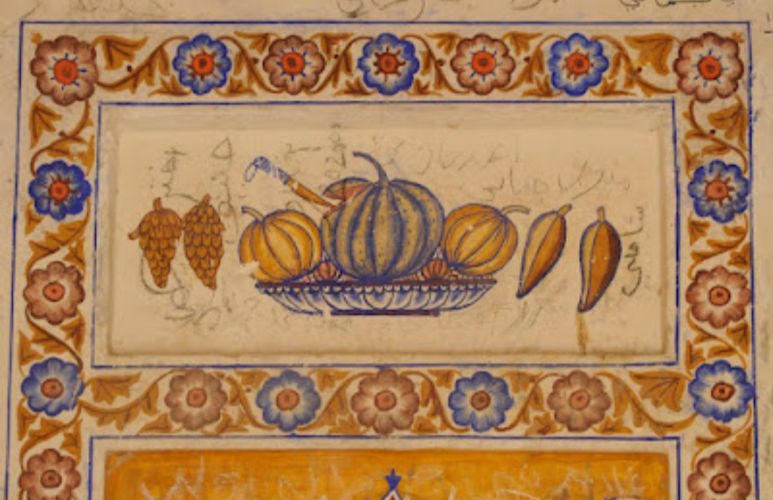 With the same perception, an image of mosque is decorated on the inner wall of tomb of Guhram Fakir Gadehi, taluka Khairpur Nathan Shah where Dairo of Mianwal Movement also still exists near cemetery. In graveyards of martyrs near village Shadan and Patt Suleman, taluka Johi, Dadu, the pictures of mosques are painted. Suleman Khan was an influential tribal chieftain. He was contemporary to Ghahnwar Khan and like Ghahnwar khan Main Naseer Muhammad gave land to Suleman khan in the area of Arari which nowadays is known as patt Suleman, taluka Johi, Dadu District
From the images of mosques depicted on inner walls of tombs located in this area, the main motif shows the tendency of people to Islam. The painters had painted the scenes of mosques according to spiritual and Islamic leaning of people as well as the painter’s own inclination towards Islam.
Duldul is believed as sacred mule horse type ridding solely of the Holy Prophet Muhammad (S.A.S). Some Muslims also believe the Duldul as a ridding animal of Hazrat Ali (A.S.), Imam Hassan (A.S) and Imam Hussain (A.S). Even some Muslims believe that Duldul is flying Buraq of holy Prophet Muhammad. However, the historians have enlightened us over the Duldul in some detail. In prophet’s (Muhammad) life the governor of Egypt in response to a letter by Muhammad (S.A.S) to convert to Islam, sent a she-mule as a gift. Her name was Duldul. (11) In the meantime, during discussion, a prominent poet and writer Naseer Mirza describes that it was a ridding animal for religiously high ranked personalities, like Prophet Muhammad and Hazarat Ali (A.S). He further added that in past during the processions of Ashoore days the tradition of Duldul was prevalent at high level in Sindh for paying tribute to Hazrat Ali (A.S). Inayat Khan agreeing Naseer Mirza writes that the Prophet Muhammad admired the horse (Duldul) as one of the objects worth attaining in life — Hassan and Hussain (A.S) the great martyrs of Islam are represented with their beautiful horses called Duldul (12).
In the light of Urdu poetry, Syed Akber Hyder has discussed in details and justified the mentioned thoughts about Duldul and Imam Hussain who had rode on the shoulders of Prophet. He expresses that once Hussain climbed on the prophet’s back while the prophet was in the state of prostration during prayers. He has opined that Hussain’s horse was just like Duldul and Duldul is the name of mule that the prophet Muhammad rode when confronting Islam’s adversaries. Hence it is not surprising that Hussain’s horse is so proud that it does not want to step on the lowly earth (13). Richard Bulliet is also of the same opinion. He writes, when Prophet Muhammad (S.A.S) passed away he left mule Duldul for his son-in-law or maternal grandson (Imam Hussain) and Cousin Ali ibn Talib (14). Probably, the writers and historians have followed the Arabic, especially Persian literature regarding Duldul. It is believed that the sacred or royal horse of Imam Hussain is called Zuljinnah. Richard Burton also relates Zuljinnah with Hazrat Ali (A.S) in his book “Sindh and the Races That Inhabit in the Valley of Indus” (15). It is also supposed that Zuljinnah had wings. In Past and present, during the processions of Ashoore day the tradition of adorned Zuljinnah is practiced throughout Sindh and Pakistan.
Off course, in the past, Sindh became more influenced by tradition of Duldul and Zuljinnah for the duration of the processions of Ashoore day in Talpur period and it continued in British period. The licenses were used to issue by government for keeping Duldul and Zuljinnah in British period. Still, the tradition of Duldul and Zuljinnah during the processions of Ashoore day is common in Sukkur and Hyderabad. But in other towns and cities of Sindh, mostly the tradition of Zuljinnah of Imam Hussain is practiced.
 A royal horse is painted on the inner wall of the tomb of Lashkar Khan Laghari, noted as tomb, in the necropolis of Lashkar Khan Laghari, taluka Johi, District Dadu near village Rajo Dero, along the bank of ancient stream of mighty river Gaaj. The horse tinted on the octagonal wall of tomb seems to be very distinct among the other horses illustrated on walls in this area. The horse appears in running mood but its back legs are roped with peg which points toward its imprisonment. The embroidery like festooned representation, with greenish, yellowish and reddish brown colours on its whole body proves it as religiously and sacred horse. The neck and head of this distinct and royal horse are also nicely painted. Two arrows are penetrated into its back side and one arrow is infiltrated near its tail. The brilliant adornment, royalty and penetrated arrows in its body indicate that most probably, this distinct horse is whether adorned Duldul or Zuljinnah of Imam Hussain (A.S) which was seriously injured with arrows of Yazid’s army in the battle of Karbala in 680 A.D.
Hinduism
Hinduism is also a major and ancient religion of the world. It is originated on the Indian subcontinent and containing many systems of principle, belief, and ritual. In Hinduism, the Hindu deities have different and distinct manifestations. The manifestations Hindu deities are depicted on walls of various temples in Sindh. Some religious manifestations and incarnations of deities of Hindu deities are painted marvelously on the walls of Shiva-Krishna temple Johi and Mehar towns of Dadu District.
Shiva
Shiva also pronounced as Siva, is one of the main deities of Hinduism. Shiva has many varieties of forms and manifestations (16). Parvati is Shiva’s one of female consort under various manifestations. Shiva had two sons Sakanda and elephant-headed Ghanesha (17). Probably, Shiva is oldest among Hindu gods who has been worshiped in Sindh from ancient time. A bull for the ridding of Shiva is called Nandi (18). Shiva is usually painted on the walls of temples as white with a blue neck as it is depicted on the wall of temple of Johi town, District Dadu. In one picture, painted on the wall of Johi temple, Shiva and Parvati are in embrace of each other. Shiva’s one hand is on the shoulder of Parvati and Parvati’s one hand is also on the shoulder of Shiva. Parvati either holds a cup or any other thing in her hand. She looks at Shiva. A garland of skull and serpent (Cobra) are around Shiva’s neck. Shiva has trident (Tirshole) in his other hand. While their son Ghanesha stands beside them with four hands. Probably, a lotus flower is in one hand of Ghanesha. In other image painted on the wall of temple, Shiva and Parvati are shown sitting on earth. Between them, a pitcher type earthen pot of red colour is placed on earth. In this image other red pitcher type pot is painted on wall over Shiva and Parvati. A cup is in Parvati’s prolonged hand. One hand of Shiva is on earth beside trident and Rudhraksha is in his other hand. A snake and garland of skull are around Shiva’s neck. Bull (Nandi) is depicted between two cows on octagonal part of temple. The colour of Nandi and two cows are very light reddish while other cow and its calf are of earthen colour. Calf is suckling its mother cow. Here on the walls of the temple cows are of two types. Most probably very light reddish coloured cows like Nandi are Mother Cows (Gai Mata) which is considered as sacred.
 Vishnu
Vishnu is one of major Hindu deities. According to Hindu philosophy Vishnu is four handed god. Vishnu has many incarnations and manifestations in Hinduism. Some manifestations of Vishnu are depicted on the wall of Johi Mandir. On walls of Johi Qubi (Temple), Vishnu is depicted in four pictures. In two different sized images Vishnu is reclining on the coils of seven headed Cobra and Lakshmi is sitting beside his feet and her hands are on the legs of Vishnu. Vishnu is in a royal dress. Most probably he is adorning with auspicious jewel Kaustubha. The conch (shankha), club (gada), Lotus (padma) and discus (chakra) are in his four hands. In another image, Vishnu’s incarnation “Matsya” is framed in which he is killing demon named Ajnana (19). Vishnu is up to waist in the belly of fish. Forth image is also painted with motif of Vishnu. He is shown fighting with demons. Picture is over the arch of the temple. Vishnu is between two demons and he is killing the demons and demons are in fear. One image of Vishnu is painted on the walls of Sanat Thanwerdas temple Mehar, District Dadu.
Krishna
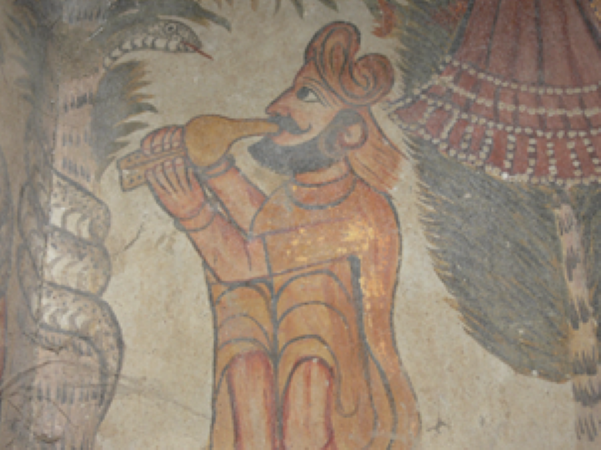
Krishna is one of the most well-liked of all Indian divinities. Krishna is worshiped as incarnation of Vishnu. He married princess Rukmini but Radha was his beloved. Radha’s love with Krishna is considered as pure and divine love (20). Krishna’s manifestations regarding gopis are very famous and symbolically are believed as loving relationship between god and human spirit. Krishna enchanted gopis with playing flute and he teased gopis (girls) with different tricks (21). Many images of Krishna are portrayed on the walls of temple of Johi town. In one photo Krishna is playing flute and Radha is in his arms. A woman is standing beside Krishna and Radha. A cup like thing is in her one hand while her other hand is on the mouth of cup. She looks to Krishna and Radha. Either she is Rukmini or gopi.
In another image Krishna and Radha are painted. Both are in arms of each other and in full mood of love. In this image Krishna kisses Radha. Krishna’s two pictures of manifestations regarding gopis are depicted here. In one picture Krishna is taking butter from the two pitchers of gopis. Gopis are clad in Sindhi cultural dress of Gajj and Parro. In second picture, naked gopis are shown taking bath in river. Krishna has taken their clothes and has climbed on tree where he is playing flute in joyful mood and the clothes of gopis are kept beside him. Naked gopis are beseeching him for returning their clothes beside the both sides of stem of tree from river.
Krishna is standing beside one cow pictured here on the wall of the temple. He plays flute. Krishna fights with massive snake incarnation of Vishnu, depicted on wall of temple. Enormous snake represents powerful evil force that is beyond human capacity or power to face. It requires divine or supernatural intervention to fight. The huge snake has seven faces or mouths. Krishna is over five faces of the massive snake and tail of snake is in his hand. One mouth of snake is swallowing a woman on his right side and in same way other mouth of snake is swallowing other woman painted on left side in same design. Most probably women are gopis. Sadly, in this image the face of Krishna has been damaged.
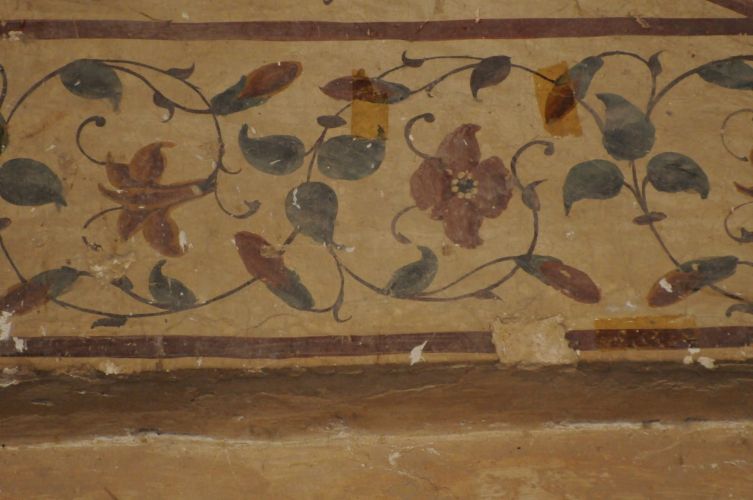
Except above discussed themes, the mountains, lakes, birds, rivers, fruits, fishes, crops, dishes, trees, horses, camels, hunting scenes, deer, Sindh Ibexes, elephants, hyenas, lions, falconry and other social and cultural daily life are adorned, on other hand, the different kinds of floral designs, foliated or leaf designs, arabesque designs, stalactite designs, honeycomb designs and geometrical are depicted on the walls of monuments in Dadu District.
References
(1) M.G Konieezany, Translation, Quarterly Mihran Vol. 22/1-2, 1973, Sindhi Adabi Board Jamshoro / Hyderabad, p.168
(2) M.G Konieezany, Translation, Quarterly Mihran Vol. 22/1-2, 1973, Sindhi Adabi Board Jamshoro/ Hyderabad, p.162
(3) Ali Ahmed Brohi, History on Tombstones Sindh and Balochistan, Sindhi Adabi Board Jamshoro 2005, p.48.
(4) Michelle Coxall and Sarina Singh, Rajasthan, First edition 1997, Lonely Planet Publications, Australia, p.256
(5) Michelle Coxall and Sarina Singh, Rajasthan, First edition 1997, Lonely Planet Publications Australia, p.45
(6)MH Panhwar, An Illustrated Historical Altas of Soomra Kingdom of Sindh, Soomra National Council Pakistan, Karachi, January 2003, P–201.
(7) Michelle Coxall and Sarina Singh, Rajasthan, First edition 1997, Lonely Planet Publications, Australia, p.43.
(8) Aziz Kingrani, Sindh Tourism-An archaeological Journey, Sindh Tourism Department Corporation Karachi, 2012, p-112
(9) Richard Bulliet, A Satire, iUniverse, 2011, p-164
(10) Inayat Khan, Sufi message of Hazrat Inayat Khan: Gathas, Library of Alexandria,
(11) Syed Akbar Hyder, Reliving Karbala: Martyrdom in South Asian Memory: Martyrdom in South Asian, Oxford University Press, 2006, p-35
(12) Richard Burton, Sindh and the Races That Inhabit the Valley of the Indus, Asian
(13) Dowson, John. A Classical Dictionary of Hindu Mythology, and Religion, Geography, History. Calcutta: Rupa & Co, 1984, P.190
(14) Dowson, John. A Classical Dictionary of Hindu Mythology, and Religion, Geography, History. Calcutta: Rupa & Co, 1984, P.107
(15) Ishtiaq Ansari, Jitey Manik Maag, Sindhica Academy, 2009, p.274.
(16) Dowson, John. A Classical Dictionary of Hindu Mythology, and Religion, Geography, History. Calcutta: Rupa & Co, 1984, p.360
(17) Dowson, John. A Classical Dictionary of Hindu Mythology, and Religion, Geography, History. Calcutta: Rupa & Co, 1984, P.105
(18) Dowson, John. A Classical Dictionary of Hindu Mythology, and Religion, Geography, History. Calcutta: Rupa & Co, 1984, P.160
(19) ibid
(20) ibid
(21) ibid
Read: Part-1
_______________________
 Aziz Kingrani, hailing from village Haji Manik Kingrani, Johi, Dadu District, Sindh, Pakistan, is poet, short story writer, playwright and a researcher. He has been contributing in the fields of history and literature. He has served as a professor as well. His 17 books are published in English and Sindhi language.


