The practice of art of painting on walls of the tombs, mosques, temples and graves flourished from early Kalhora dynasty (1718- 1782 AD) under the influence of Mughals and this tradition continued up to British Period.
Aziz Kingrani
When we glance at the history of art of painting done on walls in Sindh, the period of Samma dynasty (1353-1521 AD) and in early Mughal period the art of paintings in Sindh can be considered in its early ages. The practice of art of painting on walls of the tombs, mosques, temples and graves flourished from early Kalhora dynasty (1718- 1782 AD) under the influence of Mughals and this tradition continued up to British Period. During Kalhkora and Talpur (1783-1843 AD) dynasties the art of painting on walls in Sindh touched magnificent heights. In spite of Mughal or Rajput art influence, there is no trace of example worth mentioning of wall paintings in Samma, Mughal, Arghuns and Tarkhan periods. In the neighborhood between the right bank of the River Indus and mountainous range from Bandhani, District Jamshoro and towards north up to graveyard of Mir Ahmed Khan Chandio and Mitho Mastio, District Qamber-Shahdadkot, the paintings mostly seem to be of Kalhora, Talpur and British periods. This can be gauged from the fact that the age of paintings in the tombs (Graveyard of Mir Allayar Khan Talpur) of Johi Taluka is 200 years (1). Most probably, these paintings have been painted in more than two phases or periods. It can be marked out through the different colour schemes, floral, and geometrical designs; and themes of imageries depicted on the walls as well as architecture of the mosques, tombs, graves and temples. The painted costumes and weapons in these paintings support for presuming that the period of Tapur is dominant.
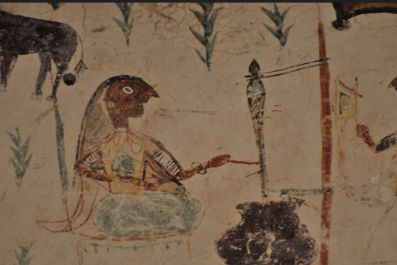
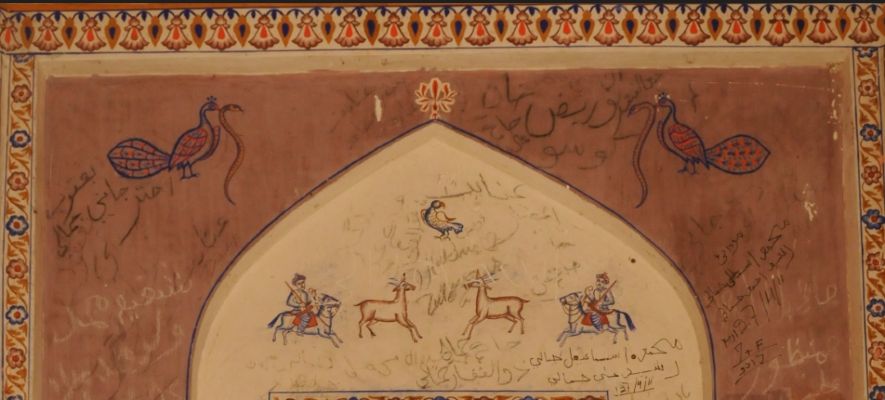 From the late Kalhora and early Talpur period, the tradition of decorating the inner and outer walls of the tombs, mosques and graves with paintings became common or even popular. The walls were used to be decorated with floral and geometrical designs, pictures of fruits, birds, animals, battles, legends, myths, musical instruments, boats, dances, daily life, camel and horse riders, warriors, royal and noble men and women; and other scenes of cultural and ritual traditions, social life and the nature with harmonious colours.
The paintings on walls here in Dau District including the arid of Kachho within the boundaries of Dadu district are remarkable and breathtaking. The painters were expert and skillful in their work. The faultlessness and accuracy in art of painting on the walls show the expertise and skill of the painters of their time. A German scholar M.G Konieezany is of the opinion that while seeing paintings, it can be said that both, Rajput and Mughal arts are merged in these paintings (2). Ali Ahmed Brohi just supports Mustafa Konieezany, but raising a question he writes, “The paintings seen on the walls of Muslim tombs at Khore (Torre), clearly belongs to Rajput school. But how and why such paintings, could be used for interior decoration of Muslim tombs, especially when the toms were known to be those of Kalhoras, who were deeply religious and had a large following as religious leaders (3). Michelle and Sarina Singh are nearly of the same opinion. Distinguishing Rajput and Mughal paintings they write, “The early Mughal influence, manifested in floral arabesques and geometric designs. According to dictates of their religion the Mughals never created a representation of an animal or human – gave way to influences from Rajput Royal courts (4). This enlightens that both, the Rajput School of art and Mughal Schools of art were certainly involved in the paintings on the walls of the tombs in Kachho region. The patterns of the cited Indian schools of art were either geometric or were styled after the flora and fauna and, at times depicted human figures.
In view of Vincent Arthur Smith the Rajput painting has none of the characteristics of a new art. It is, on the contrary, related to the classic art of Ajanta, as the Hindu language and literature are related to the older Prakrits and Sanskrit. The Rajput paintings, indeed, show a remarkable combination of folk idioms with ancient hieratic design.’ Mughal art, on the other hand, is a purely miniature art, unrelated to the ancient Indian frescoes. It is courtly not popular, secular, not religious, material not spiritual (5). The Rajput Paintings are also well-known as Rajasthan Paintings, which is a style of Indian painting. Rajput painting was originally recognized for its use of a limited range of colour, shallow space, and decorative vividness and mythic subjects. The themes of the paintings were mostly religious and love subjects. The bold outlines and luminous colours are main characteristics of the Rajasthani paintings. We can observe the influence of Rajput school of art on Sindhan School of art here in the paintings of area of Dadu District.
Obviously, in the paintings on the walls in the area of right bank of Indus River, the basic principles of Rajput and Mughal schools of art are merged. Some bouquets of floral paintings have been found depicted on the walls of an old Jamia mosque of Khudabad of Kalhora dynasty and some on the walls of the tombs of Mir Suleman Khan alias Mir Kako Khan, Mir Allahyar Khan Talpur, Mir Chhutto Khan and Mir Manik Khan Talpur as well as in necropolis of Mian Naseer Muhammad Kalhoro are clearly influenced by the Mughal paintings portrayed on walls of the tomb of Mughal Emperor Jahangir. Meanwhile, in Rajput paintings human faces had distinctive features such as almond-shaped eyes and prominent noses (6). The illustration of love legend of Laila Majnu on walls of tombs in this area is influenced by Kamangari School of art of Kutch and Persian art of painting. Thus, the same characteristics of mentioned schools of art are largely observed in the depictions on walls in this area. All the men and women are depicted with almond eyes and prominent noses on the inner walls of tombs and Masques in Dadu District.
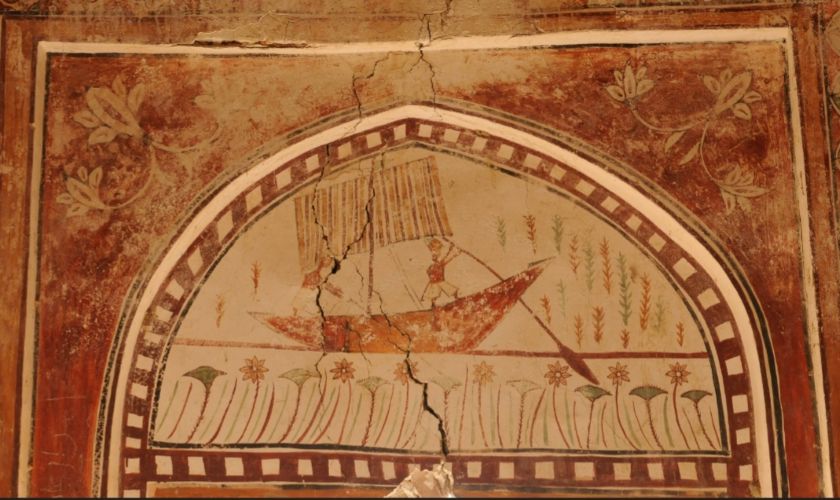
Undoubtedly, it can be considered that here paintings on walls might have been influenced by schools of art of the other regions of India or most probably the experts and famous Ustas (Masons) and painters have been hired or employed for paintings from the other areas of India. Later, working with those hired or employed expert painters; the local Sindhian artists and craftsmen learnt art of paintings and became expert in their artwork and promoted highly the Sindhian School of art and craft.
The colours are the soul of murals. In the paintings, the usage of colours is considered highly subjective, but they have visible expressive, symbolic and psychological effects. The placement of colours skillfully in the principal design or representation would be counted as an artistic approach of the painter.
In past, all the colours were derived from natural sources such as vegetables, minerals and even insects. Yellow was derived from turmeric and buttermilk; green from banana leaves; orange from saffron and jasmine; black from coal and iron rust; blue from indigo; red from sugarcane and sunflower; and purple from the kirmiz insects. Colours were either fast or unfading like browns, blues, and greens or fleeting of fast-fading like vibrant yellows, oranges and pinks (7). Undoubtedly, people of ancient Sindh were well aware of colours and produced indigo and madder for many millennia for local use and export. (8).
According to local traditions and written on walls of tombs, the town of Drigh Bala of Talpur Amirs and village Garhi of Mian Naseer Kalhoro now in District Dadu were the hub of Sindhian painters and artisans during Kalhora and Talpur periods. Even now, Soonharo Jokhio, a nonagenarian, and his son Manzoor Jokhio, resident of Drigh Bala, construct and paint walls of tombs. His forefathers were also masons and artisans. He told that in past, the painters of Kachho, used to procure colours for paintings from various rock minerals and plants or even from textile dyes. He narrated that, presently, he purchases colorant material and brushes from the market and paints on dry cemented walls. But previously, in Kachho region, artists used to first draw a free sketch in black colour and then, if satisfied, white background made of limestone, or, if design required, of another color, was applied. And finally painting was done on wet or semi-wet plaster. He told that colors were then filled artistically, but quickly, in various portions of major sketched motifs on the wet plastered wall so that the paint could become an integral part of the wall. Brushes were made from thin stems of date palm tree or palm like bush locally called peesh. After filling colour in main sketch, border, shades, and gloss were applied with fine and slim hairy brushes which were mostly made from the hair of sheep or camels.
Soonharo Jokhio also said that artisans mainly focused on the usage of colour and contrasts. He added that all the colours were prepared locally by artists. Therefore, quality of colours and the style of colouring differed from one part of Kachho to another and to different regions of Sindh. The colours, especially, black, red, yellow and purple were extracted from pulverized rock or ochre which was locally called ‘gerris’. These coloured rocks were found in neighboring Khirthar mountainous range. The blue was obtained from indigo, while orange, green, and pink were extracted from flowers and vegetables. Some colours were taken out from iron and red lead rust. Meanwhile, some other colours were also obtained from the mixing of two or more colours. The brilliance was given to colours by mixing tree gums of babool (Acacia), Gaz or Asree Lao (Tamarix articulata) and of other trees. The painters of Kachho used to mix milk of camel or other mammals and water for smooth movement and treatment in desired motifs. The pigments were prepared in big earthenware pots. The valuable information suggests that local Sindhian painters possessed similar expertise as that of Mughal, Rajput and Kamangari schools of art of India.
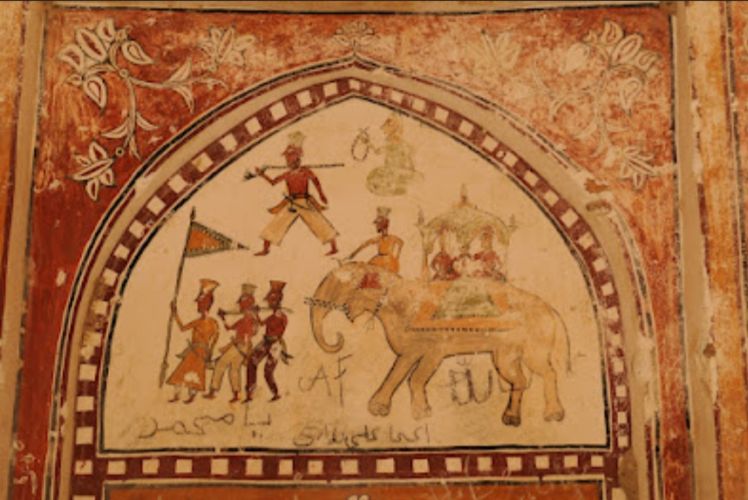
In my opinion, a new school of art emerged from the paintings found in Sindh which can be called Sindhian School of art. We can observe the influence of Islamic, Mughal and Rajput schools of art on the Sindhian School in the paintings of the area of Kachho. The calligraphy, the floral and geometrical arabesque designs, painted nonlocal lily and other flowers show the influence of Islamic and Mughal art and depiction of men, women, legends, myths, dejins and other marvel beings and animals demonstrate the influence of Rajput and other Indian schools.
Moreover, in the paintings on the walls in the area of the right bank of Indus River in Dadu District, the basic principles of Rajput and Mughal schools of art are fused. The depictions which have been found on the walls of an old Jamia mosque of Khudabad and on some of the cemeteries and the walls of the tombs of Talpur and Admani Laghari chieftains are quite influenced by the Islamic and Mughal style depicted in the tomb of Mughal Emperor Jahangir. Similarly, the distinctive Rajput features such as almond-shaped eyes and prominent noses are also noticeable in most of human representation found on the inner walls of tombs of the area of Kachho. (9). Kamangari School of the art of Kutch and Persian art of painting also find representation in the illustration of love legend of Laila Majnu on walls of tombs in the area Dadu District.
The Sindhian school of art might have followed some traditions of schools of art of other parts of India and some earlier traditions of their predecessors. In fact, the depiction of figures on walls of tombs appears to be the continuation of ancient social and cultural traditions of the people of Sindh. Interest in pet animals and birds, fondness for riding, sporting and racing of animals, hunting, and other cultural activities; the belief in myths and legends are still in vogue in society. Thus, all these themes find expression on walls of tombs. However, the local Sindhian painters and artisans might have learned art of paintings and acquired expertise and developed their own distinctive the Sindhian School of art and craft. (Continues)
Read: Thull Mir Rukan: Sindh’s Buddhist Heritage
____________________
 Aziz Kingrani, hailing from village Haji Manik Kingrani, Johi, Dadu District, Sindh, Pakistan, is poet, short story writer, playwright and a researcher. He has been contributing in the fields of history and literature. He has served as a professor as well. His 17 books are published in English and Sindhi language.