There were two contrasting visions of America at its 250th birthday. Each was presented by a prominent American and could not have been more different.
By Tom Arms | London
For those who looked carefully, there were two contrasting visions of America at its 250th birthday. Each was presented by a prominent American and could not have been more different.
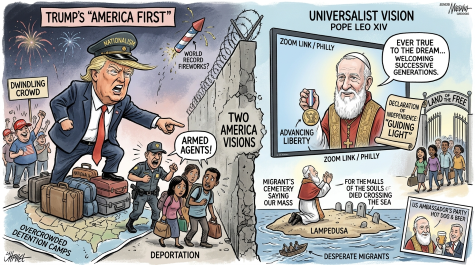
The first Is Donald Trump’s America First vision. This is an America where immigrants are not only refused entry but are rounded up by armed agents; sent to overcrowded detention camps and deported. It is vision which is viewed through the narrow lens of American nationalism.
The second was rooted in the idea that America has a responsibility beyond its borders—a universal vision which is closely linked to immigration, human dignity and the belief that America’s ideals belong to everyone, not just Americans.
The Universalist vision was expounded by another prominent American, Pope Leo XIV. The pope was invited to Washington for the 4th of July celebrations. He declined the invitation. The Vatican has never explained why the pope declined, but some papal observers have speculated that Leo was concerned that his visit would be used for political purposes supporting Donald Trump.
Pope Leo did, however, visit via video link the day before the big day. On July 3rd, he was presented via Zoom link with the Liberty Medal at the National Constitution Centre in Philadelphia. The medal is presented annually to the individual whose “courage and conviction” has done the most to advance the cause of liberty around the world. The center is strictly non-partisan, and former recipients have included Volodymyr Zelensky and the Dalai Lama
In his acceptance speech, Pope Leo was careful to echo the Centre’s non-partisan tradition. He did not criticize the administration. He did not mention Trump’s name. He did not call for open borders. Bevere did express the hope that America would remain “ever true to the dream that has earned it the title of land of the free and home of the brave.”
He also praised the Declaration of Independence whose ideals he hoped would remain “a guiding light for the present moment and for the years to come.” Finally, the pope said that America had become a “byword for freedom” because of the way the country had welcomed successive generations. And he urged Americans to remain faithful to that tradition.”
The following day, Pope Leo XIV was flown to Lampedusa by the Italian Air Force. Lampedusa is a tiny limestone island only seven miles long and two miles across. Home to barely 6,500 people, it lies just 70 miles from Tunisia but 127 miles from Sicily. Politically it is Italian. Geographically it sits on the edge of the African continental shelf. It has become Europe’s symbolic frontier, where desperate migrants from Africa first set foot on European soil. So far this year about 7,000 migrants have landed in Lampedusa. Thousands more have died in their attempt to cross the Mediterranean.
While Donald Trump was making a long, rambling political speech before a dwindling crowd and breaking the world record for the longest-ever fireworks display, the pope was saying mass in a migrant’s cemetery and praying for the souls of those who died crossing the sea.
Before the pope left for Lampedusa, the Vatican press office released a letter to the American people in which he praised the United States as a nation built by migrants. “Immigrants,” said the pope, “have formed a part of the history of this country (America) from its very beginning.” He goes on to argue that defending human life includes “welcoming and assisting immigrants.”
Once again, the Pope did not criticize Donald Trump or his administration. He was also careful to focus on the country’s basic ideals. However, the context of his actions, spoke louder than any of his words: The acceptance of the Liberty Medal, his letter to the American people and finally—on the 4th of July itself—a visit to Lampedusa to pray for the migrants who drowned crossing from Africa to Europe.
But Pope Leo did remember his American roots. His journey to Lampedusa was only a day trip. That night he returned to the Vatican where he attended the 4th of July party given by the US ambassador to the Holy See, Brian Burch. Presumably, the pope enjoyed a hot dog and a beer.
Read: Observations of an Expat: Gaza
________________________
 Tom Arms is foreign editor of Liberal Democrat Voice. He is also a regular contributor “The New World” and lectures on world affairs. Tom is the author of two editions of “The Encyclopedia of the Cold War”, “World Elections on File”, “The Falklands Crisis,” and “America Made in Britain.”