The September Nights Begin with the Songs of Ramapir by the Indigenous People of Sindh
- A cool September breeze, scented with the soft, melodious tunes of the tamburo and jhanjh, mingles with the fragrance of agarbati, awakening the ancient vibes of the Indus Valley and the peaceful soul of Sindh.
By: Kalavanti Raja
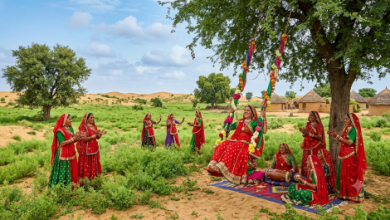
There are September nights in Sindh, in the month of Bado Hindi, when the ordinary rhythm of life seems to retreat quietly into the background and another, much older rhythm begins to take its place. September arrives after the long and exhausting months of summer, and as evening slowly descends over the villages, towns, fields and old neighborhoods of Sindh, the atmosphere around a small Ramapir shrine begins to change. Someone lights a lamp before the deity, someone burns agarbati whose fragrance gently spreads into the night, families begin arriving with offerings, and elderly devotees settle close to the shrine while children sit beside them. Then the first notes of the tamburo rise softly into the darkness, followed by the resonant sound of the jhanjh, and the gathering gradually turns into a night of bhakti. The singing continues, the lamps remain alive, conversations become quieter, and the shrine becomes the center of a world that seems to exist outside ordinary time. This is the season of Ramapir, a season in which devotion is not merely observed but lived, sung and passed quietly from one generation to another.
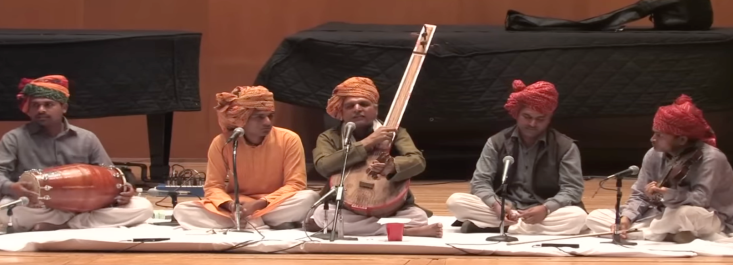
For many of the old and historically rooted Hindu communities of Sindh, particularly those living across upper Sindh and the wider Sukkur Division, the annual Ramapir Mela is therefore much more than a religious occasion. It is a return to memory, a return to places where parents and grandparents once prayed, to vows made many years ago, to bhajans remembered from childhood and to stories preserved not in libraries but in courtyards, temples, homes and journeys. When the Dhaja, the sacred flag, rises above the shrine, it seems to carry with it the memory of an entire community, while the night-long Jamma Jagran becomes a living gathering of devotion in which bhajans, satsang, lamps, offerings and music continue deep into the night. The tamburo carries the melody and the jhanjh gives it rhythm, but together they do something more profound than accompany worship; they carry memory itself, transforming a religious gathering into an intimate expression of culture, belonging and collective identity.
The phenomenon is not confined to one village, one district or even one country. At the heart of this immense cultural geography stands Ramdevra, near Pokhran in Jaisalmer, Rajasthan, where the principal shrine of Baba Ramdevji is located. The annual Bhadwa Mela at Ramdevra, held during August and September, is one of the great devotional gatherings associated with the saint and attracts pilgrims from many parts of India. Rajasthan’s official cultural and temple traditions describe Ramdevji as a fourteenth-century folk saint whose following extended across caste and religious boundaries and eventually spread into Rajasthan, Gujarat, Haryana, Punjab, Madhya Pradesh, Delhi, Mumbai and Sindh. Devotees travel great distances to Ramdevra, many of them on foot, transforming the journey itself into an act of devotion. Traditional temple accounts record offerings of sweets, coconuts, misri, makhanas, cloth horses and other objects of bhakti, while devotional singing continues throughout the great annual fair. In this way, the road to Ramdevra becomes more than a road; it becomes a moving prayer carried by thousands of feet, voices and memories.
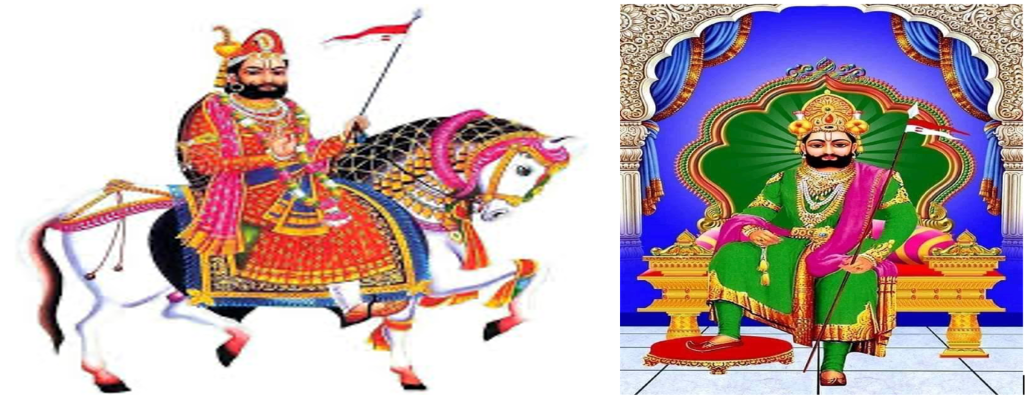 Ramapir, the Saint Whose Story Crossed Every Boundary
Ramapir is known by many names, including Baba Ramdev Pir, Ramdevji, Ramapir, Ramdev Otar, Ramlo Pir, Ramshah Pir and Ramsa Pir, and these names themselves reveal the extraordinary geographical and religious reach of his memory. In Rajasthan he is deeply associated with Ramdevra, while in Sindh his name has become part of the cultural vocabulary of communities separated from the main shrine by a national border. The official Rajasthan tradition associates him with a life devoted to the uplift of the downtrodden and with a devotional following that crossed social and religious boundaries. His great annual fair is therefore not simply an event in the calendar of Rajasthan but a major source from which countless local traditions across the desert and river lands have drawn their inspiration.
The chronology of Ramdevji’s life is surrounded by different traditions. Some widely circulated accounts place his birth around 1352 CE and his samadhi around 1385 CE, while other traditions give later dates, including 1458 or 1459 for his samadhi. Rajasthan’s traditional cultural material places his birth in Vikram Samvat 1409. These differences should not be concealed, because the story of Ramapir has been preserved through a combination of written accounts, temple traditions, oral histories and devotional literature, each carrying its own chronology. What remains consistent is the central memory of a saint whose influence far exceeded the boundaries of the time and place in which he lived.
Traditional genealogy identifies his father as Ajmalji of the Tanwar or Tomar lineage and his mother as Mainade or Minaldevi. His wife is remembered as Netalde or Nihalde, traditionally associated with the Sodha family of Amarkot in Sindh, creating an important symbolic connection between Rajasthan and Sindh within the Ramapir tradition. His brother is remembered as Viramdevji, while devotional genealogies speak of his sons Saadaji and Devaaji and his daughter Chandrakunvarba. Such genealogies form an important part of the religious memory surrounding Ramapir, although they should be understood as traditional devotional history rather than as uniformly established modern historical fact.
What made Ramapir extraordinary, however, was not simply the genealogy attached to his name but the communities that found themselves reflected in his story. He became a saint whose memory was especially powerful among people who had historically experienced social exclusion. Rajasthan’s official development material acknowledges the special place of Ramdevji among the Meghwal community and also records the Meghwal claim that Ramdevji himself belonged to their community, while noting that other traditions identify him as a Tanwar Rajput. This question of identity becomes particularly important when the story reaches Sindh and the Meghwar communities who have preserved their own understanding of Ramapir for generations.
Ramapir and the Meghwar Memory
The conventional account identifies Ramdevji as the son of Ajmalji Tanwar and Mainadevi, but Meghwar and Meghwal community traditions have preserved a different genealogy and have claimed Ramapir as one of their own. Dr. Kusum Meghwal’s work Meghwal Baba Ramdev developed this alternative interpretation, arguing that Ramdevji was born within the Meghwal community and identifying Sayer Jaipal Meghwal and Mangani, or Magni, Devi as his parents rather than the conventional royal genealogy. Community traditions further connect Sayer with Ajmalji’s household and place the Meghwar identity at the center of Ramdevji’s life.
This remains a contested historical interpretation, and it would be wrong to present one version as conclusively established when the traditions differ. The significance of the Meghwar claim, however, goes far beyond genealogy, because it helps explain why Ramapir’s devotion became so deeply rooted among communities that saw in him not an inaccessible figure of royal mythology but a saint whose spiritual dignity belonged to ordinary people. A saint becomes truly powerful when people see their own struggle, dignity and aspirations reflected in his story, and the continuing strength of the Meghwar tradition demonstrates precisely how deeply that identification has taken root.
The figure of Dali Bai makes this connection even more compelling. She is remembered in the Ramapir tradition as his spiritual sister, a Meghvanshi girl raised within his family as a sister, and her samadhi at Ramdevra remains an important site of devotion. Rajasthan’s official cultural tradition preserves her story alongside Ramdevji’s relationship with socially excluded communities. Her place in the tradition is important not simply because she was close to Ramapir, but because her memory became part of the larger social imagination through which communities understood their relationship with him.
The devotional world surrounding Ramapir contains many other figures, including Harji Bhati, Ratna Raika or Rebari, Lakkhi Banjara, Rani Rupande and Rao Maldev. These stories belong to different layers of oral and devotional tradition, but together they form a remarkable cultural archive. The story of Harji Bhati, for example, tells of Ramdevji appearing in the guise of a sadhu and asking for goat’s milk before revealing his identity and blessing him. The traditional cloth horse associated with this story became part of the wider symbolism of Ramapir devotion, and at Ramdevra horses remain among the familiar devotional offerings.
Another celebrated tradition tells of five Muslim pirs who came from Mecca to test Ramdevji and, according to the legend, were so impressed by his spiritual power that they recognized him as Ramshah Pir. Whether read as sacred legend or cultural memory, this tradition helps explain why Ramapir came to occupy a unique position in the religious imagination of both Hindu and Muslim communities. Hindu devotees call him Ramdevji or Ramapir, while Muslim devotees have historically remembered him as Ramsa Pir or Ramshah Pir. His story therefore carries a larger message about the possibility of reverence crossing the boundaries that human societies so often construct.
The Old Cultural Road Between Rajasthan, Sindh and Cholistan
The cultural geography of Ramapir cannot be understood through today’s political map alone. The desert stretching between Rajasthan and Sindh existed as a connected human landscape long before the modern border divided it. Pastoral communities moved across it, traders followed old routes, families maintained relationships across distances, and religious stories travelled with them. Ramapir became one of those stories, carried across the landscape until the saint was no longer merely a figure associated with Ramdevra but a living presence in settlements far away.
This is why the Ramapir tradition in Sindh should not be regarded simply as a distant reflection of Rajasthan. It has become part of Sindh’s own cultural life. In many settlements, particularly among historically rooted Hindu communities, the presence of a Dhaja above a shrine announces the existence of an Asthan or Mandir where Ramapir is remembered. The flag may appear simple, but behind it lie generations of worship, family memory and community identity. In the wider Ramdevji tradition the devotional flag is also known as the Neja, while sacred footprints, or Pagliye, and village shrines known as Thans preserve the saint’s memory far beyond Ramdevra. Traditional accounts also associate Ramdevji with the Kamadia tradition and the Terah Taali devotional performance.
The night-long Jamma or Jagran is equally important. It is a devotional vigil in which devotees gather around the shrine and spend the night in bhakti, singing bhajans, reciting devotional verses, keeping lamps burning and sharing the experience of worship. The music is not decoration added to the religious ceremony; it is one of the principal ways through which the tradition lives. A bhajan remembered by an elderly devotee can be learned by a child, and a rhythm played on the tamburo can connect a gathering in a Sindhi village with a tradition that reaches back across centuries. Through music, the community does not merely remember the past; it participates in it.
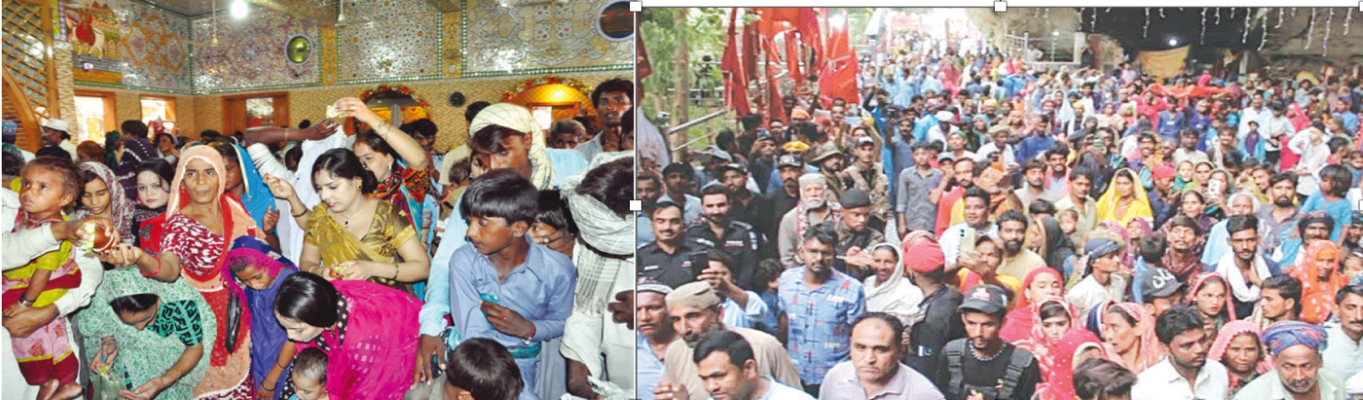 Sukkur Division: The Living Heart of Ramapir’s Sindh
If one wants to understand the depth of Ramapir devotion in Sindh, one must travel mentally, if not physically, through upper Sindh and especially the Sukkur Division. Here the tradition is not represented by a single famous shrine but by a remarkable network of temples, asthans, village centres and annual Melas spread across Sukkur, Khairpur, Ghotki and the adjoining districts.
The Government of Sindh’s official temple directory records Rama Peer Mandir at Village Noor Shah Bhit in Arore, Rohri, Shri Ram Dev Mandir at Village Roshan Abad in Kandhra and Shri Baba Rama Peer Mandir at Mari in Kandhra. It also records Rama Peer Mandir at Sanat Nagar on Tipri Road in Gambat, Rama Peer Mandir on Nawab Shah Road in Kumb, Kot Diji, Rama Peer Mandir in Kot Diji itself, another at Shah Tando Kot Diji and Rama Pir Mandir at Nihal Goth in Deh Saho, Kot Diji. In the Ghotki region, the official record includes Shri Rama Peer Mandir at Village Bashir Abad in Ubauro and Rama Pir Mandir at Kamu Shaheed.
These official listings, however, represent only the formal record of temples. The living cultural landscape is wider, and communities remember annual Ramapir gatherings and Melas across Gambat, Bozdar Wada, Kumb, Janullah Shah Mari, Rohri Kandhra, Rohri Jidani, Pano Aqil Khari, Roopasar, Loi Mubarakpur, Khangarh, Shanti Nagar, Dhahiki, Dad Road, Kamu Shaheed, Ubauro, Kandhkot and Bakhshapur. Each locality has its own history, its own families of devotees and its own relationship with Ramapir, yet together these places form a devotional network that stretches through the riverine and desert-edge landscape of upper Sindh.
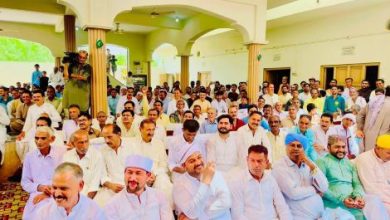
Janullah Shah Mari near Kandhra offers one particularly vivid glimpse into this tradition. Reporting from the Ramapir Mela there in 2025 described hundreds of devotees gathering during the Bhadav season, with people arriving from different parts of Sindh and northern Pakistan. Satsang, bhajans, prayers and oil lamps continued into the night, while local Muslims also participated in the gathering. The tradition at the shrine was reported to be more than a century old, attributed to the family of Shri Naibhoo Mal. Such a Mela demonstrates how a religious tradition can become a local cultural institution, drawing together families and communities that may otherwise rarely gather in such numbers.
From Gambat to Kumb, from Kot Diji towards Rohri and Kandhra, and onward through Pano Aqil, Ubauro and the districts farther north, the Ramapir landscape takes on the character of a cultural river. At one place the shrine may be large and established; at another it may be a modest Asthan known principally to the local community. One Mela may attract thousands while another remains intimate and village-based. Yet the essential pattern continues through the Dhaja, the shrine, the offerings, the singing, the night vigil and the stories of Ramapir. This is what makes upper Sindh so important to the understanding of the tradition. The great shrine at Ramdevra may be the geographical centre of the pilgrimage, but Sindh contains countless smaller memories of the saint, each rooted in the lives of people who continue to worship him.
From Rohri and Khairpur to the Wider Sindh Tradition
The Ramapir landscape does not stop at Sukkur Division. It extends southward through Sindh, reaching Hyderabad, Tando Allahyar, Tando Muhammad Khan, Sujawal, Badin and other districts. The Government of Sindh’s official records include Rama Pir Mandirs at Mirwah Road in Tando Allahyar, Mochi Mohalla in Mirpur Bathoro and Dehlakhi Ajumail Village in Sujawal, as well as several Ramapir temples in Hyderabad.
Badin offers an especially revealing connection with the Meghwar tradition. Official listings have recorded Rama Pir Mandirs in Meghwar or Menghwar localities, including Matli and other settlements. The presence of Ramapir shrines within Meghwar neighbourhoods adds another layer to the long-standing community claim that Ramapir’s spiritual identity belongs intimately to the Meghwar people.
Tando Allahyar has emerged as one of the most prominent Ramapir pilgrimage centres in Pakistan. Its Rama Pir Mandir on Mirwah Road is officially recorded, and its annual Mela has grown into one of the country’s major Hindu religious gatherings. The scale is different from the village Melas of upper Sindh, but the essential experience remains remarkably similar: pilgrims gather, offerings are made, bhajans are sung, vows are fulfilled and the shrine becomes the center of an extraordinary collective expression of faith.
In this way, the Ramapir tradition forms a broad cultural chain across Sindh. The large Mela at Tando Allahyar, the historic shrines around Rohri and Kandhra, the temples of Gambat and Kumb, the gatherings of Ubauro and Kamu Shaheed, and the many village centres scattered through upper Sindh all belong to the same larger devotional landscape, and beyond them all stands Ramdevra.
A Mela Is Also an Archive of Memory
Perhaps the most important thing about these Melas is what they preserve without ever announcing that they are preserving it. A Mela is not only a religious ceremony; it is also an archive of memory. It carries family histories, village histories, songs, names, rituals and relationships that may never have been written down. A grandmother’s bhajan can preserve a memory of a shrine that has disappeared, a pilgrimage route can preserve the connection between two communities separated by many kilometers, and a Dhaja can mark the location of a religious tradition that has survived political and social changes for generations.
This becomes particularly meaningful in Sindh, where the twentieth century brought enormous transformations to the cultural landscape. Migration, Partition, new borders and changing patterns of settlement altered communities on both sides of the frontier. Yet the Ramapir tradition continued to cross the border through memory. The political boundary changed the geography, but it could not completely erase the cultural relationship between Sindh and Rajasthan.
The desert did not understand the border because culture had never been created according to modern borders, and the same is true of music. A melody does not require a passport, and a bhajan does not stop at a boundary marker. A devotional story can travel in the memory of a family even when the road itself has become inaccessible. This is why the Ramapir Mela is so much more than a festival. It is a meeting between generations, a conversation between memory and the present, a place where a community can see itself and, perhaps most importantly, a place where religious devotion can coexist with cultural openness.
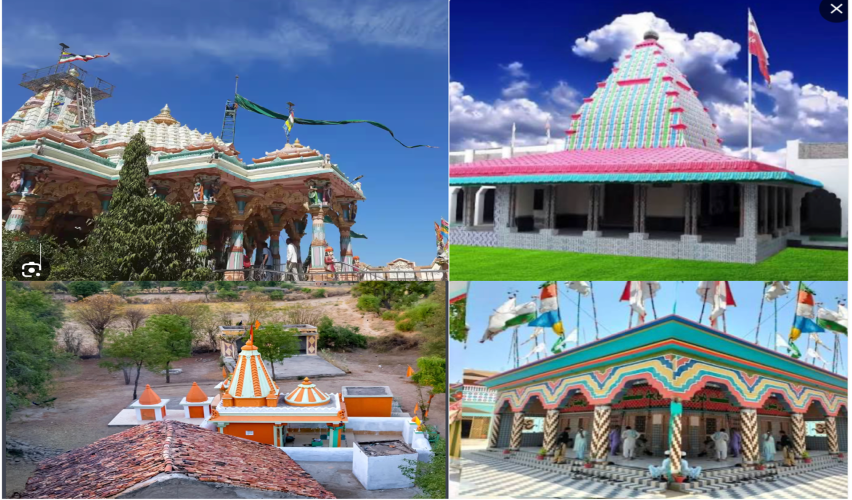 The Music That Brings People Together
There is something deeply human and intellectually profound about the role of music in the Ramapir tradition. Religious argument often emphasizes difference, but music can create a space in which difference does not have to disappear for people to share the same human experience. The tamburo does not ask a person which caste they belong to, the jhanjh does not ask where they were born, and the lamp does not ask which language they speak. The music simply begins, someone sings, another person responds, and gradually the gathering becomes a single listening community.
The older generation recognizes the verses while the younger generation learns them. The rhythm gives structure to the night, while the repeated words give continuity to memory. The Mela therefore becomes a place where culture is transmitted without classrooms, textbooks or formal instruction. This is perhaps why Ramapir’s message has endured among communities that have experienced exclusion and marginalization. His story is remembered not simply as a story of supernatural power but as a story of compassion, dignity and human equality. The traditions surrounding him may differ, and the historical interpretations may sometimes contradict one another, but the emotional centre remains remarkably consistent: Ramapir belongs to the people.
That is also why the participation of local Muslims in some Sindhi Ramapir Melas is so significant. It demonstrates that cultural coexistence does not require religious identities to be erased. People can remain fully conscious of their own traditions while respecting the sacred memory of another community. The shared experience of a village festival can create a form of harmony that formal declarations often struggle to achieve.
When the Dhaja (Flag) Rises Again
When September returns to Sindh and the evening begins to settle over the fields and towns of upper Sindh, the old cycle starts again. At Ramapir shrines in Gambat, Kumb, Kot Diji, Rohri and Kandhra, at Mari and Janullah Shah, around Pano Aqil and Khari, through Khangarh and Ubauro, at Kamu Shaheed and farther towards Kandhkot and Bakhshapur, and at the many other centres scattered across Sindh, devotees gather according to their local traditions. In Tando Allahyar and other major centres the gatherings may become larger, but the emotional language remains familiar.
The shrine is prepared, offerings are brought, lamps are lit and the Dhaja is raised. As darkness deepens, the fragrance of agarbati moves through the gathering and the first devotional songs begin. The tamburo carries the voice, the jhanjh answers, and the Jamma begins its long passage through the night. Somewhere an elderly devotee remembers a verse, somewhere a child hears it for the first time, somewhere a family tells the story of an ancestor who once walked to a Ramapir shrine, and somewhere a pilgrim has come to fulfil a vow made years ago. In such moments the centuries seem to collapse, because Ramapir is no longer merely a name in a book; he is present in the song, in the Dhaja, in the memory of the people, in the journey and in the quiet depth of the night.
Perhaps this is the real strength of Ramapir’s tradition. It has survived not because history has always agreed about him, but because people have continued to remember him. His chronology may be debated, his genealogy may be interpreted differently, and communities may tell different versions of his life, yet the devotion remains alive. It has crossed caste boundaries, religious boundaries, geographical boundaries and political borders. It has moved from Rajasthan into Sindh and from great pilgrimage centers into the smallest village shrine, carried by people whose faith has made memory stronger than distance.
It has become part of the cultural soul of the land.
That is why the annual Ramapir Mela deserves to be understood not simply as a Hindu religious festival but as one of the living cultural traditions of Sindh and the wider desert region. It is a celebration of memory, music, community and human connection. It reminds us that cultures survive not only in monuments and museums but also in songs sung at midnight, in lamps lit before small shrines, in flags moving gently in the night wind and in the journeys people continue to make because their ancestors made them before.
So when the Dhaja rises again above a Ramapir shrine in September, it should be seen not merely as a religious symbol but as a sign that a long cultural memory is still alive. It tells us that the old relationship between Sindh and the desert has not disappeared, that the songs of generations have not been silenced, and that communities continue to find meaning in a saint whose story has travelled farther than any political boundary could contain.
The invitation, therefore, belongs not only to devotees. It belongs to everyone who believes that peace is stronger than hatred, that harmony is more beautiful than division, and that music can bring human beings together without demanding that they surrender their identities. Anyone who loves the cultural richness of Sindh, anyone who values its plural traditions, and anyone who wishes to experience the extraordinary power of a community gathering around faith and music can find something deeply moving in a Ramapir Mela.
Come to Ramapir not merely to see a temple or a festival, but to experience a living tradition. Come to hear the tamburo carrying its ancient melody into the September night, to hear the jhanjh answering it, to see the Dhaja moving gently above the shrine, to breathe the fragrance of agarbati among the lamps and to witness generations gathering around a memory that has survived centuries. For in that moment, the Mela becomes more than a celebration; it becomes a living conversation between the past and the present, between devotion and culture, between memory and belonging.
And when the night grows deeper, when the lamps continue burning and the tamburo refuses to fall silent, perhaps one can finally understand why Ramapir has remained so close to the hearts of his devotees: because some traditions are not preserved by books alone. They are preserved by families who remember, by communities who gather, by pilgrims who continue the journey, and above all, by people who continue to sing.
Read: Political Silence Stalls Minority Quotas
___________________
Kalavanti Raja is a social and political activist from Gambat, Khairpur Mirs, with 30 years of work on women’s rights, minorities, and social justice. She has served in Sindhiyani Tahreek and participated in national and international forums across Asia, Europe, and America.. She can be reached at kalavanti.raja@gmail.com