In view of the population booms and climate change vulnerability we have to work more efficiently to depend upon the recurring cycles of natures by the molecular biological means.
By Bisma Wassan
The growing population around the globe caused the scarcity of food. These food requirements are meet by adapting new scientific procedures to increase the Food productivity. The food crops like wheat, barley, rice, maize etc. are the food source for the human beings. At the first instance, the continents of Asia and Europe are suffering the worst of fertility loss and impairments. The lands are being degraded for salt imbalances. The salinity of the soil is a trouble on account of long time spanned anthropogenic interventions. It caused the fertility crisis on soils being fade up with Systematic irrigations. These systematic irrigation diverts the natural streams of water to dry areas with lesser available water. Furthermore, the drainage problems caused to downscale the fertility index of arable lands.
In addition to these fertility issues, the depletion of mineral resources added to the woes of food crops deficits. It is quite a worried situation. Even in present times, soils are losing the fertility in newly discovered continents of America, Australia and Canada. In past, fertility loss issues of soils were tackled by enriching the minor and major nutrients as synthetic fertilizers. In the beginning, Nitrogenous and phosphate fertilizer were used to restore the nutrient status and fertility enhancement. Nitrogenous fertilizer were made by conversion of methane gas into urea fertilizer. Likewise, the phosphate rocks of Morocco and other countries were used to make fertilizers like DAP, SSP, TSP and NP fertilizers. The Phosphorus rocks need a special grade with high contents of P2O5, to make it in available form of phosphorus. It is quite serious that, the supply of these source minerals is getting exhausted in coming times. Eventually, the manufacture of synthetic fertilizers will be at halt or slowed down to meet the fertility enrichment requirements.
After the depletion of resources and fertility loss issues, we should take into consideration the Climate Change vulnerabilities. These vulnerabilities has brought numerous issues related to productivity of food crops. The carbon emissions caused to change time table of seasons like erratic and untimely rainfalls and increase in Celsius. These change in climatic indicators disturbed the whole biological systems. Furthermore, the use of synthetic fertilizers, pesticides and persistent tillage operations eliminated the natural means to conserve the life and carbon storage mechanisms in soil. The mechanisms were meant to perpetuate the fertility by biological mechanisms of nature. The nature requires the stability and perpetuity of bio systems. The cycles of nature ensure the resource conservation coupled with sustainability in nature.
In such a situation, when the humanity is confronted with upcoming challenges of resource scarcity, it is time to learn from miracles of Molecular biology, plant breeding and genetics. It was the molecular biological research and development that caused to increase the production of wheat from 15 maunds per acre to 50 maunds per acre. The evolvement of TJ 83, TD 1, Akbar, Abdul Sattar and IV wheat varieties brought the revolution in wheat production of Pakistan. It caused to increase yield of wheat from 15 to 60 maunds. Likewise, the CRISPR varieties for the cotton crop changed the cash crop economy of farmers to avail unbelievable yields.
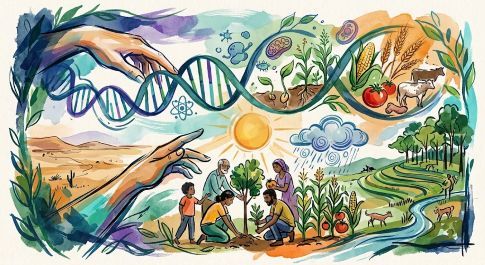
In view of the population booms and climate change vulnerability we have to work more efficiently to depend upon the recurring cycles of natures by the molecular biological means. The scientific research and technological means made it possible to work and manipulate with cells at the levels of DNA & RNA. It was miracle of molecular biology that corona vaccine was generated in a short span of time. These biological and genetic mutation procedures ensure the sustainability in food production. The nature has ability to replicate its creatures, this endorsement of nature may be used to secure the food and adapt the climate change vulnerabilities.
Read: Tribal Clashes Ravage the Indus Eco-Zone
______________
 The author is freelance writer to write the articles in newspapers on Molecular Biology, Climate Change, and Agriculture.