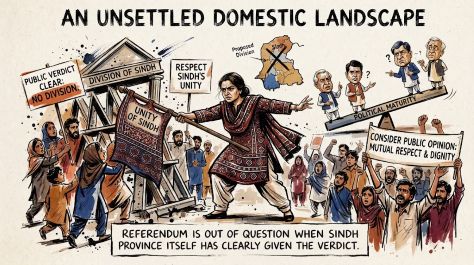
Referendum is out of question when Sindh province itself has clearly given the verdict.
There is still time to approach this matter with mutual respect, dignity, and political maturity. The public’s opinion, which has already become increasingly evident, must be given due consideration. It is important to recognize that a significant section of Sindh’s population does not support the proposed division.
Pakistan has earned considerable importance on the international stage in recent times, however, despite this diplomatic progress, the country continues to face several pressing challenges at home that threaten its internal stability – terrorism in Khyber Pakhtunkhwa and Balochistan, persistent political instability, and a polarizing debate over whether the governance system needs a “reset” through new provinces.
The terrorism continues to weigh heavily on Khyber Pakhtunkhwa and parts of Balochistan. It claims lives, deters investment and stretches security institutions. It also feeds a wider sense of insecurity that makes every other reform harder. No governance debate, however well intentioned, can substitute for a sustained and coordinated response to this threat, and political fragmentation makes that response harder to deliver.
Repeated cycles of confrontation between the government and the opposition have raised political temperatures and eroded public confidence in institutions. Bilawal Bhutto Zardari has argued that the country needs a political reset to restore that confidence. He has said Parliament should be the starting point. That candour is unusual, and any serious reform conversation should begin from it. Under Article 239, creating a province requires a two-thirds majority in both houses of Parliament and a further two-thirds majority in the assembly of the affected province.
Reports of how far the plans might go have added to the anxiety. Sindh’s response has been the sharpest. The Sindh Assembly passed a resolution rejecting any proposal that would divide the province or carve a new one from its territory. Mr. Bilawal said that the proposal should be settled through constitutional procedure. He has also warned that a forced division or referendum could lead to unrest and uncontrollable situations. Sindh’s sensitivity to the question of division is long-standing, and the right to decide it belongs to its people.
The strongest point of agreement across the political divide is that this matter belongs to Parliament, not to business forums or televised exchanges between ministers.
Administrative reform may well be necessary, and many of the system’s weaknesses, such as weak local government, uneven service delivery and centralized decision-making, are real. But redrawing provincial boundaries in a polarized climate, while parts of the country face immense challenges, risks adding a new source of instability to the existing ones.
It is better to first strengthen local governments, build political consensus on the issues and restore trust between the center and the provinces.
Referendum is out of question when Sindh province itself has clearly given the verdict. There is still time to approach this matter with mutual respect, dignity, and political maturity. The public’s opinion, which has already become increasingly evident, must be given due consideration. It is important to recognize that a significant section of Sindh’s population does not support the proposed division.
Rather than allowing the situation to escalate, every effort should be made to maintain a peaceful environment, encourage constructive dialogue, and respect the sentiments of the people. Matters of such importance should be addressed through public consensus, democratic principles, and mutual understanding, not through confrontation or the imposition of decisions.
Areeba Altaf
Larkana Sindh
______________