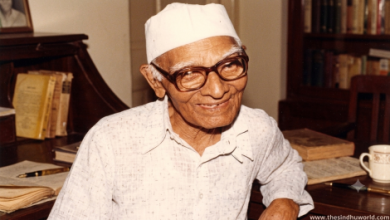
Colonel John Harold Henry Coombes is a man whom official narratives have largely overlooked, but whose legacy continues to shape generations
- To generations of Petarians, Coombes is more than a founding principal—he is a formative presence, almost mythic in stature.
By Raphic Burdo
Sindh is a land of paradoxes. Across its cities, towns, and villages, one encounters institutions, roads, and public spaces named after figures whose contributions to the region are, at best, contested and, at times, deeply problematic. Meanwhile, those who quietly and diligently laid the foundations of modern Sindh often fade into obscurity, their names absent from the markers of public memory. Yet history resists erasure. However selectively it may be recorded, it endures in lived experience, in institutional culture, and in collective memory.
One such figure is Colonel John Harold Henry Coombes—a man whom official narratives have largely overlooked, but whose legacy continues to shape generations. Nowhere is this more evident than at Cadet College Petaro.
The year 1947 marks both independence and rupture. For Sindh, the Partition of British India triggered a profound demographic and intellectual shift. The migration of a large segment of the Hindu community—many of whom formed the backbone of the province’s educational and commercial life—left a vacuum that proved difficult to fill. Institutions once sustained by experienced educators and administrators struggled to adapt. Rural Sindh, in particular, experienced a sustained decline in educational quality, with long-term consequences for social mobility and institutional development.
Yet decline is rarely the final chapter. In response to this crisis, the government of the time conceived a bold intervention: the establishment of a premier residential institution that could cultivate discipline, leadership, and intellectual rigor among the youth of Sindh. Thus emerged Cadet College Petaro—a boarding institution with a military ethos, designed not merely to educate, but to shape character.
Located in the austere, rugged landscape of Jamshoro, the college might never have attained its stature without the leadership of Colonel Coombes. An Oxford-educated scholar and a veteran of the Second World War, Coombes brought with him not only academic distinction but also a deeply internalized sense of discipline forged under extreme conditions, including his time as a prisoner of war in Singapore. These experiences were not incidental; they were formative, and they found expression in the institutional culture he built.
To generations of Petarians, Coombes is more than a founding principal—he is a formative presence, almost mythic in stature. Stories of his life and conduct circulate across cohorts, passed from one generation to the next. He was known to value character over credentials, once remarking that he was less interested in producing “First Divisions” than in shaping “real men.” At the core of his philosophy was an unwavering belief in a Code of Honour—a moral framework he considered indispensable to the making of responsible citizens.
His attention to detail was legendary. He nurtured the physical environment of the college as carefully as its intellectual one, personally tending to its greenery and landscape. His famously small handwriting—rumored to have developed during his years of captivity, when discretion was a necessity—became part of institutional folklore. Even in retirement, his attachment to the college endured; he named his home in Kent “Petaro,” a quiet testament to the depth of his identification with the institution.
Coombes assumed charge as principal in 1958, when the college was still operating from its temporary campus in Mirpurkhas. He oversaw its relocation in 1959 to its permanent 900-acre site in Petaro, where he laid down the structural and cultural foundations, until 1965 that continue to define it. He introduced the house system, established a rigorous daily routine, and embedded a culture of meritocracy and discipline that remains intact decades later.
His leadership style was exacting but principled. Anecdotes abound—one recounts how, after a personal accident, he arrived at the college on time and gently rebuked a student’s concern, reminding him that duty must not be interrupted by sentiment during working hours. Such stories, whether embellished over time or not, reflect a consistent ethos: professionalism, integrity, and an almost ascetic commitment to purpose.
Today, Cadet College Petaro has evolved into a self-contained academic township, complete with residential facilities, healthcare, sports infrastructure, and advanced laboratories. Its curriculum has expanded beyond the traditional Matriculation and F.Sc. streams to include international qualifications, enabling students—many from rural backgrounds—to compete on a global stage.
Since 1975, the institution has been administered under the patronage of the Pakistan Navy, reinforcing the culture of discipline that Coombes first institutionalized, while the Government of Sindh has remained a key financial supporter. Over the decades, the college has produced a distinguished alumni network, including senior military officers, civil servants, political leaders, and professionals across diverse fields. Among them are Asif Ali Zardari and Dr. Asim Hussain, alongside numerous figures who have shaped Pakistan’s administrative and professional landscape.
Equally significant is the college’s contribution to academia. Its tradition of teaching excellence—carried forward by dedicated educators—reflects a continuity of purpose that extends beyond individual leadership. The emphasis on multidimensional development has produced not only competent professionals but also individuals capable of navigating complexity with resilience and ethical grounding.
Colonel Coombes did not merely establish an institution; he cultivated an ecosystem of discipline, integrity, and aspiration. In the stark hills of Jamshoro, Cadet College Petaro stands as a reminder that visionary leadership, combined with institutional rigor, can transform structural disadvantage into enduring excellence.
His recognition may remain limited in official narratives, but in the lived history of the institution he built, his presence is unmistakable—and, perhaps, indelible.
Read: Remembering A Rebel
_______________
(Raphic Burdo served as a teacher of English at Cadet College Petaro, 1996–97.)