In northern part of Sindh, the word peace has become a memory, and justice an unreachable dream
- Life here is not lived — it is merely survived. Men are kidnapped. Families are extorted
- Sindh has become an open-air prison, where criminal networks rule, and fear is the only constant currency.
By Abdullah Usman Morai | Sweden
A Land Left Behind
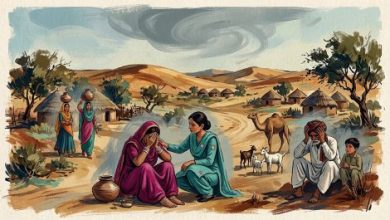
In the northern belt of Sindh — particularly Kashmore-Kandhkot, Ghotki, and adjoining regions — the word “peace” has become a memory, and “justice” an unreachable dream. Life here is not lived — it is merely survived. Men are kidnapped. Families are extorted. The poor are lured into death traps disguised as deals. And no one—not the government, not the law, not the state—is truly present to help.
In a country that proudly claims to be a democracy, this part of Sindh has become an open-air prison, where criminal networks rule, and fear is the only constant currency. There are whispers in the wind: “Kashmore-Kandhkot is not part of Pakistan anymore, it’s a jungle — survive if you can.”
Where are the forces? Where is the action? If the state could confront heavily armed militants in distant tribal mountains, why can’t it challenge criminals in the plains and riverbanks of Sindh?
The people are watching. They are hurting. They are losing hope. And still, they wait — with prayers in their hearts — for someone in power to finally care.
The Machinery of Fear: How Crime Rules North Sindh
Crime in North Sindh is no longer random — it is systematic, well-networked, and disturbingly normalized.
The tactics are horrifying:
- Fake phone calls are made using a woman’s voice to lure men into trap zones.
- Social media groups offering unrealistically cheap motorcycles, mobile phones, or electronics.
- Messages promising job opportunities or romantic meetings.
- Victims are told to come to a certain place, and then, they vanish.
What follows is trauma. Ransom calls. Threats. And in many cases, death.
Some are beaten. Some are tortured. Many are killed when families fail to pay. The criminals are not hiding — they operate confidently, as if they know no one will stop them.
But it doesn’t end there. These criminals have now taken their cruelty online. They shamelessly post videos of victims in their custody — including children and women — on social media platforms. These videos are meant to terrorize families, provoke payments, and humiliate the victims publicly. And still, these accounts stay active, and these crimes remain unpunished.
This isn’t just a crime. It’s psychological warfare against the poorest people of a forgotten region.
A Government That Watches, But Doesn’t Act
The people of Sindh vote. They pay taxes. They raise the national flag every August. And yet, when their children are taken, or their husbands don’t return from work, they are told, “We can’t go into that area — it’s dangerous.”
Dangerous for whom?
Isn’t it the duty of the state to bring safety? What is a government for, if not to protect its people from such evil?
There are police stations in name, but not in spirit. There are officials in offices, but not in the field. There are statements on paper, but not a single genuine operation on the ground.
And all this while criminals roam with guns, exploit technology, and mock the helpless.
The state must answer: Are we still a nation, or just an uneven map of suffering and indifference?
Traps and Tricks: How Innocents Are Caught
The cleverness of these criminal gangs is rooted in society’s desperation.
People in Sindh, like elsewhere in Pakistan, dream of small comforts — a better phone, a cheap motorcycle, a used car to support a family. When these things are advertised at lower-than-market prices, people fall for them. They respond. They call. They try to arrange a meeting.
But instead of trade, they find terror.
Some are trapped through love-bait. Others are trapped through false employment promises. And once they cross into the crime-ridden zones of Kashmore-Kandhkot or Ghotki, they are swallowed into silence.
It is not stupidity — it is poverty, trust, and hope that these criminals exploit.
And all the while, the people wonder: Where is the state? Why aren’t the forces acting?
If Forces Can Handle Fanatics, Why Not These Criminals?
In recent years, this country’s forces have shown bravery and capacity in dealing with extremist networks in harsh, mountainous tribal regions. Complex operations have been conducted. High-value targets were neutralized. Entire militant hubs were dismantled.
Then why, with all this capability, can’t the same be done in North Sindh?
These criminals are not invisible. They are not hidden in caves. They live in katcha lands, by the river, among forests and fields. They are known. People speak their names. Their hideouts are whispered about in tea shops.
If a state can mobilize for security in Swat or Waziristan, what excuse is there to ignore Kashmore – Kandhkot or Ghotki?
Is it because these people are poor? Is it because their votes are taken for granted? Or is there a darker agenda — a desire to let the people suffer until they migrate?
The Cost of Fear: A Dying Region
This isn’t just about individual cases of kidnapping. The social fabric of North Sindh is being torn apart.
- Schools are emptying out. Parents are too scared to let children travel.
- Markets are shrinking. Trade is dying because no outsider wants to risk entry.
- Migration is accelerating. Entire families are fleeing to other districts, not for better jobs, but for safety.
What’s left behind is trauma, abandoned fields, and echoes of prayers unanswered.
The psychological impact is immense. People don’t trust strangers. They hesitate before answering phone calls. Communities live in paranoia. Fear has become a culture, and that is the greatest defeat of any state.
Basic Questions, No Answers
Let’s ask the questions any responsible state should be asking itself:
- Why are there still no dedicated special operations to clear out crime zones?
- Why are complaints ignored or laughed off by local authorities?
- Why haven’t emergency protection measures been implemented for transport, mobile networks, or trade routes?
- Why is there no real-time tracking of ransom phone numbers?
- Why are criminals allowed to post horrifying videos online and still go untouched?
- Why is the media so quiet about this? Is it because these stories don’t trend or sell?
And most critically:
Why is peace not being treated as a human right for the people of North Sindh?
Silence is Complicity
There’s a silence — an intentional silence — among those who have power.
Those in Karachi’s air-conditioned offices. Those in Islamabad’s policy rooms. Those in control of law, politics, and budgets.
They speak when a city suffers. They cry when a viral video makes it to Twitter. But they turn their heads when North Sindh bleeds.
Silence in the face of suffering is not neutrality — it is betrayal.
The people in Ghotki and Kandhkot- Kashmore are not just numbers on a map. They are citizens. Humans. Families. Children. They laugh like us, they cry like us. Their blood is red like ours.
They are not “too far” to matter. They are not “too rural” to count.
What the People Ask: Peace, Not Pity
The residents of North Sindh are not begging for charity. They are not asking for luxuries. They want what every citizen deserves — peace and justice.
If the forces take this seriously and act to clear these criminal networks, the people will bless them with every prayer they have left.
The child whose father returns home alive.
The mother who no longer jumps at every phone call.
The student who walks to school without fear.
These are the silent dreams waiting to be fulfilled.
Whoever brings peace to this region will not only restore order, they will restore faith in the idea of the country.
Time to Wake Up: The Shame of Inaction
Let this be a national reminder: Any state that cannot protect its most vulnerable is already defeated.
It doesn’t matter how many flags we wave or songs we sing. If entire regions are surrendered to crime, then the anthem becomes hollow.
Sindh has given this country its thinkers, poets, farmers, and soldiers. It has given its votes, its resources, and its loyalty.
Is this the return it deserves?
A Moral and Strategic Call: 10 Actions Now
- Immediate clearance operations by dedicated law enforcement units in known crime zones.
- Satellite surveillance and mapping of katcha areas.
- Complete shutdown of mobile networks used for ransom calls within specific geo-fences.
- Installation of security checkpoints and ID verification on roads leading to crime hotspots.
- Public awareness campaigns on fake ads and calls.
- Creation of a North Sindh Peace and Protection Authority for emergency coordination.
- Whistleblower protections for citizens who expose criminals.
- Zero tolerance policy for any local official who cooperates with or protects criminals.
- Psychological trauma centers for victims and families.
- Monthly public progress reports on arrests, rescues, and reforms.
A Final Plea for Action
North Sindh doesn’t need your sympathy. It needs your action. It doesn’t need statements — it needs justice. It doesn’t want charity — it wants peace.
Let the forces rise as they have before — not for media optics, not for temporary applause — but for the people whose lives are waiting to begin again.
And when they do — when peace returns, when justice breathes again in Kandhkot, Kashmore, and Ghotki — the people will not forget. Their gratitude will echo louder than any applause.
To those in charge: this is your moment. Either lead with courage or admit your failure. But know this —
The land may forget your name, but the people will remember your silence.
Read: Feudalism Must Fall
_________________
 Abdullah Soomro, penname Abdullah Usman Morai, hailing from Moro town of Sindh, province of Pakistan, is based in Stockholm Sweden. Currently he is working as Groundwater Engineer in Stockholm Sweden. He did BE (Agriculture) from Sindh Agriculture University Tando Jam and MSc water systems technology from KTH Stockholm Sweden as well as MSc Management from Stockholm University. Beside this he also did masters in journalism and economics from Shah Abdul Latif University Khairpur Mirs, Sindh. He is author of a travelogue book named ‘Musafatoon’. His second book is in process. He writes articles from time to time. A frequent traveler, he also does podcast on YouTube with channel name: VASJE Podcast.