Pakistan’s birth was actually forged through a complex interplay of post-WWII British imperial collapse, regional political dynamics, and inherited colonial legal frameworks.
By Noor Muhammed Marri, Advocate | Islamabad
An analytical, historical, and subjective examination of the narratives surrounding the creation of Pakistan reveals a fundamental tension: the divergence between romanticized state mythology and the cold realities of realpolitik, geopolitics, and constitutional mechanics. Post-colonial states almost universally construct neat, linear founding myths. In Pakistan, the standard script emphasizes the transcendent leadership of Quaid-i-Azam Muhammad Ali Jinnah, the spiritual vision of Allama Iqbal, the legal cornerstone of the 1940 Lahore Resolution, and the collective sacrifices of the Muslim masses. However, a rigorous historical interrogation reveals a far more complex, structural reality. Pakistan was not born merely of a single resolution, a mystical vision, or a uniform popular movement. It was forged in the crucible of a chaotic convergence: imperial exhaustion following World War II, structural constitutional frameworks inherited from the British Raj, and shifting regional alignments across heterogeneous provinces.
The contemporary narrative that “provinces made Pakistan”—or conversely, that a unified Muslim nation effortlessly swept through the provinces—oversimplifies the messy political topography of the 1940s. The Muslim-majority regions that eventually constituted Pakistan possessed radically different political dynamics. Bengal and Sindh were indeed the primary engines of early Muslim League support. Sindh was the first provincial assembly to pass a resolution in favor of Pakistan in 1943, while Bengal provided the bulk of the electoral weight for the All-India Muslim League in the 1946 elections. Yet, much of this support was driven by localized socio-economic grievances—such as peasant movements against landed elites—rather than a centralized ideological blueprint.
In contrast, as late as the mid-1940s, Punjab was dominated by the Unionist Party, a secular, cross-communal coalition of Muslim, Hindu, and Sikh landowners who prioritized agrarian interests over religious nationalism. It was only on the eve of Partition, as imperial departure became imminent, that the Muslim League successfully brokered alliances with Punjabi landlords and pirs to shift the political tide. Meanwhile, the North-West Frontier Province was governed by the Khudai Khidmatgars aligned with the Congress, and Balochistan comprised chief commissioner’s provinces, tribal agencies, and princely states like Kalat, where integration was governed by executive accession and tribal councils rather than mass democratic mobilization.
Similarly, the 1940 Lahore Resolution is frequently cited as the immutable foundation of the state. Functionally and historically, however, it was a strategic political instrument rather than a precise constitutional draft. Speaking of “Independent States” in the North-Western and Eastern zones, it was framed with deliberate ambiguity to maximize bargaining power against both the British Crown and the Indian National Congress. From a strict constitutional standpoint, the resolution held no formal legal validity within British imperial jurisprudence. The British Raj operated on parliamentary statutes, orders-in-council, and viceregal decrees. The resolution functioned as an effective moral leverage point and bargaining chip, but power in 1940 remained squarely within the institutional frameworks dictated by Whitehall.
While ideological discourse dominated public platforms, the actual scaffolding of the post-colonial state was drawn directly from British legislation, most notably the Government of India Act 1935. This statute established provincial autonomy, defined federal-provincial power distributions, and institutionalized administrative centralism. When Partition occurred in 1947, neither India nor Pakistan possessed a freshly minted constitution. Both entities adopted the modified 1935 Act as their provisional framework. The institutional DNA of Pakistan—its bureaucratic-military structure, viceregal executive power, and federal-provincial friction—was directly inherited from this colonial statute. Far from being an immediate ideological creation, the daily operations of the early Pakistani state were anchored in British administrative traditions.
Crucially, the departure of the British was less a sudden surrender to local moral arguments or democratic agitation and more a consequence of overwhelming external pressures, primarily the catastrophic fallout of World War II. By 1945, Britain was economically bankrupt, its global empire was financially unsustainable, its domestic electorate was weary of imperial commitments, and its military was stretched past its breaking point. As H.V. Hodson meticulously documents in The Great Divide, the British exit was defined by an overwhelming urgency to divest from an unmanageable imperial commitment rather than a measured, benevolent transfer of power. The geopolitical landscape had shifted permanently, leaving Britain dependent on American financial assistance and unable to project power as before. Furthermore, the British could no longer guarantee the absolute loyalty of the Indian Armed Forces, a vulnerability starkly demonstrated by the 1946 Royal Indian Navy mutiny and unrest within army units. The British Empire’s exit was consequently an act of rapid, calculated liquidation.
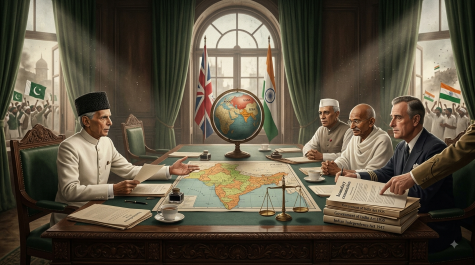
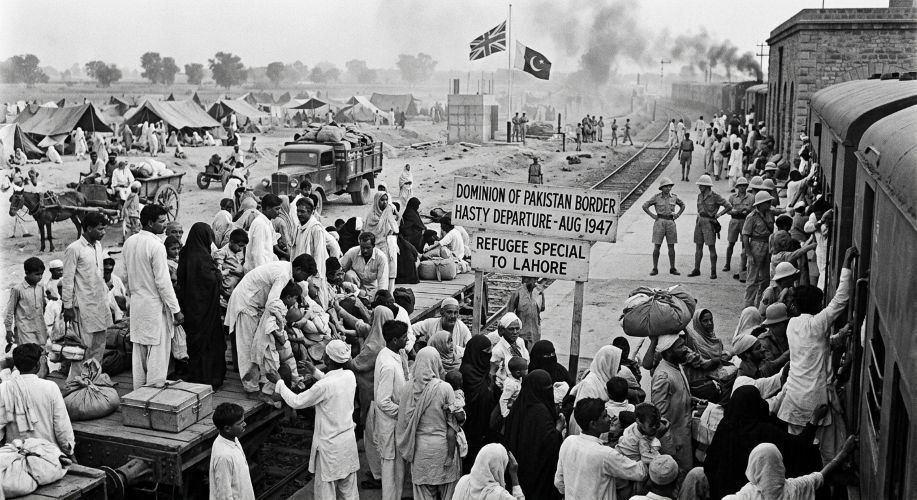
In this rushed imperial liquidation, local leadership was routinely sidelined on crucial logistical decisions. Stanley Wolpert, in Shameful Flight, lays bare the disastrous haste with which Lord Mountbatten accelerated the timeline of withdrawal, compressing what should have been years of careful constitutional transition into a chaotic scramble of mere weeks. The demarcation of boundaries in Punjab and Bengal was entrusted to Sir Cyril Radcliffe, a British lawyer who had never set foot in India prior to his appointment. Native political leadership—including Jinnah, Gandhi, and Nehru—were not members of the boundary commission itself; they were forced to accept the determinations of an imperial arbiter. This reckless timeline triggered catastrophic Partition violence and mass migration. Furthermore, the division of military equipment, financial reserves, and civil infrastructure was heavily mediated by British authorities like Field Marshal Auchinleck, leaving the newborn state structurally disadvantaged at its inception.
This geopolitical context highlights a stark contrast between South Asia’s transition and nations that achieved statehood through total revolutionary defeat of imperial powers. When Vietnam vanquished French colonial rule at Dien Bien Phu in 1954 and later repelled the United States, or when Algeria fought France, Mozambique and Angola fought Portugal, and Indonesia fought the Dutch, statehood was declared unilaterally by insurgent forces. They smashed the colonial legal framework entirely, stepping onto the world stage as fully sovereign republics forged through military victory. In contrast, the Indian subcontinent underwent a negotiated, constitutional transfer of power driven by Britain’s post-war exhaustion.
Because the struggle led by the All-India Muslim League and the Congress operated through legal negotiations and parliamentary frameworks, the exit mechanism was governed entirely by British legislative statutes. This produced Dominion status under the Indian Independence Act 1947 rather than an immediate declaration of sovereign republic status. Dominion status reflected the legal reality of a transitional, inherited arrangement. Under this status, King George VI remained the technical Head of State until 1956, and early state operations relied entirely on British constitutional precedents and Governor-General executive powers. Dominion status was accepted as a pragmatic bridge: it provided legal continuity using the 1935 Act, allowed for the gradual division of the military under British officers, ensured immediate international legal standing within the Commonwealth, and secured a rapid British exit. India shed Dominion status in 1950, whereas Pakistan remained a Dominion until passing its first constitution in 1956.
To analyze this period objectively, historiography must move past absolute hagiography and absolute dismissal. Muhammad Ali Jinnah’s brilliance lay in his constitutional intellect and strategic agility, transforming a fragmented Muslim League into a formidable political force that utilized the 1935 Act’s structures and the 1940 Resolution’s bargaining leverage to force a tripartite negotiation. Gandhi and Nehru, representing the centralizing vision of the Congress, made Partition inevitable through their refusal to accept a weak federal center like the one proposed in the 1946 Cabinet Mission Plan. Allama Iqbal provided the philosophical framework for reimagining Muslim identity, though translating concepts into a state required pragmatic political maneuvering. Ultimately, Pakistan emerged not from a single domestic narrative, but from a dialectic between popular mobilization, regional diversity, elite negotiation, and, above all, the overwhelming geopolitical imperatives of a post-WWII British imperial collapse.
Read: Understanding Armed Struggle in Balochistan
___________________
 Noor Muhammad, Advocate and Mediator, Islamabad