Naravahan said, “You must have heard of Maharaja Dahir, the last independent Hindu king of Sindh. His defeat was the defeat of our entire Hindu world.”
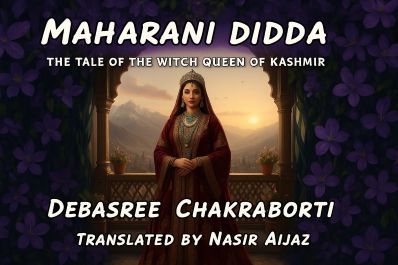
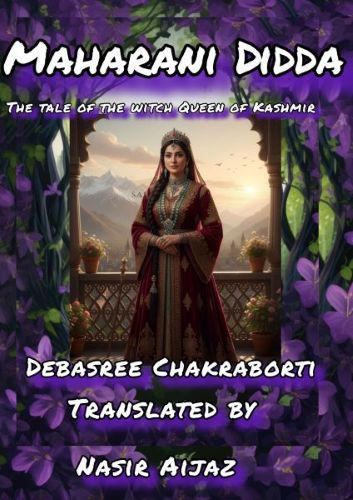
Maharani Didda: Witch Queen of Kashmir
By Debasree Chakraborti
Kṣemagupta’s palace stood atop a vast mountain on the banks of Lake Satisar. On this day, the entire palace was adorned with lamps and red roses.
 Torches had been lit along the road that rose from the lakeshore up to the hill, and all of Srinagar was dressed in the glow of red roses and torchlight. Maharaja Kṣemagupta was returning to the capital after marrying his new queen, Didda. Yet there was no joy among the people of the kingdom. The entire city seemed submerged in grief; perhaps all this light and the beautiful flowers had been arranged to conceal the anger and sorrow in the hearts of the people, to create a bright and festive atmosphere. Normally, when a new queen arrived, the citizens would line both sides of the road to welcome her. But when Didda passed along the shore of Lake Satisar, seated on the back of an elephant, there was no one standing on either side of the road.
It was at the moment between day and night—at dusk—that Didda arrived in Srinagar. In the surrounding nature, the reflection of Didda’s own life seemed visible. The sun had just set, and the crimson glow of sunset was reflected in Lake Satisar, spreading in all directions, casting a blood-red hue over the landscape of Srinagar. From the royal palace, the royal family watched Didda’s ceremonial arrival. With rows of elephants, horses, and an abundance of gifts, King Kṣemagupta was returning to the palace with his wife Didda. Queen Chandralekha stood with the Queen Mother, ready to welcome the new queen. After her husband’s death, the Queen Mother had permanently She had been living in Kashi; then, for some unknown reason, she abandoned her attachment to Kashi and returned once again to the palace in Kashmir. When Maharaja Kṣemagupta decided to marry again, Queen Chandralekha could not at first accept the matter in her heart at any cost. For the Maharaja was the Kālidāsa of her life, and she was the heroine of every creation of that great poet. How could she accept the arrival of another woman in that imagined life?
But her father made her understand that the Maharaja had entered into this marriage solely for political reasons. If the vast kingdom of the Lohars were to merge with Kṣemagupta’s realm, his kingdom would become even more powerful. Moreover, Princess Didda was physically disabled; such a disabled woman could never, in any way, secure a place in the Maharaja’s life. Hearing all this, Chandralekha felt reassured.
As for Kṣemagupta’s mother, the Queen Mother, whether she stayed or not made little difference; she was completely guided by the Prime Minister, Phalgun. The Prime Minister had explained the same thing to her as well, and she herself believed that once a son was born nine months after the marriage, Kṣemagupta would cast aside a disabled woman like Didda from his life. Therefore, she too waited calmly, with a smile, for the right moment.
At the time of Kṣemagupta’s marriage to Chandralekha, she had been in the holy city of Kashi, and so she could not be present at her son’s first wedding. Since her husband’s death, she had become deeply absorbed in religious observances. She had, in that sense, little attachment to worldly life. Trusting Phalgun, she had placed all the responsibilities of the household in his hands. She believed that if there was any true well-wisher of her family, it was Phalgun. Yet, though she spoke of a life detached from worldly bonds, upon returning from Kashi to Srinagar and seeing Chandralekha and her daughters, a new attachment to domestic life was reborn within the Queen Mother. Now, under Phalgun’s influence, she regarded Didda as an unwanted burden upon their family and silently showered her with curses.
At that moment, the gates of the royal palace opened, and conch horns sounded from both sides. Shehnai and other wedding instruments played for a long while. Seated on the back of an elephant, Didda entered her in-laws’ home. In the royal palace…Before reaching the palace, Bhalaga had covered Didda’s face. Kṣemagupta dismounted from his own elephant and came forward toward Didda’s. At that moment, Bhalaga held Didda’s hand and helped her down from the elephant. Seeing Bhalaga’s physical appearance, the Queen Mother mockingly said to Chandralekha, “If a princess’s bodyguard looks like a witch, I can well imagine the extent of her beauty—it has already become a burden to me.” Chandralekha lacked real-world wisdom in that sense and was herself guided by others, so she too responded foolishly, “She must indeed be a witch.”
At that moment, Kṣemagupta took Didda’s hand and came to stand before the Queen Mother.
Everyone in the palace knew that the woman the Maharaja had married was physically disabled and, for that reason, could not walk properly. But seeing Didda approach in such a perfectly natural manner, everyone was astonished; Queen Chandralekha received her first shock right there. Then Kṣemagupta and Didda stepped forward before the Queen Mother, bowed to her together, and straightened up. When the Queen Mother lifted Didda’s veil, the radiance of her beauty dazzled her eyes—this was no ordinary princess; she seemed like a celestial goddess descended upon the mortal world. Chandralekha could not withstand this second shock; she had never even imagined that Didda would be such an extraordinarily beautiful woman.
While the Queen Mother and the Queen were overwhelmed by the brilliance of Didda’s beauty, Prime Minister Phalgun was, at that very moment, seeing crimson clouds in Didda’s eyes. An extraordinary presence shone from Didda’s eyes and face. She stood upright, meeting the Queen Mother’s gaze directly. The Queen Mother could not hold Didda’s gaze for long.
She welcomed Didda and Kṣemagupta and then withdrew. After that, as Didda moved toward Queen Chandralekha, Chandralekha unleashed the jealousy in her heart; she could not cunningly conceal her feelings. With all her strength, Chandralekha seized Didda’s two hands from either side, pulled her close, and whispered in her ear, “Wait nine months. Give birth to a child, and the Maharaja will cast you aside. That dark chamber will be your place then.” Stepping into her new life, Didda was deeply wounded by Chandralekha’s behavior. Valaga understood everything; Bhalaga came up from behind and held Didda’s arms, standing firm. As long as she lived, she would protect Didda from every danger—this was her lifelong vow.
To steady the situation, Prime Minister Phalgun addressed Chandralekha and said, “Chandra, go—take your sister to her chambers.” Chandralekha was mentally guided by her father; she always believed that whatever her father did was for her own good. Therefore, even behind her father’s command, she imagined some noble purpose and prepared to lead Didda toward her chambers. At that moment, Didda said, “You need not hold my hand. Just show me the way.”
Hearing such an authoritative statement from a newlywed bride, everyone was taken aback. Phalgun could not retract his words. Chandralekha, compelled, led her toward the chambers, showing her the way.
Didda greatly liked her new chambers. Kṣemagupta himself had had them newly arranged for her. The interior of the palace chambers was adorned with various kinds of weapons and arms. Three sides of the chambers were open, from where the beauty of the valley could be seen stretching far into the distance. The male and female attendants had brought in all the gifts and belongings sent from Didda’s parental home and placed them in her chambers. Now only Didda and Bhalaga remained.
After arriving in her new home, Didda clearly understood one thing: this marriage had taken place solely by Kṣemagupta’s will. In this family, Didda would have to fight to create her own place. But she had never been one to seize anything by force. Therefore, some other path would have to be chosen here. Thinking all this, Didda stood before the open window, gazing with all her heart at Kṣemagupta’s kingdom, and said, “Bhalaga, I wish to give some gifts to the members of my new family.”
Understanding Didda’s desire, Bhalaga replied, “An excellent idea. The members of the new family will be very pleased.”
Just then, Maharaja Kṣemagupta entered Didda’s chambers with Naravahan. In the darkness of night, amid the half-lit atmosphere of the chambers, Didda and Naravahan met for the first time. Maharaja Kṣemagupta said, “Didda, this is…” “…Naravahan, my childhood friend and minister. The two of you should become acquainted with each other. Prime Minister Phalgun has summoned me; I must go to see him once.”
Before speaking with Naravahan, Didda said to Kṣemagupta, “Maharaj, please forgive me. Perhaps it is not for me to say this, but how does a Prime Minister dare to summon the Maharaj to his own chamber? If he has any need, he should come to you himself to seek counsel. This is not proper.”
The Maharaj replied, “Didda, it is he who has managed this kingdom all these years. If he is slighted, the kingdom will fall into ruin.”
Didda said, “Maharaj, have faith in yourself. Self-confidence is a king’s greatest weapon. Without this weapon, you truly cannot succeed.” Then she stepped a little closer and added, “Whatever has happened until now is the past. From today onward, I am by your side. In ruling this kingdom, you will receive every kind of support from me.”
At that moment, a guard arrived and said, “Maharaj, the Prime Minister is extremely anxious. He has summoned you to the Queen Mother’s chamber. The Queen is also there.” The Maharaj thought for a moment, then left Didda’s chambers.
Didda was a woman of great presence. Concealing her thoughts behind a composed expression, she looked toward Naravahan, smiled gently, and greeted him. Returning her greeting, Naravahan said, “Didda, since the moment I saw you, I have begun to dream again.”
In astonishment, Didda said, “You have begun to dream about me!”
Naravahan replied, “Truly, given the dreadful state into which this kingdom has fallen, this realm needed someone like you—someone who can show the Maharaj the right path.”
Didda said, “The moment I arrived here, I understood that the Prime Minister is the real controller of this kingdom and of the royal family as well. Everything moves at the flick of his finger.”
Naravahan replied, “The people of the kingdom are passing their days in utter helplessness. In such a situation, you must take charge of the state as their guardian.”
Didda said, “Will I be able to do that? I can certainly help by giving the king proper counsel and assisting him in governing the kingdom well, but to take the reins of rule directly into my own hands is an extremely difficult task.”
Naravahan said, “If Yashobati could rule the kingdom single-handedly, why shouldn’t you be able to?”
Didda said, “Yashobati?”
Naravahan replied, “Yes, Yashobati. Damodar, the son of Gonanda, the king of Kashmir, went to kill Shri Krishna. When he was slain by Krishna, by Krishna’s will the governance of the kingdom was entrusted to the pregnant queen, Yashobati. When the ministers refused to accept a woman’s coronation, Shri Krishna cited scriptural injunctions and declared that a woman is not merely an object of enjoyment—she is the earth itself, and she has the power to sustain Kashmir. Then why should you not be able to do the same?”
Didda said, “You are right. Self-confidence helps a person make even the impossible possible.”
Bhalaga said, “Princess, you have surely heard the name of King Tunji. Tunji was one of the greatest kings of Kashmir. Not only in times of happiness, but also in times of sorrow, he showed how a ruler should stand beside the people, how far a helping hand can be extended to the suffering subjects when one holds the power to govern. Maharaja Tunji stands as a blazing example of this. In the history of Kashmir, he has taken the seat of a living legend, almost like a god, and he will remain so.”
In mountainous Kashmir, hailstorms are nothing new. But during Tunji’s reign, hail began to fall even before the autumn rice could be harvested. As a result, famine spread across the land; cries of despair rose everywhere. Family life became imperiled. If a father found food, he ate without giving it to his son; if a son found food, he ate without giving it to his father. Seeing the suffering of the people, and being unable to provide them with food, when the ruler, in his own…It is precisely when a ruler expresses the willingness to sacrifice his own life that his greatness is revealed. It must be remembered that the cries of the people during the famine had driven this king toward self-sacrifice. Princess, Prince Vikram Sen and I together once dreamed a great dream with you at its center. In that dream, you were the ruler of an undivided Kashmir. Moreover, the condition of the country is far from good. In the western sky I see crimson clouds; in that direction, the blood-festival of demonic times has begun.
Naravahan continued, “You must have heard of Maharaja Dahir, the last independent Hindu king of Sindh. His defeat was the defeat of our entire Hindu world. On one side, foreign enemies glare threateningly from the western frontier; on the other, terrible discontent is accumulating among the subjects of the kingdom.
In such a situation, you alone are the means to protect the state. First, you must take this royal palace and the Maharaja himself out of the circle of impending evil, and then, gradually, the entire kingdom.”
Didda said, “Naravahan, I wish to personally give some gifts to every family of subjects in my husband’s kingdom. Make the arrangements.”
Naravahan was overwhelmed by Didda’s intelligence. He said, “As you command, Your Majesty.”
Didda realized that her marriage was not like ordinary marriages. It was as if God had prepared for her a vast and expansive field of duty, and marriage was merely the gateway into that field.
That day, after Naravahan left, no relatives or kin came to the chambers. The Maharaja too had gone and did not return. A few maidservants came only to serve the night meal to Didda and Bhalaga and then left. That night, as Didda and Bhalaga stood together at the open window, gazing intently at the valley in the darkness, Queen Shreelekha sat in her own chambers, staring fixedly at the flame of a lamp. At that moment, the Maharaja arrived. He said, “Queen, today the curse upon our lives has been lifted, and yet you sit here in such sorrow!”
Queen Shreelekha replied, “Maharaj, an incident from the past has made me deeply anxious.”
The Maharaj said, “Which incident from the past, Queen? Tell me without hesitation.”
The Queen replied, “Long ago, once, a great yogi stayed for some time on the Char Chinar Island in Srinagar. You may remember—hoping for a son, I went to that yogi. When I reached Char Chinar Island in the evening, there was no one there. The yogi had just finished worshipping Mother Bhavani and was sitting peacefully before the goddess. When he saw me, he seemed startled. From a distance I offered him my salutations, and he asked me to sit. Then he looked at me for a while, reflected on something, and said words which now seem as though they are about to come true.”
Deeply concerned, the Maharaj said, “Queen, do not hide anything from me. What did he say?”
In a trembling voice the Queen said, “Striking the ground several times with the palm of his hand, he said ‘your daughter will one day become the sovereign of this land. With her rise, the entire existence of the present royal dynasty will be wiped out.’”
The Maharaj said, “Didda is now Kṣemagupta’s wife. She will never harm her husband or his family in any way. I know her very well—she will give herself completely for the sake of the family, but will never expect anything in return. Such is her nature. So be at ease.”
Queen Shreelekha said, “But have you considered that through marriage she has now come to that very place?”
The Maharaj replied, “Many such things happen. There is no need to worry and ruin your health over this. It is quite late now—come, let us go and rest.”
The Maharaj blew out the lamp and led the Queen away to rest, but in his mind the prophecy of that ascetic yogi continued to echo. (Continues)
Click here for Part-1, Part-2, Part-3, Part-4, Part-5, Part-6, Part-7, Part-8, Part-9, Part-10, Part-11, Part-12, Part-13,
________________
 Debasree Chakraborti is a renowned novel writer of Bengali language. Based in Kolkata, West Bengal, India, she has done Master’s in Modern History from the Kolkata University, and authored some thirty books, mostly the novels, with historical perspective and themes. Her novel is ‘Maharaja Dahir’ that covers the history of Sindh from 662, the year of first attack on Sindh by the Arab armies till date, was published last year and translated by Nasir Aijaz into Sindhi language.