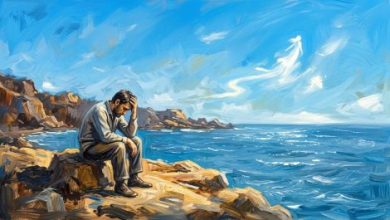
On the far edge of the village, there lived a man whom the villagers called “the madman.”
“Perhaps people will always call me mad… but maybe madness itself is freedom. To be mad is to free oneself from the eyes of others and to see the world through one’s own. Maybe the truth of my existence lies hidden in my dreams”
Naveed Sandeelo
In a small village, nestled between lush green fields and towering trees, there lived a man whom the villagers called “the madman.” He lived on the far edge of the village, in a tiny thatched hut surrounded by olive and mango trees, beneath whose shade flocks of birds would spend their days fluttering, chirping, and weaving through the branches.
The villagers called him mad because he believed in things beyond their everyday customs and traditions. But in truth, he was a madman of a different kind — one who looked at the world through the light of his inner vision, seeing reality from a perspective unlike theirs.
The madman had an obsession with books. Inside his small hut, piles of old and new books were stacked high; the scent of time drifted from their pages. He spent long hours reading, thinking, and losing himself in the mysteries of existence. He had a deep love for the stars; at night, he would gaze at the sky for hours, as though conversing with a distant universe. There was always a dream in his eyes — a dream unknown to others — the dream of life, the dream of freedom, the dream of understanding the meaning of existence.
Sometimes, he would wander to the banks of the nearby canal. The soft ripples of water collided gently with the shores, and the golden hues of the evening twilight scattered across the surface like fragments of broken dreams. As he sat there, gazing into the water, he would ponder about life — why, despite living amidst forests, rivers, and fields, people had grown distant from their own selves.
When the villagers saw him sitting by the canal, they would whisper softly to one another:
“Look, there’s the madman again… lost in his own strange world.”
But the madman was never truly lost. He simply saw the world from an angle unfamiliar to them. To him, life was not merely a collection of customs, rituals, and social rules. For him, the essence of life was freedom, questioning, and the pursuit of meaning.
As the gentle evening breeze touched his face, the madman began talking to himself:
“I have been searching for so many years… but what is it that I am searching for? Does existence have a meaning? Descartes once said, ‘I think, therefore I am.’ But is mere thought enough to sustain existence? No… perhaps the meaning of existence lies beyond thought — maybe it lies in feeling, maybe in dreams.”
Staring at the ripples on the water’s surface, he whispered:
“Look at these waves… sometimes they clash, sometimes they dissolve… human life is just like this. Hume was right when he said — reason has its limits, and experience is the true source of knowledge. But I know this too… not all experiences happen in the outer world; the greatest experiences happen within. Only when a person faces their fears, hopes, desires, and dreams… do they truly come to know themselves.”
He fell silent for a while, then continued in a low voice:
“I see now… people are born with empty minds, just as John Locke said. But soon, society, traditions, fears, and desires begin writing upon those minds. Perhaps freedom means taking back the pen and writing upon our own minds. Perhaps the true meaning of life lies in this — to create ourselves.”
Suddenly, the words of the existential philosopher Sartre rose within him like waves:
“Existence precedes essence… Man is the master of his own destiny. It is in his hands to choose what life to live, though the path of freedom demands courage and risk.”
The madman tilted his head back, staring at the stars, and thought:
“And then comes Kant… he said that reason and experience together create knowledge. Perhaps he was right. Maybe the answers I seek won’t be found entirely in books, but deep within myself — where reason, feelings, and dreams merge into one.”
As the sun sank behind the trees, its fading light rippling across the water, flocks of birds began returning to their nests, filling the air with soft cries. The madman remained seated on the canal bank, wrapped in an unusual serenity, as though time itself had paused before his thoughts.
He murmured to himself:
“Perhaps people will always call me mad… but maybe madness itself is freedom. To be mad is to free oneself from the eyes of others and to see the world through one’s own. Maybe the truth of my existence lies hidden in my dreams.”
Slowly, the madman rose to his feet. A soft smile touched his lips. He walked back toward his hut, where his books, unwritten pages, and incomplete dreams awaited him. In the darkness of night, he lit a small lamp and began speaking to his pen. The words flowed, not from his mind, but from the depths of his soul.
The villagers still called him mad, but the madman now knew the truth — his dreams were his reality. His life was a journey of endless questioning, and it was this journey itself that kept him alive.
Read: A Journey Toward Intellectual Awakening
__________________
 Naveed Sandeelo is a poet, writer and critic, and Lecturer at Department of Philosophy University of Sindh Jamshoro. He is author of five books: three books are on the subject of philosophy. Doing PhD at the department of Philosophy University of Karachi.