A real poet or author does not focus on awards or being a best seller. Popularity and greatness should not be confused – Dr. Jernail S. Anand
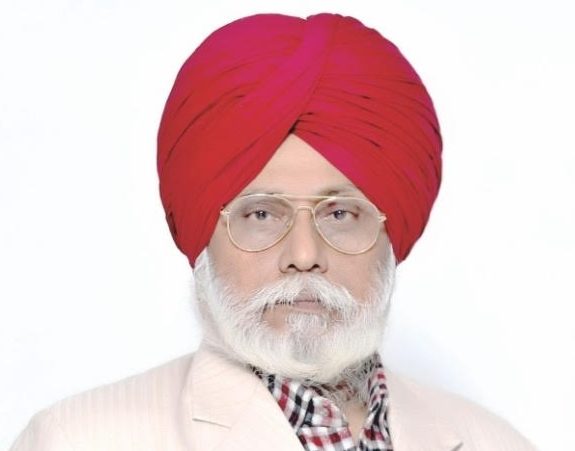
Dr. Jernail Singh Anand is author of more than 190 books, laureate of Seneca Award, Charter of Morava, Franz Kafka and Maxim Gorky Awards, whose name appears on the Poets Roc in Serbia. The interview concerns Dr. Anand’s recent publication: The Cosmic Trilogy.
Interviewed by: Rupa Rao | New Jersey
Dr. Anand, after “Mahakaal Trilogy”, you came up almost immediately with “Cosmic Trilogy”. Much as I am intrigued with the Trilogy, I would like to ask you about these great books, your epics – how are you churning them out at such a furiously fast pace? How is it humanly possible?
 Literary creation both poetry and epic poetry come to me quite naturally. I have never wrestled with words, nor with ideas. In my case, it is a facile movement of ideas which keep downloading as in a fax machine. As far as these Mahakaal and Cosmic Trilogies are concerned, both of them are works of neo-mythology. I go back to Eastern and Western mythology quite often, but there are some great figures which are entirely the creation of my imagination. But these characters act and interact with celestial figures. Mahakaal Trilogy had a great figure, Lustus, the Prince of Darkness, who was a symbol of Corporate Evil. I felt that our age which is marked by vile and bloody aspirations, is too much for Satan’s sensibilities. So, Lustus was created who could withstand any attempt by God, and he outlasts two fierce battles with gods. The trilogy in the 3rd book saw Queen Ultronia, who reigns the post Kalyuga times, a woman whom gods decide should change the history of mankind by creating a woman-centric civilization, in which the natural stature of a woman was 6 feet and a man did not rise about 5.5.
Now, let me come to the Cosmic Trilogy. This was written to offer a philosophical context to the increasing role of the AI, which is considered inimical to mankind and its operational systems. In the first book, The Alternate Universe, I have created a techno-king Craza who offers to enhance humanity, get rid of all corruption, and create better human beings. But, in Book II, The Divine Order Crashes, he comes into conflict with Lustus, who wants Craza on his side, and sends Helen of Troy and Cleopatra, the Greek Queen, to tempt him into a honey trap. But Craza defeats their intentions. However, he lands in trouble with gods who do not like the idea of transparency. They want mystery and fear to stay so that people could remain in a state of dread at the cosmic establishment.
Interesting indeed!! What is the 3rd book of the Trilogy about? The title of the book is enchanting: The Celestial Assimilation.
Craza’s plans to uplift humanity faced rough weather in the 2ndbook, ‘The Divine Order Crashes’. In the last book of Trilogy, the main issue is celestial acceptance of the mechanical world as a part of universal phenomenon. Craza is sainted, and he is advised to ensure that like other forms of life, machines too are imparted consciousness. A Nemetic App is developed by Craza which helps in digitalizing the crimes committed by the people, and to ensure that they know for what crimes they are being punished by Nemesis. The focus is on transparency, though finally, God appears and asserts His might, and declares that Craza, Lustus, Machines, Animals, Waters, Winds all form a part of the created Universe, and they flow towards a common destiny.
Do you think, a day will come, as you have envisioned, when machines and AI will serve humanity or is it just a fabulated dream sequence?
 Men are prone to dreaming, and then, working to realize them. Just as literature gives direction to society from which it comes up, in the same way, dreams also give a positive direction to human thought. AI is suspect these days, but look at the innovation of electricity. When it came into existence, people were sceptical about it too. If it is dangerous, how many people die of electric shock? And on the contrary, you can see civilization will come to a standstill in the absence of electricity. In the same way, AI too will be absorbed by humanity, and its benefits will make us forget the dangers involved.
I believe that whatever progress takes place, everything is following a set pattern. On this earth of gods, nothing can happen which is not godly. Even demons like Satan or Lustus have to follow the diktats of Heaven. Nothing is beyond God’s powers.
I have heard about OVERLAP. Do tell me about it – What is it?
In ‘The Alternate Universe’, Craza, the techno-king suggests that the world now cannot be divided into Good and Evil. Both these characteristics overlap in men. So, it is not easy to classify people who die and allocate them to Heaven or Hell because they do not fulfil the qualifications. So, he proposed OVERLAP , a facility suspended between Hell and Heaven, in which people who are under trial for their good or bad or who are given time to improve their prospects, are kept. Craza says most of the people who die go straight to Overlap, because they are fit neither for Hell nor for Heaven.
So, what is ahead for you – after the Cosmic Trilogy? What are your plans regarding your onward journey?
I think there is no end to man’s problems viz a viz the celestial powers. The Muse is kind enough and it has directed me now to write another epic on Man’s relationship with the Unknown. I have titled it: In Conflict with the Unknown’. Although it seems things are going at an even pace, still, man, out of his nature, often finds himself confronting the Divine Will. His greatest tragedy is that he does not know whom he is fighting. He has no idea of God, Heaven or Hell and the powers that control him and force him to tread the beaten path. Those who defy the diktat of the gods, suffer. The best thing for man is to identify the unwritten text. What turns him into a tragic figure is when he takes the divine law into his own hands, interprets it the way her wants, and then, the divine forces get after him. Ordinarily, nobody knows what is happening to him, and if he is under control, who are the controlling forces.
You have written around two hundred books. What do you think about your career as a writer, and what is your vision of life?
I have drawn on divine inspiration, and Muse has always inspired me, and stood by me in these creative ventures. My aim is to analyze the essential issues of life, the way they strike me. In my opinion, man is quite helpless before superior forces, but still, if he is awakened, he can convert this life into a joyful experience. It all needs the acumen of an artist, to rearrange the available material so that it gains an aesthetic dimension.
People are writing and writing, discussing poetry, releasing books, and millions of books are published every day. Do you think the pursuit of literature has helped bring human life to any betterment?
Poetry loses its ethereal charm when it becomes professional. With such poems, we can impress, but how long they keep inspiring relates to the fact how they deal with the immortal issues of life. A real poet or author does not focus on awards or being a best seller. His prime issue is discharging his duty and writing the verses or fiction, and giving it over to the ethereal forces. A writer differs from other professionals at least in that he is after the dissemination of his ideas, not after awards or the number of copies sold. When Shelley calls upon the West Wind to carry his dead thoughts to the vast world, was it a bargain with the wind?
What is your idea of success as a writer? As a philosophical being?
It has two aspects. One is the writing of a book, and the other is how it affects the society. If you are inspired, and you act according to the dictates of the Muse, your work is bound to be extraordinary and meant for eternity. And people who access your work will be eternally blessed. Whether its copies sell or not, who buys it or not, these things are a matter of time. When your time comes, your writings will have their day. Popularity and greatness should not be confused.
_____________________
 Rupa Rao, a scholar, interviewer, poet, mentor and anchor from New Jersey, Chief Coordinator of the International, Academy of Ethics