

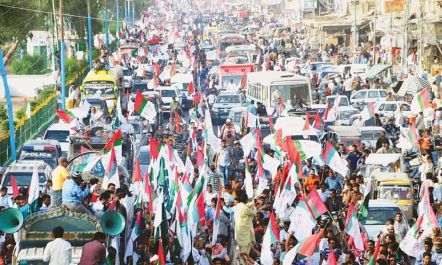
The pressing inquiry is: Why has its political landscape become synonymous with division, confrontation, and instability?
By Dr. A.G. Arijo
For over three decades, the politics of Sindh, and particularly urban Sindh, cannot be comprehensively discussed without the role of the Muttahida Qaumi Movement (MQM). Originating as a student-led initiative, MQM has evolved into a powerful urban political force, maintaining its influence while remaining a source of controversy.
The fundamental question is not about the political strength of MQM. The pressing inquiry is: Why has its political landscape become synonymous with division, confrontation, and instability?
The MQM emerged in the mid-1980s from the All Pakistan Muhajir Students Organization, becoming the political voice for Urdu-speaking migrants in urban Sindh. It gained traction by addressing genuine grievances such as quota policies and political exclusion, offering organization and identity to marginalized urban residents.
Its initial rights-based focus evolved into a confrontational stance characterized by street power politics, allegations of militancy, and accusations of extortion, deepening ethnic divisions between urban and rural Sindh. Instead of promoting integration, the party’s rhetoric often deepened divisions, as the narrative of grievance became institutionalized and politics became performative.
Urban vs. Rural Sindh: Manufactured or Mismanaged Conflict?
Sindh’s strength has historically been its plural identity. From the cosmopolitan fabric of Karachi to the cultural depth of interior Sindh, coexistence was not only possible—it was visible.
Yet over decades, the province witnessed:
- Escalating ethnic rhetoric
- Demands for administrative fragmentation
- Competing narratives of victimhood
Critics contend that the leadership of MQM consistently portrayed Sindh’s politics as a zero-sum game, implying that the advancement of one community inevitably resulted in the detriment of another. This perspective undermined the concept of a shared provincial destiny. At the same time, it is important to recognize that rural political elites also failed to adequately incorporate urban issues into provincial planning. Thus, the divide was not formed in a vacuum; it was perpetuated by mutual distrust. However, the electoral consolidation along ethnic lines further complicated the prospects for reconciliation.
Governance or Power Bargaining?
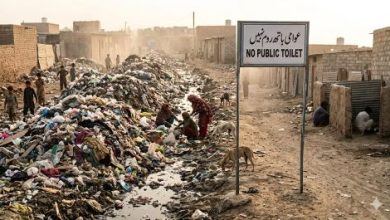
Karachi, Pakistan’s economic engine, significantly contributes to the national treasury, yet it faces persistent challenges, such as:
– Waste management crises
– Deteriorating infrastructure
– Law and order instability
– Political turf wars
For years, the MQM dominated Karachi’s municipal structures, claiming to represent the city’s interests. This begs the question: If MQM held such electoral power, why did administrative outcomes not match its political claims?
While provincial-federal tensions and bureaucratic constraints complicate governance, results should ultimately define effectiveness. Political victimhood cannot replace genuine administrative performance.
The Establishment Factor
No analysis of MQM is complete without examining its complex relationship with Pakistan’s power centers. At various stages, analysts argue, the party benefited from state patronage; at other times, it faced severe crackdowns.
This oscillation produced:
- A cycle of empowerment and suppression
- Leadership exile and fragmentation
- Factional splits within MQM
The post-2016 fragmentation, particularly after the distancing from founder Altaf Hussain, exposed structural weaknesses. Multiple factions diluted ideological clarity and weakened electoral strength.
A party built around centralized authority struggled to transition into institutional democracy.
The Larger Crisis: Politics without Vision
It would be simplistic—and unfair—to claim that any single party is “against Sindh.” The crisis is broader.
Sindh’s tragedy is not MQM alone. It reflects a wider failure of:
- Urban governance
- Rural development
- Provincial coordination
- Accountable leadership
MQM has been part of this equation sometimes as a victim, sometimes as an actor, sometimes as an opportunist.
The deeper issue is not representation.
The deeper issue is representation without responsibility.
Time for Political Maturity
If MQM wishes to remain relevant, it must transform from:
- Ethnic mobilization
- Policy-driven urban reform
Sindh needs
- Integrated provincial planning
- Ethnic harmony
- Transparent municipal governance
- Devolution based on efficiency, not ethnicity
Karachi is not separate from Sindh.
Sindh is not separate from Pakistan.
Political maturity requires abandoning the politics of perpetual grievance and embracing the politics of measurable reform. Without that shift, fragmentation will continue to define the narrative. And Sindh, rich in culture, diversity, and resilience, deserves better.
Read: Migratory Birds in Sindh: Emerging Threats
_______________
 Abdullah Arijo is a professor and curriculum architect at Sindh Agriculture University, Tandojam, specializing in Parasitology, fisheries, aquaculture, zoology, and environmental sciences. He is also a civic advocate for climate resilience and sustainable development.


Very good and informative sir
Nice words
Great job sir 🤎
mashallah sir great knowledge