Establish small and easy-to-manage community libraries in every village and city.
- Instead of short videos on digital platforms, authors should share short stories, poetry, and articles. Establishing e-book and online public libraries can make books more accessible to people.
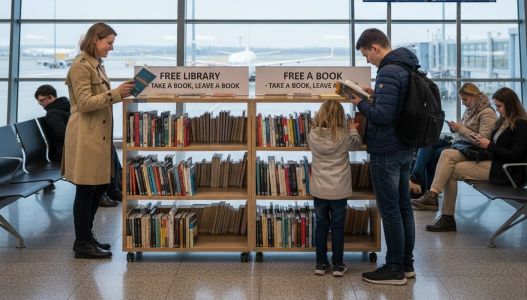
- Open and free libraries at our bus stops, parks, and other public places
By Abdullah Usman Morai | Sweden
Throughout human history, books have always been lighthouses of knowledge. History tells us that whenever nations have remained connected to knowledge, literature, and intellect, their civilizations have flourished. Conversely, when they have distanced themselves from books, their societies have faced decline. Books are not merely sources of information; they also give birth to thought, insight, and creativity.
In today’s digital age, technology and the digital world, mobile phones, social media, and short videos have captured people’s attention and captivated them. The glow of screens has overshadowed the light of book pages, and the habit of reading is gradually diminishing. What was once a common practice, taking time to sit down with a book and read seriously, has now become a fading and old-fashioned hobby. All over the world, especially in our society, people are moving towards brief content for entertainment and information. The notion that reading is only for education is mistaken; in reality, it is a source of spiritual and mental peace. The decline in the habit of reading is not just a social trend but a dangerous signal for our thoughts, imagination, and wisdom.
Now, a question arises: are books truly being forgotten? Or do they still have the power to give new light, inspiration, and life?
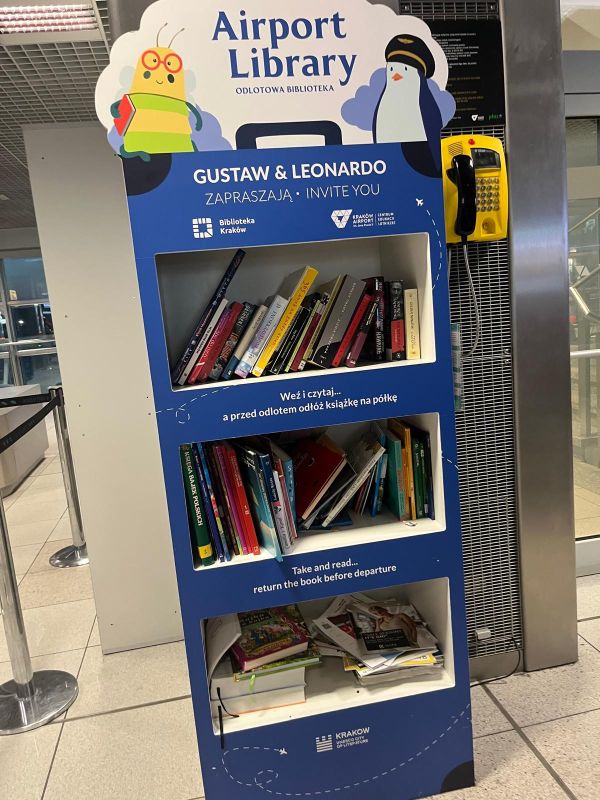 A Personal Observation: A Small Library at Krakow Airport
Very recently, I was waiting for my flight at Krakow Airport in Poland. While it’s common to see people busy on their mobile phones at airports, I was surprised to see a small library there. Books of different languages were on the shelves, and people were freely picking them up and reading. Some people were engrossed in books while waiting for their flights, and when it was time to board, they would read and then return the books to the same spot so others could benefit. This sight was amazing to me, and it made me realize again how precious books are.
At that moment, I felt that books are not just books, but friends who accompany you on any journey, during any wait, and in any difficult moment. I was left wondering if the habit of reading had really ended. If such a passion for reading exists in an airport, where everyone is in a hurry, why can’t we revive it in our own society? This one incident forced me to realize that books are not just a source of information, but a joy that everyone can experience.
Why is the Habit of Reading Decreasing in Society?
There are several reasons for the decline in the habit of reading. For example, people lose themselves in the problems of employment, education, and other issues. But the most important reason is the increasing consumption of social media and digital content. Platforms like TikTok and Reels provide quick and short-term entertainment, which reduces interest in reading longer content. Another reason is the weakness of our education system, where reading is considered just a means to pass exams, not a tool for personal growth. Finally, the problem of access to books is also a major obstacle. Libraries are either non-existent or inactive in our areas, which makes it difficult for people to get new books.
Benefits of Reading Books
There is not just one benefit of reading books; the list can be long. For example, reading broadens the mind and opens new avenues for thinking. It also generates patience, awareness, and empathy, which enhances a person’s ability to speak and write. The act of reading connects an individual to the world and its history. Psychologically, books also provide companionship and help people feel less lonely.
Suggestions to Revive the Habit of Reading
Reviving the habit of reading is a collective effort. The government and social institutions need to pay serious attention to this. The following suggestions can help achieve this goal:
- Establish community libraries: Small and easy-to-manage libraries should be established in every village and city. These libraries should not only have books but also weekly reading programs and book discussion sessions.
- Use digital content correctly: Instead of short videos on digital platforms, authors should be encouraged to share short stories, poetry, and articles. Establishing e-book and online public libraries can make books more accessible to people.
- Role of parents and teachers: Parents should read storybooks to their children from an early age. The habit of reading should be made a part of the curriculum in schools, and a special period should be designated for reading every week.
- Open and free libraries: Models like the one at Krakow Airport can be established at our bus stops, parks, and other public places. Such open book racks or cupboards will encourage people to read.
Conclusion
The purpose of this article is to say that just as seeing people engrossed in books at Krakow Airport made me realize that seekers of knowledge and literature still exist, the habit of reading is not a fading light. Rather, if society gives it importance, it can still become a new inspiration and breath of life. Reading books is not just a habit; it broadens the mind and gives wings to imagination. It connects us with different worlds and makes our thinking deeper and more conscious. If we want to bring this light back to our society, we have to work together so that books become an essential part of our lives, and we start with ourselves by carrying books and encouraging others to adopt this habit. To forget books is to forget the light within ourselves, and to keep them alive is to see human life with new eyes.
Read: Participatory Politics for Democratic Voice
_____________
 Abdullah Soomro, penname Abdullah Usman Morai, hailing from Moro town of Sindh, province of Pakistan, is based in Stockholm Sweden. Currently he is working as Groundwater Engineer in Stockholm Sweden. He did BE (Agriculture) from Sindh Agriculture University Tando Jam and MSc water systems technology from KTH Stockholm Sweden as well as MSc Management from Stockholm University. Beside this he also did masters in journalism and economics from Shah Abdul Latif University Khairpur Mirs, Sindh. He is author of a travelogue book named ‘Musafatoon’. His second book is in process. He writes articles from time to time. A frequent traveler, he also does podcast on YouTube with channel name: VASJE Podcast.