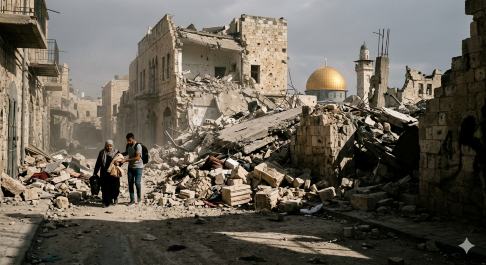
The sky over Jerusalem was draped in a somber shade of gray when the sirens wailed. It wasn’t just a sound; it was a blade slicing through the heavy silence of the narrow alleyway
By Abdel latif Moubarak | Egypt
I: The Iron Scream
The sky over Jerusalem was draped in a somber shade of gray when the sirens wailed. It wasn’t just a sound; it was a blade slicing through the heavy silence of the narrow alleyway. For Arthur, the sound wasn’t new, but this time, it carried a different weight—a gravity that pulled at his very bones.
He leaned with all his might on his metal crutch, that cold companion that had become a permanent part of his new identity. His right leg twitched with nervous energy, while on the left, his trouser leg fluttered hollowly over the void. He began to scramble toward the nearby shelter, the rhythmic clack of the metal against the stone pavement setting the pace of his panic.
II: The Impossible Sprint
Every step was a battle against gravity. Sweat poured down his forehead, and his eyes searched desperately for the heavy iron door of the bunker. Pedestrians blurred past him—complete bodies, moving with a fluid ease he no longer possessed. He was trapped in his own slowness.
Finally, he reached the massive entrance. He threw his weight against it, but his hand slipped on the cold surface, and he tumbled to the hard ground. In that moment, his eyes locked onto a dark stain on the edge of the iron door—a patch of rust that looked hauntingly like dried blood. Arthur froze. He no longer saw the shelter; he saw Gaza.
III: The Bleeding Memory
Time collapsed, dragging him back months. The noise there was different; it wasn’t the rhythmic wail of sirens, but the predatory howl of jets and the mechanical roar of the tanks he once commanded. Inside the steel hull of a Merkava, Arthur had felt invincible, viewing the world through high-tech lenses as if it were a digital game.
He remembered a specific alley in Shuja’iyya. The air was thick with pulverized concrete, and houses collapsed like houses of cards.
IV: The Child and the Ruin
He had paused behind his thermal sights, catching movement amidst the haze. A child, no older than six, was sitting atop a mound of stones that used to be a living room. The boy was crying with a terrifying, silent heaving, clutching the edge of a garment protruding from beneath a massive slab of concrete. It was his mother’s dress; her voice had vanished minutes ago. Beside her, his father’s hand was visible, turned gray by the falling ash.
The child posed no threat; he was merely a fragment of human brokenness. But the orders were “clear the zone.” Arthur squeezed the trigger. He didn’t feel the recoil of the machine gun; he only felt a sudden, hollow coldness as he watched the small figure vanish into a new cloud of dust and death.
V: The Moment of Reckoning
As Arthur later peered out from the tank’s hatch, intoxicated by a false sense of supremacy, he failed to notice the shadow slipping from behind a jagged wall. It wasn’t a jet or a missile; it was a young man holding a crude explosive and a spirit that knew no fear.
The grenade was thrown. It fell with surgical precision into the open hatch. In those micro-seconds, Arthur saw a blinding white flash and heard a roar that silenced every other sound in the world forever.
VI: Waking in the Dark
He woke up in a hospital to find that his world had shrunk. He was no longer the soldier who shook the earth with his stride; he was a remnant. They had amputated his leg above the knee because the shrapnel had left the surgeons no other choice.
The “phantom pain” in his missing limb reminded him every night of the child’s silent scream. The rubble of that house had become a tomb for a family, and a prison for his mind.
VII: Collapse at the Threshold
Back in Jerusalem, Arthur remained sprawled on the ground before the bunker door. The sirens were still screaming, but he had stopped trying to get up. The rust stain on the door expanded in his mind, becoming a sea of blood staining his own hands.
He felt that his lost leg was the price—but a cheap one—for the lives he had extinguished. Every time he tried to lean on his crutch, it felt as though he were planting it into the chest of the boy he had killed.
VIII: Belated Remorse
”Why did I do it?” he whispered to himself as people stepped over him to reach safety. Safety? What safety exists for a killer whose victims inhabit his dreams?
He remembered the faces of the parents under the ruins, realizing the dust that covered them was the same dust now staining his clothes as he crawled on the Jerusalem pavement. The war had taken his leg, but the crime had severed his soul.
IX: Facing the Self
An old man reached down, grabbing Arthur’s hand to help him up. He looked into Arthur’s eyes, which were wide with a primal terror. The old man didn’t see a hero returning from the front; he saw a wreck. Arthur entered the shelter and sat in a corner, clutching his crutch to his chest exactly the way the child had clutched his mother’s dress.
X: The Long Silence
The sirens ceased, and a heavy silence filled the bunker. But inside Arthur’s head, the explosion was ongoing. He realized in that moment that bunkers protect bodies from missiles, but there is no shelter in the world that can protect a man from his own memory.
He sat there, staring into the empty space where his leg used to be, understanding that his true lameness wasn’t in his body, but in a life forever haunted by the blood of the innocent.
Read: Eastern woman – Poetry from Egypt
______________________
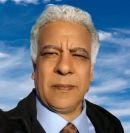 Abdel Latif Mubarak is an Egyptian poet and lyricist born in 1964 in Suez. He is widely recognized as one of the most important poets of the 1980s. His poems have been published in numerous literary journals in Egypt and the Arab world, including Arab Magazine, Kuwait Magazine, News Literature, Republic Newspaper, AI-Ahram, and The New Publishing Culture. Abdel Latif Mubarak’s fame rests on his distinctive poetic style, which skillfully combines the beauty of words with profound reflection on aspects of life and humanity. His verses are imbued with sensitivity, emotion, and a profound understanding of the human condition. Over the years, Mubarak has received numerous awards and accolades for his works.