Tales of a Wandering Soul, Landscapes, People, and Loves
By Abdullah Usman Morai | Sweden
The third book in the series of East African travelogues by Sain Baloch Sohbat Ali, titled “Kenya Ja Qurb” (The Affections of Kenya), is currently before me. His travel companions include Sain Mukhtiar Samoo Sahib, Junaid Dahar, Partab Shivani, and Mehmood Patoojo. In a continuously busy life, if someone with a wandering and tourist soul like mine gets a book, especially a travelogue, during the weekend holidays, it becomes a source of great joy and luxury. I am reading this book with great enthusiasm, interest, and passion, and let us see what insights and benefits can be derived from it now.
 In reality, a travelogue is not merely an account of journeying from one country to another; rather, it is the art of chronicling human emotions, observations, civilizations, thoughts, and the flow of time. A good travelogue allows the reader to travel the world while sitting in their chair, introducing them to new people, new temperaments, new landscapes, and new perspectives. “Kenya Ja Qurb” feels like a similarly fragrant book, taking the reader not just to the land of Africa, but to the depths of human experiences.
First of all, the dedication of the book is unique in its nature. Generally, it is often seen that authors dedicate their books to their mother or father, but in this book, Baloch Sohbat Ali honors and dedicates his travelogue to his son, Beejal, which feels like an excellent and positive gesture. Their conversations with each other over the phone, making complaints, and then reconciling, in this scenario, both father and son, who also seem like friends to each other, must certainly feel proud of one another.
Such relationships are, in fact, the true beauty of life, where love exists not merely as a tradition but in the form of friendship. A father bestowing such an intellectual and literary heritage upon his children is a beautiful act in itself because books are not just collections of words; they transmit thoughts and feelings through generations.
 Today, as I was reading this travelogue and attempting to write its preface, a cup of tea was also sitting beside me. I read in the book that Kenya ranks among the largest tea and coffee-producing countries in the world. There used to be an advertisement on TV as well, which mentioned this tea coming from those gardens of Kenya. I took a sip of the tea, smiled, and expressed gratitude to that anonymous farmer who must have cultivated this tea and cared for it all along, until it became an important element and part of the morning routine for so many other people besides myself.
Sometimes, the hard work of unknown human beings living in different countries of the world is silently integrated into our daily lives. Our single cup of tea is the result of a laborer’s hard work, a farmer’s sweat, and a long journey. Travelogues teach us to perceive such connections.
In this travelogue, one finds a very essential and excellent principle of traveling: if a traveler has to catch a bus from somewhere, they should either visit the place a day before to confirm it or ensure they leave enough buffer time so that even if they arrive at the wrong place due to a taxi driver’s mistake, they can still return and reach the correct place on time. This is exactly what happened with the friends while catching a bus from Uganda’s capital, Kampala, to the Kenyan city of Nairobi.
Travel is not actually just the name of reaching a destination, but it is also the name of patience, tolerance, management, mental preparedness, and adapting to circumstances. An experienced traveler always moves forward, keeping the estimates of time, distance, and unknown situations in mind.
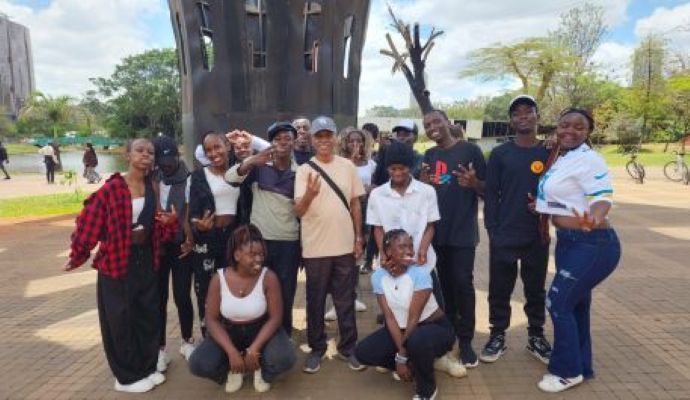 This travelogue of Kenya, a country that gives the world first-class athletes in long-distance running and marathons, provides excellent information regarding its geopolitical importance, natural beauty, historical background, the production and export of its finest varieties of tea and coffee, local cuisines, clean beaches, coastal cities and islands, traditional boats, the importance of the sea and trade through that route, various cities, tribes and their traditional attire and culture, races, politics, tourism, commuting via buses and their fares, food restaurants, hotels and the dining facilities within them, languages, Swahili civilization, currency and its careful exchange (the notes of which, by law, do not feature the image of any human being), inflation and economic conditions, agriculture, greenery, lush crops, plants and their uses, botanical gardens, jungles, forests, urban forests, traditional music and its instruments, waterfalls, natural caves, cycling paths, economy, wildlife, national parks, Uhuru Park (meaning Freedom Park), statues built as monuments of freedom, open corruption, game reserves, neighboring countries, national leaders, universities, churches, the cradle of mankind, and “The Great Rift Valley” passing through this country, the beautiful lakes present there and the flamingo birds found in them, wildlife, life, animals, history and historical places, forts, UNESCO Heritage Sites, museums, customs, traditions, mountains, and climbing them as well as wandering about there.
This is precisely the marvel of an excellent travelogue; the reader feels that they are not merely reading words, but are passing through an entire world. Baloch Sohbat Ali has presented the scenes through the power of observation in this travelogue in such a manner that the reader feels themselves right in the midst of those roads, bazars, sea breezes, and wild regions.
When I read the travelogue and, in my imagination, envisioned the elephants near Mount Kilimanjaro and the interesting annual migration of animals from one country to another, that spectacle seemed extremely beautiful and naturally captivating to the heart, even in my thoughts. In reality, when a person is present there, that sight would probably leave them spellbound and petrified.
Some scenes of nature are such that they silence a human being for a few moments. There, neither language nor words; only emotion remains. Due to its wildlife and natural beauty, the land of Africa is perhaps one of those few regions in the world where humans can still see nature in its original form.
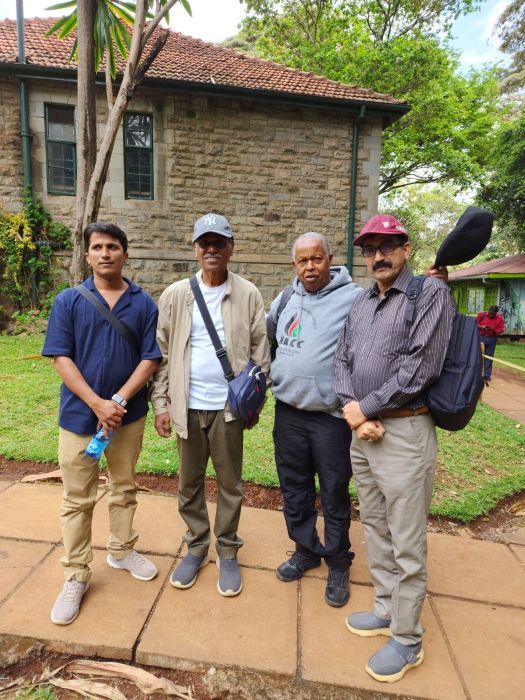 In every journey, one definitely finds something somewhere that reminds the traveler of their own homeland, and it is the author’s mastery to connect things with them so that the reader enjoys it even more. In this travelogue, there is mention of the lifestyle of people around Lal Shahbaz Qalandar and Sehwan Sharif, or the buses of Johi and Wahi Pandhi (which I myself have ridden), or the names of Sohrab Goth and bus companies, or hawkers calling out outside the bus to sell things, or the strict checking of passengers in buses lest someone might be traveling illegally. Seeing the strict checking at borders, Baloch Sohbat Ali has also written some emotional paragraphs regarding the influx of outsiders into Sindh and other matters, the summary of which is: “We are lions for our own people, but chickens in front of outsiders…” or “The homeland is a mother, so has anyone ever sold their mother?”, or examples of “suffering centuries of slavery”. Along with this, getting entangled in the manner of a Mawali (addict/eccentric), paying money to learn a lesson, and moving forward, all these things teach a lot to learn during the journey, and make this book highly interesting.
In reality, a good writer senses the fragrance of their own land even in foreign landscapes. Wherever Baloch Sohbat Ali describes the scenes of Africa, Sindh walks alongside him. This is the reason why the reader feels a sense of belonging rather than alienation in this travelogue.
In the travelogue, one also finds Sindhi proverbs, the poetry of Bhittai Sarkar (Shah Abdul Latif Bhittai) and Shaikh Ayaz, as well as a remembrance of Dadu’s tea and a mention of mangoes and rice, which only we Sindhis eat mixed. Or remembering Karachi’s Bolton Market upon seeing other markets there, or the conversation(Kachari) that takes place while sitting together among the travel companions, meaning, Sindh walks hand-in-hand in the African country of Kenya. Due to his travel companion, Partab Shivani, this travelogue also mentions the fasts of Sanatan Dharam (Hinduism), which he observes there. Baloch Sohbat Ali’s point is absolutely correct: new streets, new people, different languages, and cultures in foreign countries expand a person’s mind, making one realize the vastness of the world.
Travel makes a human being more tolerant, broad-minded, and philanthropic. When a person meets people of different colors, races, languages, and religions, they realize that the beauty of the world lies precisely in its diversity.
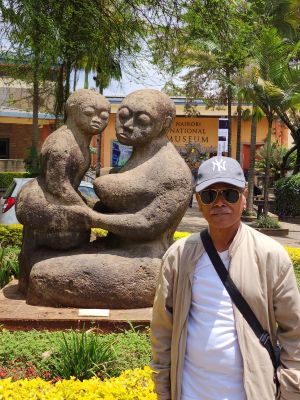
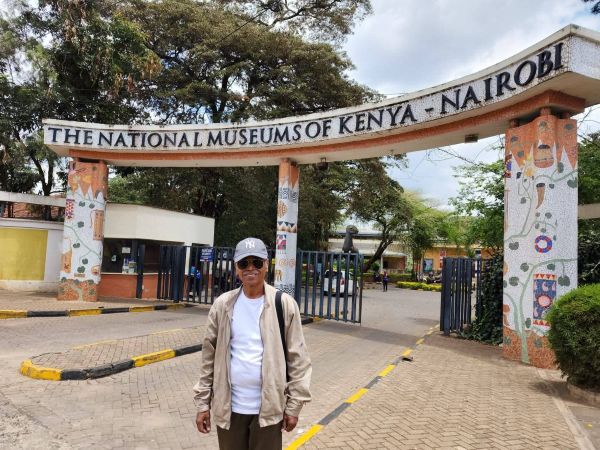
 To understand Kenya, taking a tour of its National Museum seems quite necessary. Even just reading the description of human skulls, ancient swords, the lifestyle of humans of the ancient era, chains, earthenware, zinc and copper utensils, birds and animals (especially dinosaurs, crocodiles, turtles, large lizards), arrows, thatched houses, old tools, axes, stone knives, daggers, and spears makes the heart wish that a person must travel to Kenya one day.
Museums are, in fact, the houses of nations’ memories, where time stands preserved with its ancient signs. Such places make a human realize how civilizations were formed and how they kept journeying.
While wandering through the snake section of the museum and seeing the innocent snakes imprisoned, Baloch Sohbat Ali views them excellently from his perspective as a lawyer, as if they were some innocent prisoners of Sindh who had been pointlessly implicated in false cases, forced labor, and locked up. Nonetheless, the reader gets very interesting information regarding the types of these snakes and the potency of their venom. Useful advice is also given regarding urban forests and the efforts made by “Wangari Maathai” for environmental protection, as well as the right time of day to visit the surrounding forests.
This is also a great merit of this travelogue: the author does not merely look at the scenery, but connects everything with his social and human consciousness. The gaze of a lawyer, the sensitivity of a social being, and the curiosity of a traveler combine to make this book more vibrant.
Baloch Sohbat Ali has beautifully explained a verse of Shah Latif, which mentions the young offspring of snakes, advising not to underestimate them because even if they bite an elephant, it would not be able to move from its place. The impact of these things on human life has been presented very clearly: that some matters or problems seem small in life, for example, an enemy, an illness, or some difficulty or hardship, but they should not be considered small, because when the time comes, they can cause great damage.
This is the true beauty of literature: it generates extraordinary lessons from ordinary scenes. Explaining the intellectual depth of Shah Latif’s poetry and its relevance to modern life in this manner is of great benefit to the reader. Well done, Sir, well done! A very interesting explanation and lesson.
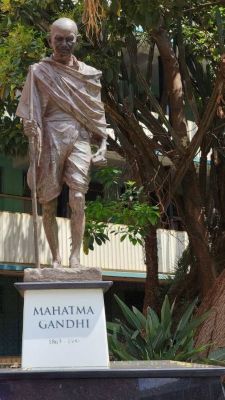
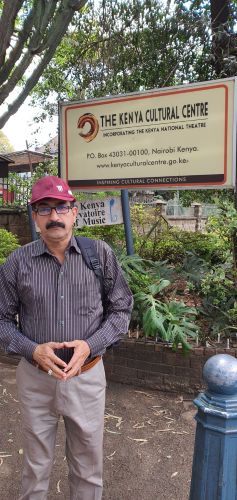
One joy of traveling lies in walking on foot, which the friends do during this journey, and during that walking, a person can evaluate different things, meet different people, and learn and teach many things. For instance, in this travelogue, while walking around, they accidentally watch a stage drama, meet its director, and hear him say: “No, we do not weaken writers, artists, and actors mentally and morally by providing them financial aid.” This sentence holds a very deep meaning for those who understand. The statue of Gandhi at the University of Nairobi, the meeting with the guards there, the education offered there, and the method of protest by teachers have also been beautifully presented.
Such accounts elevate a travelogue above mere sightseeing and turn it into a social document. How a society treats its artists, teachers, and writers is the true benchmark of that society’s intellectual development.
In this travelogue, the reader senses and understands that during travel, and that too in Africa, travelers must be mentally prepared to leave their comfort zone. In my opinion, not just in Africa, but whenever a person goes on any journey within the country or outside the country, one has to say goodbye to the daily comfort zone in every circumstance. It is precisely in this that the joy of traveling lies, allowing a human being to closely observe other things and the lives of other people. Through this, it also happens that a person expresses gratitude to the Almighty Lord for the facilities they enjoy in their own homeland and home.
Travel teaches humility to human beings. It tells us that the world is very vast and our experiences are very limited. Only when a person steps out of their comfort zone can they understand themselves better.
 It is also read in the travelogue that, according to an Indian shopkeeper who has been living there with his family for the past fifty years, the men there only engage in flirtation and laziness, whereas the women there are hardworking. In my opinion, women across most parts of the world are hardworking. Hearing the mention of that Indian reminded me of the opportunity I got in 2006 to watch the Shandoor polo match. There, I met a local youth who looked just like us but was actually born and brought up in New Zealand; his name was Sohrab Memon. According to him, his ancestors were from Nasarpur or its surroundings in Sindh, who had first migrated from Sindh to Mombasa, Kenya, for business, and then from there, perhaps, his grandfather migrated to New Zealand. After seeing Sindh, the land of his ancestors, he had set out for tourism in the northern areas of Pakistan. No matter where a human being is, they remain connected to their homeland in one way or another, which is a very beautiful thing.
Homeland is not actually just a piece of land, but it is a collective identity of memories, language, fragrances, people, and emotions. No matter which corner of the world a human being is in, the fragrance of the soil of their land always remains alive inside them.
So in the end, it can be said that reading this travelogue provides a lot to learn and think about, which is truly a benefit. Kudos to Sain Baloch Sohbat Ali, who penned down his journey and conveyed it to other friends who will also derive benefit from this book.
“Kenya Ja Qurb” is not just the account of an African country, but it is a beautiful saga of human curiosity, observation, cultural consciousness, love for the homeland, and the desire to understand the world. This book will not only inspire the reader to travel but will also teach them how to look at the world with an open heart and an open mind. I am certain that this travelogue will prove to be a beautiful addition to the tradition of travelogues in Sindhi literature and will be read by readers with love and interest.
Read: In the Land of a Thousand Hills
_____________________

Abdullah Soomro, penname Abdullah Usman Morai, hailing from Moro town of Sindh, province of Pakistan, is based in Stockholm Sweden. Currently he is working as Groundwater Engineer in Stockholm Sweden. He did BE (Agriculture) from Sindh Agriculture University Tando Jam and MSc water systems technology from KTH Stockholm Sweden as well as MSc Management from Stockholm University. Beside this he also did masters in journalism and economics from Shah Abdul Latif University Khairpur Mirs, Sindh. He is author of a travelogue book named ‘Musafatoon’. His second book is in process. He writes articles from time to time. A frequent traveler, he also does podcast on YouTube with channel name: VASJE Podcast.