

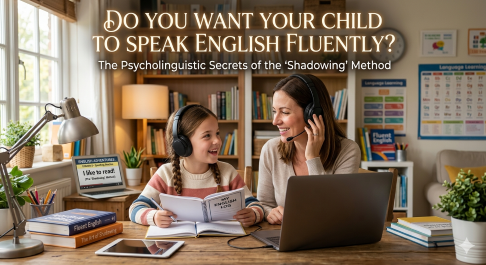
Shadowing literally means “following like a shadow.” Rooted deeply in psycholinguistics, its core mechanism is remarkably straightforward: the child listens to an English audio source (a cartoon, a song, or a dialogue) and, within 0.2–0.5 seconds, repeats the native speech aloud simultaneously.
Artikova Shohida Anvarovna
Many parents enroll their children in prestigious tutoring programs where they spend months expanding their vocabulary and acing textbook tests. However, when it comes to live communication and real-time interaction, they often freeze in silence. Does this sound familiar? Rest assured, the issue does not lie within your child’s capability, but rather in outdated instructional methodologies.
Today, we will explore a modern approach that yields the highest results in contemporary linguodidactics (The theoretical science of language teaching and learning) and eradicates the language barrier at its roots: the “Shadowing” method and its cognitive benefits.
What is Shadowing and How Does It Work?
Shadowing literally means “following like a shadow.” Rooted deeply in psycholinguistics, its core mechanism is remarkably straightforward: the child listens to an English audio source (a cartoon, a song, or a dialogue) and, with a mere delay of 0.2–0.5 seconds, repeats the native speech aloud simultaneously.
Unlike adults, preschool and primary school children should not be subjected to monotonous drills. Instead, we implement gamification—transforming the exercise into an engaging play technology:
“Let’s turn into your favorite bunny right now, and voice-over exactly what they are saying!”
Secrets of the Brain: Why This Method is Ideal for Children?
The period from ages 3 to 7 or 8 represents the sensory (most receptive and critical) period for language acquisition in human development. At this stage, a child’s brain does not consciously “learn” a language; rather, it “absorbs” it implicitly, much like a native tongue. The scientific benefits of the Shadowing method rely on the following psycholinguistic factors:
Activation of Mirror Neurons: The human brain possesses specialized neurons responsible for imitation. When a child does not merely listen to English speech but replicates it simultaneously, the auditory and speech centers of the brain (Broca’s area) fire concurrently. Consequently, the language is mapped onto the memory infrastructure several times faster.
Learning via “Lexical Chunks”: Traditional methods teach children isolated vocabulary words (e.g., apple, run). In Shadowing, however, the child internalizes words in context, as pre-fabricated structural blocks. For instance, a phrase like “He is running” is absorbed as a single, holistic template without the burden of complex grammatical analysis.
Reduction of Cognitive Load: When trying to speak through traditional training, a child must first think in their native language, translate it into English, and then retrieve the correct grammatical rules. This process exhausts the brain. Shadowing bypasses this translation chain entirely, accelerating speech reflexes to the level of automaticity.
4 Core Benefits of the Shadowing Method
Impeccable Pronunciation and Intonation: The child replicates the distinctive phonemes (sounds), rhythm, and intonation of a native speaker with absolute precision. This proactively prevents the crystallization of a heavy non-native accent in their future speech.
Transitioning Passive Vocabulary to the Active Phase: Children often understand many words passively by simply watching cartoons, yet they fail to produce them. The simultaneous repetition practice transfers these words into speech motor skills, enabling active utilization.
Phonematic Auditory Capacity: Continuous, high-focus listening trains the child’s ear to effortlessly distinguish between highly similar English acoustic variants (such as the [w] and [v] sounds).
Psychological Freedom: Because children perceive this process as a game, the debilitating “fear of making mistakes” or anxiety regarding communicative failure never takes root.
A Methodological Algorithm for Parents at Home
To effectively implement this method at home, parents do not need to possess flawless proficiency in English. Simply following this structured sequence is sufficient:
Selecting Multimodal Content
Auditory and visual synergy
Choose short, highly engaging animations featuring clear articulation (e.g., Peppa Pig, Steve and Maggie, or authentic nursery rhymes) that are appropriate for the child’s developmental level.
Micro-Session Discipline
The pause-and-repeat mechanism
Pause the video every 10–15 seconds and encourage your child to replicate the character’s exact words, capturing their emotional tone, laughter, and facial expressions (mimicry).
Session Duration Control
Time management constraints
Since a child’s voluntary attention span is short, avoid prolonged lessons. A mere 7–10 minutes per day is highly sufficient. The absolute key here is consistency and regularity.
A child’s brain absorbs new knowledge effortlessly, much like a sponge. Instead of forcing them to memorize a language, we must foster a natural linguistic environment through scientifically proven methodologies. Shadowing is an exceptionally effective, zero-cost strategy to bring an immersive English-speaking environment directly into your home. Play along with your children, shadow the speech together, and witness how effortlessly they begin to articulate in English!
Read: Language as a New Horizon of Consciousness
____________________
 Artikova Shohida Anvarovna is First-year Master’s Student in the Field of Theory of Education and Upbringing (Preschool Education) Fergana State University (FerSU) Margilan, Uzbekistan


