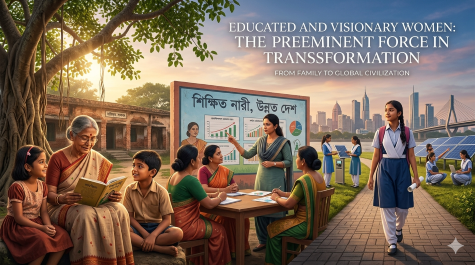
The Preeminent Force in the Transformation of Family, Society, the State, and Global Civilization
Dr. Hasan Nashid
The Architecture of Humanity
Throughout the extensive history of human civilization, men and women have been co-partners in progress. However, regarding the evolution of civilization, the construction of values, and the nurturing of future generations, the role of women is particularly pivotal. This is because the first touch of education a human being receives comes from a woman—the mother. Consequently, a woman’s knowledge, consciousness, morality, and foresight are directly linked to the future of a nation.
In today’s world, while developmental discourses revolve around economics, technology, and diplomacy, we often overlook the fact that the foundation of all these is humanity. Women occupy the most significant position as the architects of human beings. When a woman is educated, she does not merely change her own destiny; she participates in constructing the future of a family, a generation, and a nation. Reports from the United Nations, the World Bank, and various international research organizations consistently emphasize that sustainable development is impossible without the advancement of female education. Educated women contribute immensely to health, education, economics, social awareness, and the development of humanitarian values.
In the context of Bangladesh, this issue is of paramount importance. Since independence, female education has been one of the sectors where Bangladesh has achieved remarkable progress. The expansion of girl-child education, increased female employment, and active participation in various social development indicators have propelled the country’s progress to new heights. However, education is not merely the acquisition of a degree. True education renders a person visionary, humanitarian, and rational, making them conscious of the future. Therefore, a woman must not only be educated but also visionary, for education remains incomplete without foresight.
Lessons from Civilizational History
The history of human civilization is a history of joint contributions by men and women. Yet, at various stages of history, the role of women has not been duly evaluated. In many civilizations, women were confined to domestic roles, and their knowledge, wisdom, and leadership were undervalued. Nevertheless, history bears witness that women have played crucial roles in the progress of civilization in every era—be it in ancient Egypt, Greece, Rome, India, China, or Islamic civilizations.
In Islamic history, Khadija (RA), Aisha (RA), and Fatima (RA) were not just religious figures; they were unique examples of knowledge, wisdom, and leadership. Specifically, Aisha (RA) is recognized as one of the most important figures in Islamic scholarship. Similarly, the history of female education in Bengali society has been a struggle. In the 19th century, when female education was considered unnecessary by many, Begum Rokeya spearheaded a powerful movement, believing that national development was impossible without educating women.
The Foundation of Nation-Building
Education develops the power of thought, liberates people from superstition, and fosters a rational perspective. While education is vital for economic development and political stability, its true purpose is to create conscious, responsible, and humanitarian citizens. When a woman is educated, the benefits ripple through society because a woman is directly connected to every member of a family. Global research indicates that the higher the level of a mother’s education, the higher the educational attainment of her children.
The influence of an educated woman is multi-dimensional. Firstly, she educates the family; secondly, she instills positive values in children; thirdly, she increases social awareness; fourthly, she participates in economic development; and fifthly, she plays a vital role in creating future leadership. This is why it is said: “If you educate a man, you educate an individual; but if you educate a woman, you educate a family.”
Foresight is the ability to envision the future and make decisions accordingly. A visionary woman prioritizes long-term welfare over immediate gain. In the modern world, the concept of leadership is evolving to emphasize empathy, cooperation, and morality—qualities that often make female leadership particularly potent.
Shifting Realities: From Micro to Macro
The family is the primary educational institution where a child learns language, behavior, and ethics before entering a formal school. As the central figure in this process, the woman is the primary architect of the “factory of nation-building.” In families where women are educated and conscious, children demonstrate higher levels of discipline, empathy, and responsibility.
Furthermore, a mother’s influence is deeper than that of any other teacher. The child’s personality is largely formed in childhood, influenced by the mother’s education and perspective. A visionary mother does not just foster a desire for academic knowledge; she strives to raise her child as a truthful, responsible, and socially conscious human being.
This influence extends directly to health and economic metrics:
Health Awareness: An educated woman plays a critical role in maintaining family health. She understands the importance of immunization, nutrition, maternal health, and hygiene. Studies show that child mortality rates are lower among educated mothers. In Bangladesh, female education has significantly contributed to reducing maternal and infant mortality.
Economic Development: Women are now a driving force in the global economy, contributing to fields like medicine, research, engineering, IT, and administration. An educated woman’s entry into the workforce increases family income, improves children’s educational opportunities, and alleviates poverty. The World Bank notes that increasing female economic participation boosts national productivity. In Bangladesh, the contribution of women in the Ready-Made Garment (RMG) sector is a cornerstone of national economic growth.
Social Change: Educated women often emerge as pioneers of change against social inequality and superstition. They have played significant roles in movements for human rights, environmental protection, and social justice. By combating child marriage and promoting scientific thinking, they lead society toward progress.
Global Benchmarks of Leadership
History is replete with women who changed the course of humanity. Marie Curie pioneered new chapters in science and remains the only person to win Nobel Prizes in two different scientific fields. Rosa Parks sparked a new movement in the struggle against racial discrimination. Mother Teresa elevated humanitarian service to a new global standard, while Malala Yousafzai became a global symbol for the right to education.
Addressing the Bottlenecks
Despite progress, challenges remain, including poverty, child marriage, social prejudices, and the digital divide. To ensure holistic national development, we must prioritize the following interventions:
Ensure quality education for every girl child.
Expand technical and digital literacy for women.
Foster leadership qualities through educational and social organizations.
Create a safe and dignified environment in workplaces and educational institutions.
The Path Forward
Analysis of history and contemporary reality makes one truth clear: an educated and visionary woman is the foundation of a nation’s development. She nurtures children, enlightens families, strengthens the economy, and leads the state toward prosperity. Her influence flows through generations.
The principle of national development should not be competition between men and women but partnership. However, since the source of a human being’s first education and values is most often a woman, her role in nation-building is unique. To build a knowledge-based, humanitarian, and sustainable world, we must prioritize female education and visionary leadership. An educated woman is the architect not just of a family but also of the future of a nation.
Read: A humanoid demon in a tree
___________________
 Dr. Hasan Nashid is a poet, writer and PhD Research Fellow, Faculty of Education, International Islamic University Malaysia, Malaysia.