

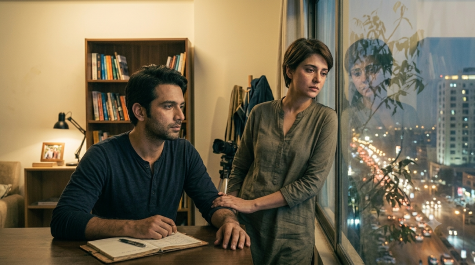
Some prisons are built by tradition. Some are built by fear. And some are built by the courage to remain free. There is pain in being progressive.
By Mohammad Ehsan Leghari
I know a man and a woman.
Or perhaps I do not know them at all.
People say they grew up together in a village where the summers were long and the dust settled slowly over the old haveli walls. They studied in the same schools, sat beneath the same neem tree in the courtyard, read the same books, and dreamed the same impossible dreams.
They grew up believing that the world could be better than the one they had inherited.
Then they married.
By twenty-eight, he had already published two books. Poems, essays, stories — words that travelled farther than he ever had as a child.
By twenty-six, she had found her place before cameras and lights. Acting, modelling, the uncertain world of performance. A world larger than the village and louder than literature.
They had three children. A family.
He believed in freedom. Not the kind people praise in speeches and deny in their homes, but the difficult kind. The expensive kind.
He encouraged her career. Defended her choices. Celebrated her successes. Whenever a door opened before her, he stepped aside and let her walk through first.
She appreciated him for it. And he meant every sacrifice he made.
That is what progressive men do, isn’t it?
Or perhaps that is what men in love do.
You ask whether they loved each other.
Why are you asking me?
I am not a witness. I am not a storyteller. I know no more about their hearts than you do.
I only know that wherever there is love, there is joy.
And wherever there is love, there is pain.
Years later, they lived in a flat in Karachi. The children occupied one room. Books occupied another. The city occupied everything else.
Some nights he would sit by the window after everyone had gone to sleep. A notebook lay open before him, though he often wrote nothing. Outside, the city lights drifted through the darkness. And sometimes, reflected in the glass, he saw the old neem tree.
Not literally, of course. The tree still stood in the haveli courtyard hundreds of kilometres away. Yet somehow it appeared beside him. Its branches pressed softly against the window. Its roots reached into the room. It had followed them. Perhaps all beginnings do.
Near midnight she would return from a shoot. He would hear the lift stop, the key turning in the lock, the quiet footsteps in the narrow passage. She had learned to move silently through the apartment, just as she had once learned not to wake the old floors of the haveli.
“The children?” she would ask.
“Sleeping.”
She would nod.
Water would run in the kitchen. A plate would be lifted from a shelf. Small sounds. Ordinary sounds. The sounds of a life built together.
Sometimes they ate in silence at the small table by the window. Sometimes she spoke about work. Sometimes he spoke about writing. Mostly they spoke about the children. And sometimes they spoke about nothing at all.
One evening she said, “Someone asked me about my last advertisement.”
“What did you tell them?”
“That it was real.”
He smiled faintly. Then he asked the question he always asked whenever the village reached them through rumours or old expectations.
“Do you want to stop?”
She looked at him carefully.
“Do you want me to?”
For a moment neither spoke. Then he turned his hand upward on the table. She placed hers inside it — cold from the night air.
“No,” he said.
That was all. The conversation ended. The question did not.
The next morning he stood again at the window. The neem tree was there. Or perhaps it was not. Memory is difficult that way.
He thought about the promises they had made beneath its shade before their nikah — the life they would build, the freedoms they would defend, the doors they would keep open for each other. He had kept those promises. She had too.
Yet promises, like trees, grow larger than the people who plant them. The roots travel farther than expected. Sometimes they crack stone. Sometimes they enter houses. Sometimes they press silently against glass.
I never saw them quarrel. I never saw betrayal. I never saw unhappiness. But some wounds are too educated to bleed. Some sacrifices are too voluntary to become complaints. Some loneliness is born not from abandonment but from faithfulness to an idea.
There is a price for being a writer.
There is a price for living in the public eye.
There is a price for believing in freedom when freedom becomes real.
The strange thing is that love does not divide the price equally. It merely ensures that both people pay. One person’s tears become another person’s eyes. One person’s victory becomes another person’s test. One person’s freedom becomes another person’s responsibility.
And still they remain together.
Perhaps happily.
Perhaps painfully.
Perhaps both.
One night she stood beside him at the window. Neither spoke for some time. The city moved beneath them. The old neem tree stood between them and behind them and within them.
Finally she said, very softly,
“We are still doing what we said we would do.”
He nodded.
“Even when the roots reach here.”
He looked at the dark glass.
“Especially then.”
They stood together for a long time. When they finally turned away, their shoulders touched briefly in the narrow passage — a small gesture, almost nothing, and yet perhaps everything.
I cannot tell you that their happiness is different.
I cannot tell you that their pain is different.
I cannot tell you that their love is different.
I can tell you only one thing.
Some prisons are built by tradition.
Some are built by fear.
And some are built by the courage to remain free.
There is pain in being progressive.
But that pain is not a flaw in freedom. It is its proof.
Because the deepest burden is not being denied a choice.
It is making the choice, knowing the cost, and refusing to turn away.
That is the price of living by your convictions.
And that is why the deepest pain is the one you choose yourself.
Read: The Crime of Blossoming
______________________
 The author is a water expert, former Sindh member of Indus River System Authority (IRSA), and a prolific writer


زبردست احسان سائين