Are our thoughts fixed at any time at anything for long? No. it is a flow. We are just moments, fleeting moments, and we are not more than snap-shots taken from a running car, which cannot be repeated even after a split second.
Dr. Jernail Singh Anand
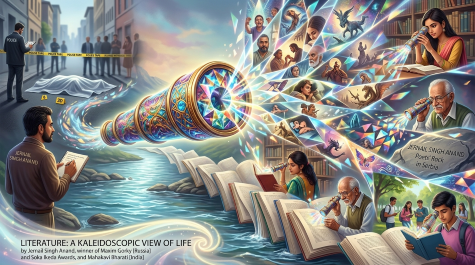
In literature, every event has a 3D personality. The first dimension of an event is what really happens, if it is based on reality. Stories and events that are found in literature are not reality, but based on reality. Suppose a murder takes place. It has a creative structure around it. Someone kills somebody for reasons best known to him. But a murdered body is lying on the road. People look at the body, talk in different ways, police arrives, and then, there are inquiries and investigations. These are things that have happened in real time.
Now, a novelist tries to bring this murder into his writing. First of all, he has no first hand of knowledge of what has happened, and how it has happened. Just as police reconstruct the scene of murder, the novelist too reconstructs the murder in his novel. What will be the difference between the real time murder and the reconstituted event? The subtext of the real time murder is entirely different from the over text that the novelist will bring to it. The novelist takes this event into the furnace of his imagination, where so many past memories are on a permanent visa. This new item is added into the cauldron and baked in his imagination. Now, what he comes up with is the over-text [essentially it is bio-text] because to the event, so much of his own personality has been added. The event is the same, a murder, but the novelist has added his own vision to it. The novelist brings it to life in his fictional world. The people who see this murder and the dead body build their own texts, but they soon evaporate because they have no appetite for putting them down into stories. The murder becomes the headlines for a few days, the subject of gossip and then, everything whispers down. So, we have two personalities of the same event, the one which goes into police investigation. And the second that becomes a chapter in a novelist’s fiction.
The story does not end here.
When this novel is read by a reader, a new over text will be created, because the story as it is told by the author will further act and react with the reader’s imagination. And in his mind, a new structure will be created, which will be the amalgam of three personalities: the real murder, the reconstructed story of the novelist, and the reflexes of his own mind, adding something off his own imagination. In this way, an ‘innocent’ event [murder] has been treated to two more personalities. Who is justifying whom, who is at fault, the novelist debates, which the reader too debates in his own mind, finally, there is a story which is entirely different from the original event.
How literature becomes a kaleidoscope?
Things don’t end here. When another reader picks up the novel, the same story will appear in a different persona. And still, if we imagine a million people read the novel, a million stories will be architextured from the text. It will be a mega amalgam of imagination, and a time will come, when it will be very difficult to extricate the real and the unreal, and the supra-real. This is the spectacle that literature offers, a thousand versions, which is the real stuff of human life.
What we live, and what we come across, are only version. We too are version, realized in a momentary state. We are always in a state of flux. Our consciousness is flowing. If we stand on the bank of a river, it is not the river alone that is flowing, our vision too is flowing. Are our thoughts fixed at any time at anything for long? No. it is a flow. We are just moments, fleeting moments, and we are not more than snap-shots taken from a running car, which cannot be repeated even after a split second.
Read: Beyond Heaven Beyond Hell
_____________________
 Dr. Jernail S. Anand, with 200 books to his credit [18 epics] is a Chandigarh-based top ranking author, whose seminal work ‘Lustus: The Prince of Darkness’ challenges the moral complacency of our era. He is founding President of the International Academy of Ethics, and Laureate of Charter of Morava [Serbia], Seneca [Italy], Franz Kafka [Germany, Ukraine, Czeck Rep] and Maxim Gorky [Russia] Soka Ikeda and Mahakavi Bharati (India) Awards, his name is inscribed on the Poets’ Rock in Serbia. Email: anandjs55@yahoo.com.