Establishing a Medical Tower from Karachi to Kashmore suggested that can connect and heal Sindh
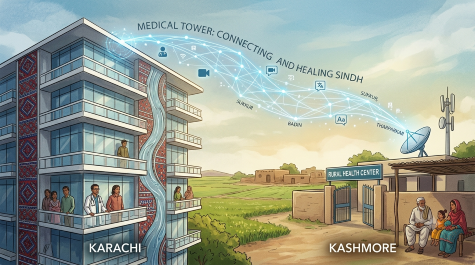
- The Medical Tower should serve as the central hub of a province-wide telemedicine network connecting district hospitals, taluka hospitals, and rural health centers with specialist doctors in Karachi.
By Nuzair Ahmed Jamro
A Timely Opportunity for Healthcare Reform
Healthcare is one of the most important public services provided by any government. It directly affects the quality of life, productivity, and well-being of citizens. A healthy population contributes to economic growth, educational attainment, and social stability. Therefore, investments in healthcare should not be viewed merely as expenditures but as investments in human development and the future of society.
Against this backdrop, the announcement by Sindh Health Minister Dr. Azra Fazal Pechuho that a master plan has been prepared for Civil Hospital Karachi is a highly encouraging development. Equally significant is the financial support being provided by philanthropist Faisal Edhi for the construction of a Medical Tower. Together, these initiatives present a rare opportunity to strengthen public healthcare services and modernize one of Pakistan’s most important healthcare institutions.
However, the true significance of the project lies not in the construction of a new building alone. Rather, it lies in how effectively this initiative can transform healthcare delivery across Sindh and improve access to quality medical services for millions of citizens.
Understanding the Current Reality
Before discussing the future potential of the Medical Tower, it is important to understand the healthcare challenges currently faced by Sindh.
Despite notable progress in recent years, significant disparities continue to exist between urban and rural healthcare facilities. While Karachi hosts some of the province’s largest hospitals and specialist centers, many district and taluka hospitals struggle with shortages of specialist doctors, modern diagnostic equipment, advanced laboratories, and critical care facilities.
As a result, thousands of patients from districts such as Shikarpur, Kashmore, Jacobabad, Ghotki, Sukkur, Khairpur, Dadu, Badin, Umerkot, and Tharparkar travel to Karachi every month seeking specialized treatment.
For many families, this journey is both financially and emotionally challenging. Travel expenses, accommodation costs, lost wages, and long waiting times often add to the burden of illness. Consequently, major hospitals in Karachi face overwhelming patient loads, overcrowded wards, and increasing pressure on healthcare professionals.
While doctors, nurses, and hospital staff continue to perform their duties with dedication, the demand for healthcare services often exceeds available resources. Therefore, expanding healthcare infrastructure has become a necessity rather than a choice.
Looking Beyond Infrastructure
Although the construction of the Medical Tower is a welcome initiative, healthcare experts worldwide agree that infrastructure alone cannot solve healthcare challenges.
A modern healthcare institution is not defined merely by its physical structure. Instead, its effectiveness depends on governance, management systems, technological integration, human resource development, and patient-centered service delivery. Therefore, the Medical Tower should be envisioned as much more than a hospital extension. It should become a center of excellence that combines specialized treatment, medical education, research, digital healthcare, and administrative innovation under one roof.
Such an approach would enable Sindh to move beyond traditional healthcare models and embrace a future-oriented system capable of meeting the needs of a growing population.
Learning from National and International Best Practices
Around the world, leading hospitals have successfully integrated technology and modern management practices into healthcare delivery. Countries such as Singapore, South Korea, the United Kingdom, and the United Arab Emirates have demonstrated how digital health systems can improve efficiency, reduce costs, and enhance patient outcomes.
Similarly, several provinces within Pakistan have introduced reforms aimed at improving healthcare services. Punjab has invested in specialized healthcare institutions and digital monitoring systems, while Khyber Pakhtunkhwa has expanded healthcare access through innovative policy initiatives.
Sindh now has an opportunity not only to follow these examples but also to establish its own model of healthcare excellence centered on technology, transparency, and inclusivity.
The Case for Digital Transformation
One of the most important reforms associated with the Medical Tower should be the introduction of a comprehensive Electronic Health Record (EHR) system.
At present, many public hospitals continue to rely heavily on paper-based records. This often leads to delays, duplication of tests, administrative inefficiencies, and difficulties in tracking patient histories.
By introducing a province-wide digital health record system, every citizen could have a unique electronic medical profile accessible to authorized healthcare providers throughout Sindh. Such a system would improve continuity of care, reduce unnecessary medical procedures, and enable faster clinical decision-making.
Furthermore, digital health records would provide policymakers with valuable data for healthcare planning, disease surveillance, and resource allocation.
Telemedicine: Connecting Karachi with Rural Sindh
While infrastructure development in Karachi is important, the ultimate goal should be to improve healthcare access throughout the province. This is where telemedicine can play a transformative role.
The Medical Tower should serve as the central hub of a province-wide telemedicine network connecting district hospitals, taluka hospitals, and rural health centers with specialist doctors in Karachi. Through secure digital platforms, patients in remote districts could consult specialists without travelling long distances. Likewise, local doctors could seek expert advice regarding complex cases.
Such a system would be particularly beneficial for residents of remote regions where specialist healthcare services remain limited. More importantly, it would reduce financial hardship for low-income families while improving access to timely medical care.
Strengthening Healthcare Governance
Infrastructure and technology alone cannot guarantee success. Strong governance remains equally important. Public hospitals often face challenges related to administrative delays, fragmented decision making, and limited accountability mechanisms. Therefore, the Medical Tower should be managed through a professional and autonomous governance structure.
An independent management board comprising healthcare experts, administrators, financial professionals, academics, and civil society representatives could provide strategic oversight and ensure transparent decision-making.
Such a model would reduce bureaucratic bottlenecks while promoting efficiency, accountability, and long-term sustainability. In addition, performance-based management systems should be introduced to evaluate service quality, operational efficiency, and patient satisfaction.
Establishing a Provincial Health Command Center
Another forward-looking reform would be the creation of a Provincial Health Command and Control Center linked with the Medical Tower.
This facility could monitor hospital performance indicators in real time, including patient admissions, emergency cases, bed occupancy rates, ambulance operations, medicine inventories, and disease outbreaks.
Access to real-time data would enable healthcare administrators and policymakers to respond more effectively to emerging challenges. It would also improve resource allocation and strengthen emergency preparedness. In an era where data-driven governance is becoming increasingly important, such a command center could significantly improve healthcare management across Sindh.
Artificial Intelligence and Smart Healthcare
Artificial intelligence is rapidly transforming healthcare systems worldwide. While the technology should be introduced carefully and responsibly, it offers significant opportunities for improving healthcare delivery.
AI-assisted systems can support medical imaging, disease screening, predictive analytics, patient risk assessment, and hospital resource management. For example, AI tools can help identify disease patterns, predict patient volumes, and support clinical decision-making. This does not replace healthcare professionals; rather, it enhances their ability to provide timely and accurate care.
By incorporating smart technologies into the Medical Tower, Sindh can position itself at the forefront of healthcare innovation in Pakistan.
Investing in Research and Human Capital
No healthcare system can succeed without investing in people. Therefore, the Medical Tower should include dedicated facilities for medical education, professional training, and research. Modern simulation laboratories, research centers, and continuous professional development programs can help improve the skills of doctors, nurses, pharmacists, and healthcare administrators.
Partnerships with universities, research institutions, and international organizations can further strengthen academic and scientific collaboration. In the long run, investments in human capital often generate greater returns than investments in physical infrastructure alone.
Why Rural Sindh Must Remain the Focus
Perhaps the most important question is this: Who will benefit from the Medical Tower? The answer should be simple: every citizen of Sindh. The success of the project should not be measured solely by the number of patients treated in Karachi. Instead, it should be assessed by its ability to improve healthcare access for people living in underserved and remote areas.
Imagine a farmer in Kashmore receiving specialist consultation through telemedicine, a teacher in Tharparkar accessing advanced diagnostic services through digital referrals, or a patient in Shikarpur obtaining timely treatment without making repeated visits to Karachi.
These are not unrealistic goals. They are achievable outcomes if technology, governance, and healthcare planning are effectively integrated. By connecting urban expertise with rural healthcare needs, the Medical Tower can become a bridge between opportunity and accessibility.
Economic and Social Benefits
The benefits of the Medical Tower extend far beyond healthcare. Large-scale healthcare investments create employment opportunities for doctors, nurses, researchers, pharmacists, engineers, information technology specialists, and support staff. They also stimulate economic activity through infrastructure development and service expansion.
Moreover, healthier populations contribute to greater workforce productivity, improved educational outcomes, and reduced poverty caused by healthcare expenses. Therefore, healthcare development should be viewed not only as a social necessity but also as an economic strategy.
The Road Ahead
The proposed Medical Tower at Civil Hospital Karachi represents a historic opportunity for Sindh. It offers the chance to modernize healthcare infrastructure, strengthen governance, embrace digital innovation, and expand healthcare access across the province.
Yet, the ultimate success of the project will depend on the vision that guides its implementation. If it remains merely a construction project, its impact will be limited. However, if it becomes the foundation of broader healthcare reform, its benefits can extend to every district and every community.
The challenge before policymakers is clear. They must ensure that the Medical Tower becomes more than a landmark building. It must become a symbol of a healthcare system that is efficient, transparent, technologically advanced, and accessible to all.
If that vision is realized, the Medical Tower will not simply serve Karachi. It will connect and heal Sindh from Karachi to Kashmore, from Tharparkar to Shikarpur, and from the largest cities to the most remote villages. That is the promise this project holds. More importantly, that is the promise the people of Sindh deserve.
Read: Keti Bandar: Reshaping Coastal Futures
_________________
 Hailing from Shikarpur, Nuzair Ahmed Jamro, is a Civil Servant and Research Fellow in Public Administration. He can be reached at: najamro@gmail.com