Urban Mining: Transforming Cities into Sustainable Resource Reservoirs
Urban mining represents one of the most promising innovations in sustainable resource management.
By: Ramesh Raja
The twenty-first century has witnessed unprecedented urbanization, industrial growth and technological advancement. As cities continue to expand, they consume enormous quantities of natural resources, including metals, minerals, fossil fuels, timber and construction materials. At the same time, these urban centers generate vast amounts of waste in the form of discarded electronics, demolished buildings, obsolete vehicles, industrial scrap and municipal solid waste. Traditionally, these discarded materials have been treated as garbage and disposed of in landfills. However, a new concept known as Urban Mining has emerged as a revolutionary approach that transforms waste into wealth by recovering valuable resources already embedded within cities.
Urban mining refers to the systematic recovery, recycling and reuse of valuable materials from urban waste streams and existing infrastructure instead of extracting them from natural mines. It recognizes cities as enormous repositories of metals, minerals, plastics, glass and other reusable materials. Rather than depending solely on conventional mining, societies can recover these resources from products that have already completed their useful lives.
Today, urban mining has become a cornerstone of the circular economy and is regarded as one of the most effective strategies for conserving natural resources, reducing environmental degradation, minimizing greenhouse gas emissions and promoting sustainable economic development.
Understanding the Concept of Urban Mining
The concept of urban mining originated from the realization that modern cities contain immense quantities of valuable materials accumulated over decades of industrialization and urban development. Buildings, roads, bridges, power transmission systems, communication network, household appliances and electronic devices collectively represent a vast stock of recoverable resources.
Read: What is urban mining – and why do we need to do more of it?
Unlike conventional mining, which requires excavation, blasting and processing of ore from the earth, urban mining extracts materials from existing products and infrastructure after they reach the end of their service life. Every demolished building, abandoned factory, obsolete mobile phone, worn-out battery or scrapped automobile becomes a potential source of valuable raw materials.
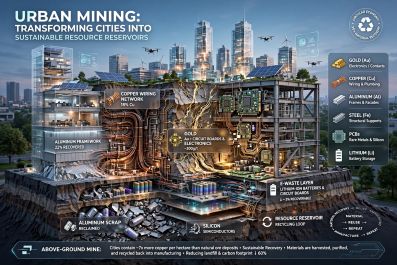
In simple terms, cities become “above-ground mines” where resources are recovered instead of discarded.
Historical Evolution
Recycling of metals has existed for centuries. Ancient civilizations melted old bronze and iron objects to manufacture new tools and weapons. However, the modern concept of urban mining gained prominence during the late twentieth century due to growing concerns over environmental degradation, depletion of natural resources and increasing volumes of electronic waste.
Japan was among the first countries to recognize that discarded electronic devices contained higher concentrations of precious metals than many natural ore deposits. Similar initiatives were later adopted across Europe, North America, South Korea and China. Today, urban mining has become an integral component of national resource management policies in many developed economies.
Sources of Urban Mining
Urban mining encompasses a wide range of waste streams and existing infrastructure. Major sources include:
- Electronic Waste
Electronic waste is one of the richest sources of valuable materials. Mobile phones, computers, televisions, printers, servers, routers and household appliances contain gold, silver, copper, palladium, platinum, rare earth elements, aluminum and high-quality plastics.
A single ton of discarded mobile phones may contain significantly more gold than a ton of gold ore extracted from conventional mines.
- Construction and Demolition Waste
Buildings, roads, bridges, tunnels, airports and industrial structures contain enormous quantities of steel, concrete, asphalt, copper wiring, aluminum, glass and timber. During renovation or demolition, these materials can be recovered and reused instead of being dumped in landfills.
Recycled concrete can be processed into aggregates for road construction, while reclaimed asphalt pavement can be incorporated into new pavement layers.
iii. End-of-Life Vehicles
Scrapped cars, buses, trucks, trains and aircraft contain recoverable steel, aluminum, copper, plastics, rubber, glass, batteries, and electronic components. Automobile recycling has become one of the largest urban mining industries worldwide.
- Industrial Waste
Manufacturing industries generate substantial quantities of metal scrap, chemical residues, plastic waste, packaging materials and reusable industrial by-products that can be reintroduced into production cycles.
- Municipal Solid Waste
Household waste contains recyclable paper, plastics, metals, glass, textiles, and organic matter suitable for composting or energy recovery.
- Utility Infrastructure
Old water supply systems, sewerage networks, power cables, railway tracks, pipelines, transformers, and communication cables contain valuable metals that can be recovered during replacement or rehabilitation.
Valuable Materials Recovered
Urban mining enables recovery of numerous valuable materials, including: Gold, Silver, Copper, Platinum, Palladium, Aluminum, Steel, Iron, Zinc, Lead, Lithium, Cobalt, Nickel, Rare earth elements, Plastics, Glass, Rubber, Concrete aggregates, Asphalt pavement materials, Timber and so many materials.
Many of these materials are classified as critical minerals essential for renewable energy systems, electric vehicles, semiconductors, telecommunications, aerospace industries, and advanced manufacturing.
Urban Mining and the Circular Economy
Urban mining forms the backbone of the circular economy, which seeks to eliminate waste by maintaining materials in productive use for as long as possible. Unlike the traditional linear economy of “take, make, use and dispose” the circular economy emphasizes reducing, reusing, repairing, refurbishing, remanufacturing and recycling.
By recovering resources from urban waste, urban mining decreases the demand for virgin raw materials while reducing environmental impacts associated with extraction, transportation and processing.
Environmental Benefits
Urban mining provides significant environmental advantages.
It reduces pressure on forests, mountains, rivers, and ecosystems by minimizing the need for new mining activities. It lowers greenhouse gas emissions because recycling metals generally consumes far less energy than extracting and refining virgin ores. It also decreases landfill volumes, reduces water pollution, minimizes hazardous waste and conserves biodiversity.
For example, recycling aluminum requires only a fraction of the energy needed to produce aluminum from bauxite ore.
Economic Benefits
Urban mining has become a major contributor to the global green economy.
It creates employment opportunities in waste collection, recycling, sorting, processing, manufacturing, logistics and research. Recovery of critical minerals reduces dependence on imported raw materials, improves industrial competitiveness and enhances national resource security.
Many countries now view urban mining as a strategic industry capable of generating billions of dollars annually while supporting sustainable industrial growth.
Technological Innovations
Rapid technological advancements have significantly improved urban mining.
Artificial intelligence, robotics, automated sorting systems, optical scanners, magnetic separators, hydrometallurgy, pyrometallurgy, bioleaching and advanced chemical recycling techniques have increased recovery rates while reducing environmental impacts.
Digital tracking systems and material passports are also helping identify recoverable materials within buildings and infrastructure before demolition.
Urban Mining in Civil Engineering
Urban mining has enormous implications for civil engineering and infrastructure development.
Construction and demolition waste can be transformed into valuable construction materials. Recycled concrete aggregates are increasingly used in road sub-bases, embankments and structural applications. Reclaimed asphalt pavement is widely incorporated into highway rehabilitation projects, reducing costs and conserving natural aggregates.
Steel recovered from demolished bridges and industrial structures can be recycled into new construction products. Copper, aluminum and utility components recovered during infrastructure modernization can also be reintroduced into manufacturing.
These practices reduce construction costs, conserve natural resources and improve environmental sustainability.
Global Examples
Several countries have become leaders in urban mining.
Japan has developed highly sophisticated electronic waste recycling systems capable of recovering precious metals with remarkable efficiency. The European Union has implemented comprehensive legislation promoting recycling and resource recovery through circular economy policies. Sweden, Germany, South Korea, and the Netherlands have invested heavily in advanced recycling technologies and sustainable waste management.
These countries demonstrate that urban mining can become an important pillar of national economic and environmental policy.
Challenges
Despite its tremendous potential, urban mining faces several challenges.
Informal waste collection often results in unsafe working conditions and environmental pollution. Lack of public awareness reduces recycling participation. Collection systems remain inadequate in many developing countries. Advanced recycling technologies require significant investment. Hazardous substances within electronic waste require careful handling. Weak regulatory frameworks and poor enforcement further limit resource recovery.
Addressing these challenges requires coordinated efforts among governments, industries, researchers, and the public.
Urban Mining in Pakistan
Pakistan possesses significant untapped urban mining potential.
Rapid urbanization, population growth and expanding consumption have generated increasing volumes of electronic waste, construction debris, vehicle scrap and industrial waste. Major cities such as Karachi, Lahore, Faisalabad, Islamabad, Rawalpindi, Hyderabad, Peshawar and Quetta contain vast quantities of recoverable resources.
The construction sector alone generates substantial amounts of recyclable concrete, asphalt, steel, bricks, and timber. Highway rehabilitation projects can utilize reclaimed asphalt pavement, recycled aggregates, and recovered steel, thereby reducing dependence on natural quarries and lowering project costs.
Pakistan can strengthen urban mining by establishing modern recycling facilities, introducing extended producer responsibility, improving waste segregation at source, formalizing the informal recycling sector, encouraging private investment and adopting international best practices.
These measures would reduce environmental pollution, conserve foreign exchange spent on imported metals, create employment opportunities and support sustainable industrial development.
Future Prospects
As the global demand for critical minerals continues to rise, urban mining will become increasingly important. Electric vehicles, renewable energy technologies, batteries, artificial intelligence and digital infrastructure require enormous quantities of strategic metals that are finite in nature.
Future cities are expected to be designed with recoverability in mind, allowing buildings, infrastructure and manufactured products to function as long-term material banks. Urban mining will therefore play a central role in climate action, resource security, sustainable infrastructure and green economic growth.
Conclusion
Urban mining represents one of the most promising innovations in sustainable resource management. By viewing cities as reservoirs of valuable materials rather than generators of waste, societies can simultaneously address resource scarcity, environmental degradation and economic development. Recovering metals, minerals, construction materials, and electronic components from existing urban assets reduces dependence on conventional mining while promoting a circular economy.
For developing countries such as Pakistan, urban mining offers an opportunity to transform waste into a strategic national resource. Through sound policies, technological investment, public awareness, and efficient recycling systems, urban mining can support cleaner cities, stronger industries, reduced imports, job creation and more sustainable infrastructure. In an era defined by finite natural resources and growing environmental challenges, urban mining is not merely an alternative to traditional mining but an essential pathway toward a resilient and sustainable future.
Read: From the Bypass to the Blueways
__________________
 Engr. Ramesh Raja is a civil engineer and managerial/ planning professional who also contributes as a freelance writer on technical matters. He may be reached at engineer.raja@gmail.com