Sindhi hospitality is a beautiful cultural tradition. We should protect it rather than allow it to become a burden.
By Abdullah Usman Morai | Sweden
Sindhi hospitality is undoubtedly rich, warm, and widely known. Perhaps one of the most beautiful things about Sindhi culture is the respect we give to our guests. Whether someone visits us in Sindh or meets a Sindhi outside Sindh, we generally try to make them feel welcome.
For us, a guest is not simply a visitor. A guest deserves respect, food, tea, conversation, and, if possible, a little extra care.
This tradition is something we should be proud of.
But like many good things in life, even hospitality can sometimes be misused.
There are people who understand the spirit of Sindhi mehmannawazi, and there are others who seem to understand only the benefits attached to it.
The difference between the two can be enormous.
When a guest becomes a full-time responsibility
A normal guest may say, “I am coming to your city. If you are free, let’s meet for tea or dinner.”
That is hospitality.
But the so-called guest may arrive with an entirely different philosophy:
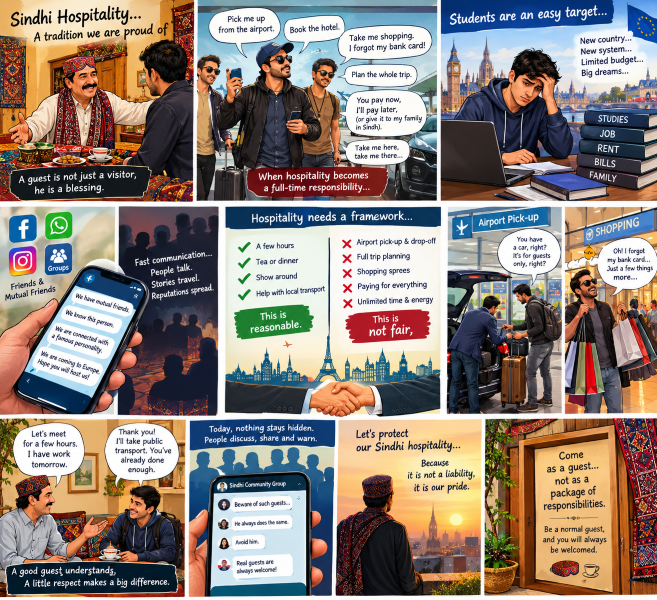
“Pick me up from the airport.” “Arrange the hotel.” “Plan the sightseeing.” “Take me shopping.” “Take me here.” “Take me there.” “Pay for this.” “Pay for that.”
And perhaps, after all this, comes the famous sentence:
“Don’t worry, I’ll pay you later.”
Sometimes “later” becomes a very distant country.
The problem becomes even more complicated when such expectations are placed on Sindhis living in Europe. Life here is not always as flexible as people imagine from a distance. People have jobs, studies, bills, family responsibilities, appointments, and countless small things that consume their time.
A person may genuinely want to meet a guest but may not be able to become a 24-hour tour guide, driver, financier, and personal assistant at the same time.
Students are an easy target
One particularly concerning trend is when students become the target of such expectations.
A student who has recently arrived in Europe is often in the early stages of building a life. He or she may be learning a new system, managing studies, working part-time, paying rent, understanding public transport, and trying to survive on a limited budget.
Then, suddenly, someone contacts the student through social media.
“Brother, we have mutual friends.” “We know this person.” “We are connected with that famous personality.” “We are coming to Europe. You will host us, won’t you?”
For a young student, particularly someone eager to build a social network, such introductions can sound impressive.
Sometimes the visitor may even suggest that having them as a guest will somehow increase the student’s social standing.
And slowly, the student finds himself trapped in a situation he never agreed to.
The guest has not merely come to meet him. The guest has apparently come with an entire project plan.
“You arrange everything; I will pay later”
One of the strangest demands I have come across is the expectation that the host should make the complete plan, arrange everything, and pay for everything.
When the host hesitates, the answer may be:
“Don’t worry. I will pay you when I get there.”
Or:
“I will give the money to your family in Sindh.”
This sounds simple until one asks a basic question:
Why should the person living in Europe finance the entire visit in the first place?
Hospitality means sharing what you have. It does not mean becoming someone’s unpaid travel agency.
And then there is the airport pick-up and drop-off.
In some cases, people seem to assume that if a Sindhi lives somewhere in Europe, his car automatically becomes a free taxi service.
The same can happen with shopping. Someone suddenly “forgets” their bank card. Then another purchase appears. Then another.
By the end of the day, the host may discover that the guest’s memory problem has become his own financial problem.
 Europe works differently
Perhaps one of the biggest misunderstandings is the difference between social life in Sindh and everyday life in Europe.
In Sindh, if someone arrives unexpectedly, people may rearrange their entire day for them. Someone can come to your house, sit for hours, have tea, lunch, or dinner, and nobody checks the clock every five minutes.
That warmth is beautiful.
But European life is generally more scheduled and practical.
Time matters.
A person may have to work from Monday to Friday. After work, there may be family responsibilities, shopping, appointments, household matters, studies, or simply the need to rest.
Even weekends are not necessarily empty.
For someone who has settled abroad, life may look comfortable from the outside, but that does not mean there are unlimited hours, money, or energy available for visitors.
Hospitality needs a framework
There is absolutely nothing wrong with a Sindhi living in Europe taking a few hours off to meet a visitor.
Have tea. Have lunch or dinner. Show them a few places. Take a walk. Help them understand the local transport system. Perhaps spend an afternoon together.
That is hospitality.
The important thing is that hospitality should remain within the host’s time, circumstances, and financial capacity.
A person should be able to say:
“I can meet you Saturday afternoon.” “I can take you for dinner.” “I can show you around for a few hours.” “I cannot pick you up from the airport because I am working.” “I cannot pay for your shopping.”
There should be no shame in saying these things. Hospitality is generosity, not surrender.
The real guests suffer too
Ironically, the biggest victims of these behaviors may eventually be genuine guests.
A decent guest understands the situation of the person hosting them. They know that the person has a job, family, commitments, and a life of their own.
Such a guest does not demand everything.
They appreciate whatever is offered.
They may say:
“Don’t worry, I can take public transport.” “You have work tomorrow; let’s meet another day.” “I’ll pay for my own meal.” “You’ve already done enough.”
These simple sentences can make a host feel respected.
But when some people repeatedly misuse hospitality, hosts may eventually become suspicious of everyone.
And then the genuine guest pays the price. A person who would otherwise happily meet a visitor may start thinking:
“Maybe this person also expects airport pick-up, shopping, accommodation and a full European tour.”
And the invitation that should have been warm becomes something people start avoiding.
The age of fast communication
There is another reality that cannot be ignored anymore.
Today, communication is extremely fast.
People are connected through Facebook, WhatsApp, Instagram, family networks, university groups, and mutual friends. Stories travel quickly.
People discuss their experiences. They share warnings. They tell each other who behaved respectfully and who did not.
There are even private groups and informal networks where people discuss such experiences and, unfortunately, individuals who are believed to have repeatedly taken advantage of hospitality.
In other words, the old idea that “nobody will know” no longer works very well.
People talk. People compare experiences. And reputations travel faster than ever.
A simple request
Sindhi hospitality is a beautiful cultural tradition. We should protect it rather than allow it to become a burden.
To those who visit Sindhis abroad, my humble request is simple:
Please come as a guest, not as a package of responsibilities.
Your host may happily give you a few hours, take you for tea or dinner, show you around, and help you understand the city.
But please understand that they also have a life.
They have work. They have studies. They have families. They have bills. They have tired days. And they have weekends that may already be full.
A little understanding can make hospitality beautiful for both sides. The world does not need fewer guests. It needs better guests.
And there is a very simple formula:
Be a normal guest, and you will always be welcomed.
But if hospitality is repeatedly treated as an unlimited service, people may eventually stop opening their doors not because they have forgotten their Sindhi culture, but because they are trying to protect it from being misused.
After all, a guest is a blessing when they bring warmth with them.
They become a burden only when they expect the host to carry everything.
Read: The Journey That Never Ends
___________
 Abdullah Soomro, penname Abdullah Usman Morai, hailing from Moro town of Sindh, province of Pakistan, is based in Stockholm Sweden. Currently he is working as Groundwater Engineer in Stockholm Sweden. He did BE (Agriculture) from Sindh Agriculture University Tando Jam and MSc water systems technology from KTH Stockholm Sweden as well as MSc Management from Stockholm University. Beside this he also did masters in journalism and economics from Shah Abdul Latif University Khairpur Mirs, Sindh. He is author of a travelogue book named ‘Musafatoon’. His second book is in process. He writes articles from time to time. A frequent traveler, he also does podcast on YouTube with channel name: VASJE Podcast.