AI Supremacy, China-US Rivalry and the Alleged Spy Game Behind a CEO’s Exit
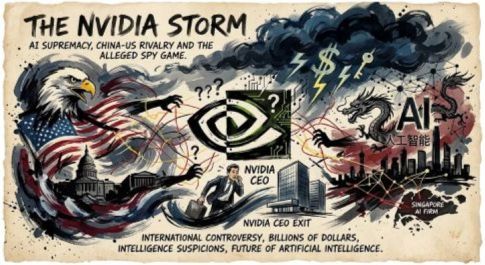
How a relationship involving one of the world’s most powerful technology leaders, a Chinese businesswoman and a Singapore-based AI company became an international controversy involving billions of dollars, intelligence suspicions and the future of artificial intelligence.
Ramesh Raja
Imagine a company whose computer chips power the artificial intelligence revolution. Its technology is used by leading AI companies, research institutions, governments and supercomputers around the world. Its market value runs into trillions of dollars. Now imagine that its founder and long-time chief executive becomes involved in a personal relationship with a Chinese businesswoman whose company has commercial links with this technology giant. Suddenly, the story moves beyond business and personal life into international politics, intelligence and national security. This is the extraordinary controversy surrounding NVIDIA, Jensen Huang, Alice Huang and Megaspeed International, unfolding in November 2026.
From a small company to the center of the AI revolution
NVIDIA was established on 5 April 1993 in the United States by three engineers: Jensen Huang, Chris Malachowsky and Curtis Priem. Its headquarters are in Santa Clara, California. Jensen Huang, born in Taiwan on 17 February 1963, became its President and CEO at the time of its foundation. He studied electrical engineering at Oregon State University and Stanford University and previously worked at AMD and LSI Logic.
NVIDIA initially developed graphics technology for video games. Its GeForce 256, introduced in 1999, helped establish the modern GPU industry. Over time, its powerful graphics processors became essential for scientific computing, supercomputers, robotics and artificial intelligence. Its advanced Blackwell B200 and GB200 systems are among the important platforms used for training and running large AI models.
By November 2026, NVIDIA had become one of the world’s largest corporations, with a market valuation in the trillions of dollars and total assets of hundreds of billions. It was competing with Apple and Microsoft for the top positions in global market value.
The US-China battle for artificial intelligence
To understand this controversy, we must first understand the competition between the United States and China. Both countries want to lead the world in artificial intelligence because AI is becoming as important as electricity, oil and military technology. America has an advantage in advanced computer chips, semiconductor design and companies such as NVIDIA. China, however, is developing its own AI companies and models, including DeepSeek, which has attracted attention for delivering competitive results with comparatively lower computing costs.
The most important NVIDIA products in this competition are its H100, H200 and Blackwell B200 processors. These are not ordinary computer chips. They can perform enormous numbers of calculations required to train advanced AI systems. Washington fears that access to the most powerful American chips could strengthen China’s military, intelligence and technological capabilities. Therefore, the United States introduced restrictions on advanced chip exports to China from October 2022 and tightened them several times afterwards. China, meanwhile, wants to reduce its dependence on American technology and develop its own semiconductor industry.
This is also a trade war, but it is bigger than buying and selling goods. It is a competition for technological supremacy, economic power, military advantage and global influence.
Alice Huang and the Singapore connection
The second important character is Alice Huang, also known as Huang Le. She is a Chinese businesswoman whose reported career began in television journalism and later moved into banking and investment management. According to corporate records reviewed by Reuters, she held senior positions at Shanghai Hexi Investment Management and had earlier worked with HSBC’s private bank in Hong Kong and CITIC Securities.
Her business journey brought her into Singapore’s technology industry. In March 2023, she became the controlling shareholder of Megaspeed International, a Singapore-based cloud-computing company. Megaspeed was originally established in 2015 as 7Road International and later changed its name. It developed a business providing access to powerful computer servers and NVIDIA processors for AI customers. NVIDIA listed Megaspeed as an official cloud partner in its Asia-Pacific network.
This partnership is important because a customer does not always need to own an expensive AI chip. It can rent computing power from a company that owns the servers. In this way, advanced chips located in one country can provide computing services to customers in another country.
Reports have also drawn attention to a figure of approximately US$4.8 billion in NVIDIA chip and server purchases associated with Megaspeed’s Malaysian business connections. Other reporting has discussed an alleged US$7.5 billion in chip shipments to Chinese customers. These are separate reported figures and should not be treated as independently established evidence of illegal exports. Reuters found that Megaspeed’s Indonesian subsidiary imported NVIDIA H100 processors and related equipment between 2024 and 2026, but those shipments alone did not establish a breach of American export restrictions.
The relationship, dinner photographs and the email
The third and most personal part of the story concerns Jensen Huang and Alice Huang. They are not related despite sharing the same surname. Photographs and reports placed them together at different events over more than two years. Reuters verified that the earliest photographs dated to December 2023. They were also seen together at technology gatherings in Taiwan in June 2024. One particularly discussed incident was a dinner in Taipei on 22 May 2025, at the San Liu Shi Fu restaurant, where video footage showed them together with other people.
The photographs became international news after the Financial Times reported on 6 November 2026 that they had a romantic relationship. On 8 November, Jensen Huang sent an email to NVIDIA employees acknowledging that he had been unfaithful to his wife. He apologized to his wife, children, colleagues, company board, business partners and shareholders. He accepted responsibility for his personal conduct and asked people to respect his family’s privacy.
Importantly, his email also addressed national security concerns. He said NVIDIA’s board had initiated an independent investigation and that he would cooperate fully. He expressed his commitment to protecting the company and supporting American national security. His email did not identify Alice Huang by name or admit that he had shared confidential information.
The intelligence angle: Was it a honey trap?
The story became much more serious when American media reported suspicions that Alice Huang might have been recruited by China’s Ministry of State Security to develop a relationship with Jensen Huang and gain access to sensitive business or strategic information. A classified intelligence memorandum reportedly prepared under Secretary of State Marco Rubio in spring 2026 was also discussed in media reports.
However, this is an allegation, not an established fact. Reuters has said it could not independently verify the espionage claims. On 12 November 2026, US Attorney General Todd Blanche stated that the Department of Justice had not reached a conclusion about whether Alice Huang was a Chinese spy. Beijing has also denied the allegations.
To understand the suspected method, we can examine a well-known intelligence concept called MICE. It stands for four possible ways of recruiting or influencing a person: (M – Money: Offering financial rewards; I – Ideology: Using political beliefs, loyalty or patriotism, C – Coercion: Using pressure, threats or compromising information and E – Ego: Exploiting personal pride, ambition, admiration or emotional needs).
One possible analytical interpretation is that money and ideology might be less effective against a very wealthy business leader with strong American national loyalties. Coercion and ego, through personal relationships and emotional influence, might offer different opportunities. But applying this theory to Jensen and Alice does not prove that an intelligence agency used any of these methods.
This brings us to the expressions honey trap and beauty trap. They describe the alleged use of romantic or intimate relationships to gain someone’s confidence, influence decisions or obtain information. A similar idea is found in the traditional Chinese collection known as the Thirty-Six Stratagems, particularly the strategy called the Beauty Trap. In modern language, the expression Romeo-Juliet spy operation is sometimes used for an intelligence operation involving a romantic relationship. These are possible interpretations of the reported events, not proven descriptions of Alice Huang’s conduct.
Weaponised interdependence: The bigger international game
There is an important international-relations concept called weaponised interdependence. It means that countries can use their control over important international networks as instruments of power. For example, America controls important semiconductor technologies, software platforms and financial networks. China has enormous manufacturing capacity, markets, supply chains and growing technological capabilities.
Both countries depend on international business networks, but they can also use this dependence to put pressure on each other. American export restrictions can limit China’s access to advanced NVIDIA chips. China can respond through its own technology policies, export controls and alternative products.
Megaspeed’s Singapore and Indonesian connections illustrate why this issue is complicated. A chip may be sold to a company in one country, installed in a data centre in another country and used remotely by customers somewhere else. The physical location of a chip and the nationality of its user are not necessarily the same. This creates difficult questions for governments trying to enforce export restrictions.
That is why this controversy is not simply about one woman, one company or one personal relationship. It concerns the control of the global AI supply chain.
Donald Trump, Elon Musk and the political dimension
Another important part of the story is its connection with American politics. President Donald Trump has maintained close relations with major technology leaders, including Elon Musk and Jensen Huang. Jensen Huang had also advocated maintaining access to the Chinese market because NVIDIA could lose a significant business opportunity if American companies were completely excluded.
The controversy has therefore created a difficult political question: should America protect its technology by restricting exports to China, even if American companies lose billions in potential business?
The Trump administration has faced pressure from Congress to strengthen restrictions. On 13 November, Reuters reported growing congressional support for limiting China’s access to advanced NVIDIA chips. The issue could influence American trade policy, diplomatic negotiations and future relations with Beijing.
The resignation and a new chapter at NVIDIA
On 12 November 2026, NVIDIA announced that Jensen Huang had resigned as President and CEO, ending his 33-year leadership of the company. The board appointed its long-serving Chief Financial Officer, Colette Kress, aged 59, as interim CEO. Harvey C. Jones became chairman of the board. The company also initiated an independent investigation into the national-security concerns.
Reuters subsequently reported that the board had appointed the law firm Wachtell, Lipton, Rosen and Katz to investigate aspects of the controversy. American lawmakers were also seeking answers, and reports indicated that Huang was expected to testify before Congress.
The resignation came after reports about his personal relationships and the possible security implications. However, it would be inaccurate to say that espionage has been proved or that the company has established that its technology was compromised.
What does this story teach us?
The NVIDIA controversy offers an important lesson about the changing nature of international power. In the past, countries competed mainly through armies, territory, oil, trade and military alliances. Today, advanced computer chips, artificial intelligence, data, technology companies and intelligence networks have become equally important.
A personal relationship can attract attention, a business partnership can create questions about technology transfers, and a commercial transaction can become a national-security issue. Concepts such as influence operations, psychological manipulation, honey traps and brainwashing help us understand possible intelligence methods, but they must not be used to declare someone guilty without evidence.
The central question is not simply whether Jensen Huang made a personal mistake or whether Alice Huang had an intelligence connection. The larger question is whether the world’s most valuable technology companies can protect their strategic knowledge while operating in a global business environment where America and China are competing for supremacy.
The real grand game is the struggle for control over the future of artificial intelligence. NVIDIA’s story shows that this competition is no longer confined to laboratories, factories and stock markets. It has entered the worlds of diplomacy, international business, personal relationships, intelligence and national security.
Read: AI Utopia: A World without Human Labor
_____________
 Hailing from Gambat town of Sindh, Engr. Ramesh Raja, is a Civil Engineer, visionary planner, PMP certified and literary enthusiast with a passion for art and recreation. He can be reached at engineer.raja@gmail.com