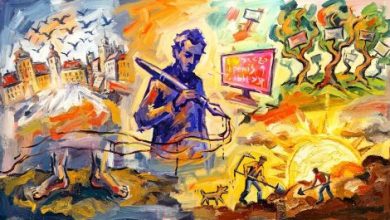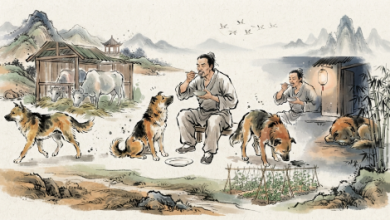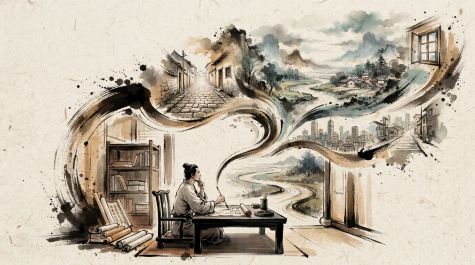
Language is the initial starting point of the creative process
Souad Khalil | Libya
When we speak of space, we must emphasize its importance in all forms of creative writing, whether theatrical, novelistic, or short fiction. Space has its own influence and leaves distinct impressions on a story or novel. Consequently, discussing the importance of space, its implications, and its various dimensions can be an extensive undertaking. There is, first, the experience of inhabiting a particular place and the impact this experience has on writing. When a writer recalls a place after a period of time, whether long or short, that place may sometimes be imagined even if it no longer exists; at other times, it remains vividly present in the writer’s mind and consciousness.
Space is the reference point that provides initial impressions and preliminary convictions about what Tzvetan Todorov calls the narrative text or the system within the narrative text, which contains meanings drawn from reality. The function of space is to provide a frame of reference where the processes of communication and reception converge. It is the starting point of creativity for the short-story writer or novelist. The creative individual’s suffering within their original reality is what drives them to break free from that reality and envision a new one. The relationship between the text and its referent will therefore become apparent according to the degree of suffering the creator experiences in their actual world.
Among the familiar sayings is the statement that there can be no history without geography, nor time without space. There are many such statements associated with scientific theories. In literature and the arts, however, particularly in narrative, there can be no storytelling without attention to space. Likewise, no narrative can exist without concern for an event, or a sequence of successive or intersecting events. This is the first lesson that a short-story writer becomes aware of, consciously or unconsciously, at the beginning of their work as a storyteller or novelist.
The acts of understanding performed by the recipient depend, first, on identifying similarities between the text and its referent, and then on identifying the features of difference that transform the fictional text from mere impressions of reality into a discourse that retains its principal features. As for the formation of these features, the relationship between the components of existence within the text, and the illumination of certain aspects of those components, these are questions of a purely creative nature.
We previously published an article on the importance of space in theatre. We now seek to demonstrate how space in narrative texts can sometimes become material that goes beyond realistic description. The writer transports us from one event to another, through sentences characterized by aesthetic qualities and artistic expression, transforming the place in which the events of a story or novel unfold into an essential element of its subject matter and the construction of its complete artistic image.
Perceiving space, contemplating it, and searching for the hidden relationships between things are among the writer’s tasks. Then come the individual abilities that distinguish one writer from another. Some writers possess the illuminating torch of art, casting light on things that the ordinary eye cannot see, so that seemingly simple objects appear as treasures overflowing with suggestive meanings.
The short-story writer Jamil Atiya Ibrahim, speaking about geography in literature, draws attention to a statement by Mohamed Hassanein Heikal, author of the novel Zaynab. In the introduction to one edition of the novel, Heikal explains that when writing its chapters in Switzerland or France, he would draw the curtains across the room’s windows so that he would not see the surrounding breathtaking scenery. He wanted to write about the Egyptian countryside. Here, the writer escapes from one geography in order to write about another geography that lives within him.
I will also offer a simple example: the writer Ibrahim al-Koni, who, despite living in Switzerland as well, writes about his desert environment in all his novels. In other words, he evokes the geography of the Tuareg and the desert, producing some of his finest literary works. If we were to discuss the geography of place in greater detail, the discussion would be lengthy, and examples abound among writers with distinguished literary histories and renowned names.
Let us return to Todorov, who argues that the system of discourse can be described as a collection of meanings that originate from their referent and then generate other meanings that extend beyond that original reference. Thus, from the familiar meanings of a place emerge new meanings, transforming it into another place.
The space produced by the self through the blending of objective reality and creative imagination becomes a means of activating the spirit of the text and communicating it to the recipient, that is, the reader. We may therefore argue that such a process becomes effective only when it produces a creative text capable of generating creative meanings. If the text fails to produce such semantic suggestions, then the transfer of real space into the realm of imagination, and its fusion with that imagination, amounts to nothing more than daydreaming or vague fantasies that reflect only a retreat from the world of the self, or an escape into another world in order to avoid the burdens of the tangible one.
Geographical space is perceived in general terms as an expanse with a particular configuration and geometry. At the creative level, however, space acquires aesthetic and intellectual values. In other words, it becomes a space employed according to a particular perspective, thereby entering the realm of assumption and imagination and moving from a real topography to an imagined one.
As we know, language is the initial starting point of the creative process. It has become clear that there is a group of media and instruments—language as a structure, the book, the page, and others—that can themselves be creatively manipulated, thus becoming artistic tools. What, then, are the particular characteristics and distinguishing features of space as a living, dynamic entity within language and literature, while taking into account the historical and cultural conditions that shape its extensions?
In this regard, Professor Abdelghani Fawzi Ibrahim identifies several points. The first concerns space in language. Literature, in its primary material, is language that presents us with a set of means through which it communicates with others. These means include writing, the page, and the book, as mentioned earlier. All of them derive their geometric significance from original physical space. In literature, however, these elements are charged with artistic energy that permeates every aspect of the creative material, thereby transforming them into tools that the creator can manipulate.
What we seek to establish through this brief discussion is the need to examine the different aspects of the creative text, which some regard as a closed structure, thereby restricting its natural extensions.
Thus, when space manifests itself through language by means of verbal positioning, some consider it subject to the text as vocabulary and structure. If space presents itself as an extension or a sequence, language, through the continuity and progression it makes possible, provides a means of grasping that space through successive moments of reading and through sequences of words and linguistic expressions.
It is clear that language possesses several means through which it reflects the cognitive patterns within which the human mind operates. Space itself is neither divided nor framed; what makes it possible to grasp is a set of self-evident assumptions that frame our vision and perception. These assumptions take the form of descriptive expressions bearing the characteristics of a particular place. Language, therefore, encodes a body of information about space, while the lexicon provides us with meanings that connect us to the material origins of place.
When we speak of space in literature, we recognize its paramount importance as one of the fundamental components of any creative work. The creator employs this element not merely as an area in which events take place, but as a space imbued with sensitivity and symbolism.
Literary works often draw us in through the names and types of their places, which, through their historical and cultural associations, refer to specific landmarks and features. This prompts an important question: Does the creator deal with space as a real place or as an imagined one? The answer may reveal methodological problems concerning the way space is presented—whether as real, symbolic, or imagined. This results from differences in theoretical perspectives and procedural concepts.
The adjectives attached to space are also linked to the diversity of the fields of knowledge in which it is employed. Space has consequently become a prominent concept in both the exact and human sciences. In literature, therefore, the concept of space extends beyond the geographical study of boundaries, natural environments, and physical territories, as understood by geographers, or the personal and social spaces examined in psychology. When space is introduced into literature, it may constitute a multifaceted whole, reflecting the diversity of the literary work itself. A particular aspect of the work may then be emphasized and used as the basis for interpreting the creative text in its entirety.
According to this definition, space is neither an independent framework nor merely a stage. Rather, it is intertwined with the human being as an integral dimension of existence. Presenting a place, portraying its elements, circumstances, and details, therefore amounts to presenting the human being who is rooted in it, both physically and in terms of values.
Since places are multiple and diverse, depending on the perspectives from which they are viewed, they provide an entry point for understanding different human models and experiences. The exchange between mental and spatial images has consequently produced an interweaving and interconnectedness between human beings and place, making it difficult to separate one from the other.
Space thus becomes a natural extension of the character. The character’s activities and transformations take place through space, not merely within it. In keeping with this idea, when space enters a literary text, it offers an organization and formulation of the world, based on a spatial structure.
One of the characteristics of space in a creative work is that it is finite, while imitating an object in the external world that is infinite. This requires transforming that infinite object into systems or patterns, of which visual characteristics may constitute one of the original features.
In his book The Structure of the Artistic Text, the critic and researcher Yuri Lotman examines the structure of space in language first. Starting from this idea, he approaches it from the perspective of its relationship with culture, focusing on the question: How does culture employ spatial dimensions to signify other things?
Language, through spatial relationships, creates a model of culture. Words such as right, left, above, below, upper, and lower, which originally indicate spatial directions, are charged by the speaker, within the context of discourse, with different meanings. Accordingly, these previously mentioned oppositions acquire new meanings within religious, ethical, and political systems. Thus, one may speak of an upper class and a lower class on the basis of a particular ideological model, or of someone as broad-minded or narrow-minded within an ethical framework.
We may conclude, with this researcher, that such words become concepts used as building blocks in cultural models. These concepts acquire linguistic systems as their foundation, around which an image of the world is organized. This image constitutes an intellectual system associated with a particular cultural pattern.
From this perspective, the artist or writer employs language as a primary model, carrying within it the heritage of their culture—the secondary model. In this way, space acquires or embodies values that produce organization and structure, and a literary text may present a distinctive system for organizing the world.
In this study, Professor Abdelghani Fawzi Ibrahim defines space through the parallel relationship between the self and the world, that is, between place and one’s vision of the world. He states that the self carries states of inner depth that correspond precisely to the vastness of space. If the world is large and expansive, the inner self reflects this through layers of feeling.
Thus, interaction with different types of places has generated symbolic values associated with their landscapes, ranging from the room to the open wilderness. These spaces produce oppositions and contrasts, not only in terms of the characteristics of the people who inhabit them, but also in the ways they experience and perceive the world.
Space consequently appears as a natural extension of the character. This approach is reflected, in one of its aspects, in the work of Gaston Bachelard, particularly in his book The Poetics of Space, in which he establishes correspondences and distinctions between the different types of spaces in which human beings live and through which they experience existence.
The contrast and division between places ultimately lead to a dialectical opposition between two poles: inside and outside. This is not merely the basis of literary debate, but also of philosophical discussion. Perhaps this is what sometimes leads those who discuss the nature of things and their details to question their very essence.
The dialectic of inside and outside generates several other dialectics, taking different forms related to lived experience and what is carried within the self. These may be identified through the dialectics of houses and expansiveness, the small and the large, and the closed and the open.
Accordingly, human life, which necessarily exists in a state of balance between the self and the world, generates a diverse symbolic dimension, just as the meanings carried by space are themselves diverse.
The house, for example, is a place of intimacy and a secret means of shaping the personality of its inhabitant. From this starting point, the individual can construct images and perceptions of humanity and the homeland, beginning from within the self—the heart and the organs.
If the house protects us from fragmentation, as Bachelard puts it, the human personality, through its inner depths, likewise protects the many formations of thought and feeling—such as those associated with the homeland and humanity—from fragmentation.
Thus, the vastness of external space is matched by the depth of internal space. The human being thereby embodies a zone through which a unique and new space opens onto the world.
If we consider space and time together, we may assume that every human practice is situated within space and time, so that its course can be defined, its events rationally organized, and its direction oriented towards the future.
According to Mikhail Bakhtin, space cannot be separated from time. We must therefore discuss what Bakhtin calls the chronotope, or time-space. Among other things, this concept refers to the interweaving of spatiotemporal relationships. What, then, are the characteristics of this unified whole that Bakhtin identifies in literature?
The concept of the chronotope first appeared in purely scientific fields, such as mathematics and physics. Bakhtin, however, introduced it into literary history, giving it a different and distinctive significance within another field.
Within this unified entity known as the chronotope, time becomes another aspect of space. Through this interrelationship, the features of each are revealed within the other. What, then, are the characteristics of the chronotope in literature?
Bakhtin begins his investigation into the characteristics of the chronotope in literature by examining the novel. He considers the chronotope in relation to content, thereby revealing its various meanings, which can be outlined as follows:
The chronotope organizes the different events contained within the subject matter, frames objects, and gives them conceptual significance. On this basis, different types of novels can be distinguished. In this context, Bakhtin presents several chronotopes, including the chronotope of encounter, which is associated with the chronotopes of the road; the chronotope of castles and salons; and the chronotope of the threshold.
To conclude this study on the importance of space in literary creativity, whether in short stories, novels, or theatre, we find ourselves confronted with an accumulation of knowledge and methodology that defines this concept and seeks to establish it as a methodological framework.
This has necessitated classifying that accumulated knowledge into different fields of understanding and, consequently, becoming aware of the problematic nature of the concept itself. This, in turn, requires the methodological awareness that accompanies such an inquiry. It is what has prompted us to investigate the distinguishing features that shape space as a living and dynamic entity within language, literature, and culture.
In concluding his important study on the nature and meanings of space, Abdelghani Fawzi Ibrahim states that the identity of place and human beings derives from the cultural roots to which that place belongs. These roots alone are what elevate it from a geographical location to a level of symbolic and intellectual meanings. Dialogue between human beings and place is therefore built upon the foundations of history, culture, and society.
In conclusion, space occupies a special position in the narrative arts of all writers.
(Part of a study by Abdelghani Fawzi – Al-Rafid Magazine, Issue No. 163)
Read: Aesthetics and Nature of the Literary Text
____________
 Souad Khalil, hailing from Benghazi Libya, is a writer, poet, and translator. She has been writing on culture, literature and other general topics.