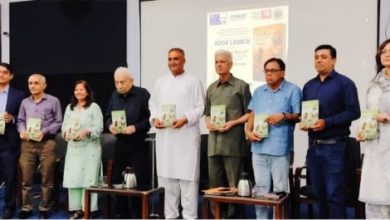
Through this award-winning novel, the author has attempted to illuminate a lesser-known chapter of Meerabai’s life
[From childhood, the author’s deep fascination with Meerabai’s songs led them to visit Meerabai’s birthplace, Kurki village, in 2012. Located 80 kilometers from Ajmer, Merta is a small settlement that the author also visited in pursuit of their novel. Even today, Meerabai’s birthplace in Kurki remains intact. Upon arriving in Kurki, the author met an elderly man, Maun Singh Rathore. The old man informed the author that there are nine forts between Jodhpur and Kurki, with the Kurki Fort being the most significant. That day, sitting in a corner of the fort, the elderly man began singing, “Kurki tera kotra nai khuti ki naak.”
The author strongly believes that before writing about any historical figure or a significant historical chapter, it is essential to visit the places associated with them. This is because, for generations, local people have preserved countless stories and legends about these historical figures or events. Within these oral traditions, the true history is often hidden, passed down through generations by the ancestors of the local people. Before writing about Meerabai, the author traveled to all the places associated with her and spent long hours conversing with the locals.
While researching Chaitanya’s disappearance, the author uncovered many mysterious aspects of Meerabai’s life. Beneath the exterior of a Vaishnav saint, a different side of Meerabai emerged—a woman with a keen political vision. This Meerabai was not only an extraordinary saint-queen with remarkable political insight but also a social reformer. From childhood, while residing inside the royal palace, she established the “Meerapanthi” community, which remains active even after 500 years. Under Meerabai’s leadership, this community played a crucial role in women’s empowerment and strongly opposed the practice of Sati. Even today, in Kurki village, many stories and legends about the Meerapanthis are passed down orally.
The author relied on information gathered from the residents of Kurki and Merta, as well as various books, to begin writing this novel. Merta was the capital of Meerabai’s grandfather, Rao Dudaji. After Meerabai’s mother passed away, Rao Dudaji brought her to Merta. The author personally witnessed the ruins of the Merta fort, which Rao Dudaji had built. A part of the fort still stands beside a vast lake, where, according to local accounts, pink lotus flowers bloomed 500 years ago, just as they do today. Standing amidst the ruins of Merta Fort, gazing at the lake, the author felt as though they were witnessing scenes from the past unfold before their eyes. The remnants of the fort can still be found scattered over a vast area.
At the heart of Merta, a palace remains preserved under the Rajasthan government’s care. Local belief suggests that Meerabai lived in this palace. In one corner of the palace, the Chaturbhuj temple still stands as a witness to 500 years of history. It is said that both Meerabai and Rao Dudaji worshipped here. Even today, the same idol of Chaturbhuj is worshipped in this temple. A statue of Meerabai has also been installed in one corner of the temple, inscribed with her birth year as 1561 Samvat (1504 AD), her marriage year as 1573 Samvat (1516 AD), and her death year as 1607 Samvat (1550 AD). A memorial dedicated to Meerabai in Merta also bears the same inscription regarding her birth and death. This suggests that she passed away at the age of just 46.
Through this novel, the author has attempted to illuminate a lesser-known chapter of Meerabai’s life. At the end of this 46-year-long journey, they have also sought to unravel some of the mysteries surrounding Meerabai’s disappearance. After 500 years, it is incredibly difficult to make definitive claims. However, through a logical approach, the author has strived to arrive at a plausible conclusion.]
Meera
By Debasree Chakraborti
Location: Chittorgarh
A loud whistle was heard, and then, as the sound began weaving into a growing hum, the train slowly pulled out of the station and disappeared into the darkness. Unlike other stations, this one felt particularly dark and silent. As she stepped off the train, a biting cold pierced her. She was the only passenger disembarking, and standing there alone didn’t feel safe. If she had known earlier that the train would be delayed by three hours and she’d be the only one getting off at this station, she would have taken the early morning train. But, caught in a mysterious trance, she had made a misstep — now there was no use regretting it. So, with two bags slung over her shoulders, she started walking forward.
 The further she went, the more the fog seemed to engulf her. In the yellow glow of the lampposts, the atmosphere appeared almost mysterious. A familiar tune floated into her ears, one that seemed to write the narrative of an unknown chapter deep in her mind. She could hear:
“Umr ghumar chahu disi se aaya,
Daman damak jhar laawan ki.”
The song was coming from far away, sung by a woman playing an ektara in a tone of separation and longing. Enchanted by the melody, she stood still, forgetting for a moment that standing alone in such a desolate place at night wasn’t safe. In these regions, women are fewer in number. But some people, like the tune of the ektara, are naturally rebellious. They drift freely, without restraint. Just as her consciousness was floating into the distance, imagining a door of a fortress in the far-off dark, a peacock suddenly flapped its wings with a harsh cry and flew away.
The woman regained her awareness and found an old man with a red turban standing in front of her. The two stood silently for a few moments — moments that seemed to rotate the wheel of time—past, present, and future—by a few degrees. Then the old man spoke,
“Madam, I’ve been calling out to you for a while. Can’t you hear me?”
She was startled, as returning to the real world from a day of drifting in a dreamlike state took a moment. The gate between her imagination and reality, which she always kept closed, now shook under the weight of the old man’s words. She nodded and said, “I need to go to Hotel Padmini Palace. Can I get transport this late?”
The old man replied, “I have my own tonga (horse cart). At this hour, you won’t find any other transport. Give me a hundred rupees, and I’ll take you there.”
She thought to herself — even if he had asked for a hundred or two, she wouldn’t have minded. Safety is priceless.
Taking her two bags, the old man walked ahead while she followed at a short distance. As they exited the station, she turned back once. Amidst the white fog and half-lit shadows, she saw the yellow signboard that read “Chittorgarh” in bold letters. A peacock sat on top of the board and upon seeing her, it spread its wings and let out a sharp cry.
The area outside the station was eerily still. There wasn’t a soul in sight. A camel lay in the distance. The combination of light mist and scattered light created an atmosphere full of thrill. It felt as though she was stepping into the first threshold of a great mystery, and it stirred her inner energy even more. On the side of the tonga, it read “Kashiram’s Tonga.” They proceeded toward Hotel Padmini Palace. She took out her phone and saw that it was 2 AM. The clatter of the horse’s hooves combined with the rhythmic tinkling of small bells created a strange harmony. All the houses around were asleep. In the distance, lights twinkled atop the hill. Kashiram said, “Madam, do you see those lights in the distance? Those are the lights of the fort. At night, they seem like they’re performing the Jauhar ritual.”
She leaned over to get a better look. Yes, indeed—the lights were burning in a straight line. But from a distance, it looked like a woman in sorrow lighting lamps, waiting for someone. A soft, melancholic tune floated from that direction:
“Umr ghumar chahu disi se aayo,
Daman damak jhar laawan ki.”
Accompanied by the sound of the horse’s hooves and the jingling bells, the traveler finally arrived at Padmini Palace.
She had already booked the hotel online, so there was no hassle. No one usually arrives this late, so the manager had to be woken up. He came and asked, “Under what name is the booking?”
She said, “Saanjh Gupta. I’ve booked for three days.”
The fact that this woman had come alone at this late hour, and the unusual firmness in her voice, made the manager raise his head and take a good look at her. She had the serenity of twilight and a mysterious gaze — the kind one cannot look at for too long.
The manager said, “You were supposed to arrive in the evening!”
She didn’t like to talk too much. She had a booking — that was the important part. When she arrived was her personal matter. She didn’t owe anyone an explanation. She remained silent.
There was something striking in her eyes and expression. The manager thought it best not to say anything further and handed her a large form.
After completing all formalities, Saanjh was taken to room number 405. This hotel could rival any haveli (mansion) in Rajasthan. The walls, furnishings, doors, and windows — everything was decorated in a traditional style. The door was plated with brass and had large bolts fitted. As soon as she stepped into the room, she saw a grand Rajasthani bed and, on the wall above it, the image of a female ascetic holding an ektara, her eyes half closed in deep devotion. Everything in the room seemed to reflect the aura of an ancient fortress.
A hotel staff member had accompanied her. Before leaving, he paused and asked, “Madam, do you need anything else?”
 She hadn’t eaten properly all day and was quite hungry. But eating heavy food so late could cause stomach issues. Considering everything, she replied, “Please bring me a bowl of veg soup, two plain breads, and a bottle of cold water. That would be great.”
After the staff left, she stood by the window. It was closed, so she couldn’t see outside. But the small lights in the garden seemed to carry messages from the past — each like a character with its own tale. These tales of joy and sorrow flowed into Saanjh’s mind, preparing the ground for an unwritten screenplay.
She sat on the sofa beside the window, her gaze fixed on the wall painting of the ascetic — the one she had come to Chittor to learn about. From childhood, Saanjh had nurtured a deep curiosity about her. That character now seemed to want to reveal her unknown story to Saanjh through subtle signs. But how would she proceed? How far could she go alone on this path?
Just then, a knock came at the door. The staff had closed it behind him earlier. Saanjh called out, “Come in, the door is open.”
Steam rose from the soup. On the side plate were slices of lightly buttered bread. Opening the cold water bottle, Saanjh said, “Tomorrow, I want to visit the fort. Please arrange a vehicle and a guide.” (Continues)
__________________
 Debasree Chakraborti is a renowned novel writer of Bengali language. Based in Kolkata, West Bengal, India, she has done Master’s in Modern History from the Kolkata University, and authored some thirty books, mostly the novels, with historical perspective and themes. Her novel is ‘Maharaja Dahir’ that covers the history of Sindh from 662, the year of first attack on Sindh by the Arab armies till date, was published last year and translated by Nasir Aijaz into Sindhi language.