It is the distant landscape, held and shaped
by the tree and the river, that is beautiful.
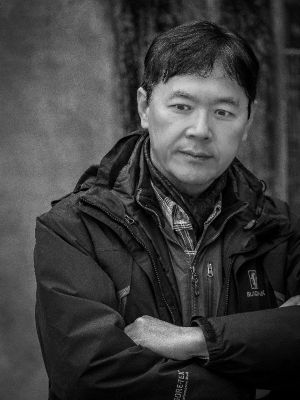 Poet Hyo-hwan was born in Jeonju, Jeollabuk-do, South Korea, in 1967, and grew up in Seoul. He graduated from the Department of Korean Language and Literature at Konkuk University and earned his doctoral degree in Korean Language and Literature from Korea University. He began his literary career in 1996 by publishing the poem “The Cat in the Mural 3” in Segye Ilbo, followed in 2002 by “Suraksan” and five other poems in Sipyong. Combining poetic creation with literary scholarship, Kwak Hyo-hwan has pursued a narrative lyricism grounded in socio-historical imagination through delicate language and profound reflection. He has taught at Korea University, Kyonggi University, and Hanyang University. He served as Executive Director of the Daesan Foundation and later as President of the Literature Translation Institute of Korea, and is currently a professor at Kyungnam University. He participated in organizing major international literary events such as the Seoul International Literary Forum and the East Asian Literature Forum. He has also worked as editor of Daesan Munhwa and as a member of the editorial boards of Munhak Namu and Uri Munhwa. His poetry collections include The Indio Woman (2006), The House Not Found on a Map (2010), The Frame of Sorrow (2014), You Are (2018), and The One Who Wept Silently and Passed Away (2023). His scholarly and critical works include Northern Consciousness in Modern Korean Poetry (2008) and You Entered Too Deeply into Me (a poetry commentary, 2014). He has also edited and co-edited numerous volumes, including Father, I Long for You (2009), Poetry and Poetics of Gubo Park Tae-won (2011), Selected Poems of Lee Yong-ak (2012), Because Poor I Love the Beautiful Natasha (2012), The Complete Works of Lee Yong-ak (2015, co-edited), Cheongnokjip: A Poetry and Art Collection Commemorating the 70th Anniversary of Cheongnokjip (2016), and Counting the Stars at Night: A Poetry and Art Collection Commemorating the 100th Birth Anniversary of Yun Dong-ju (2017). In addition, he has published numerous collaborative poetry collections, co-authored and edited books, and many academic papers. His poetry collection The Frame of Sorrow was translated and published in Mongolian, while You Are was translated into French. He has received numerous literary awards, including the Korea University New Writer’s Award, the Aeji Literary Award, the Pyeonun Literary Award, the Yusim Literary Award, the Kim Dal-jin Literary Award, and the Youngrang Poetry Award.
Distant Landscape
A tree that has lived for centuries
does not know where the branches of its body will reach.
Nor does a river flow for thousands of years
know where its waters will open a path, or to what place they will finally run.
Where the branches extend,
where the waterways are born—
these things do not truly matter.
What matters is that green rises on every branch,
that blossoms break into full bloom,
that wherever the waters arrive, life begins to stir.
It is the distant landscape, held and shaped
by the tree and the river, that is beautiful.
Nor do I know how I myself will stretch outward,
or to what place I shall arrive.
so, I will not rush to foresee the landscape they may someday shape.
먼 풍경
수백 년을 살아온 나무는
제 몸의 가지가 어디로 뻗을지 알지 못한다
수천 년을 흐르는 강 또한
물길이 어디로 나고 어디로 흘러갈지 모른다
가지가 어디로 뻗든
물길이 어디로 나든
그것은 중요하지 않다
가지마다 초록이 오르고 꽃이 만개하고
물길 닿는 곳마다 생명이 움트는
나무와 강이 품고 빚어내는
먼 풍경이 아름다운 것이다
나도 내가 어떻게 뻗어 어디로 가게 될지 모른다
하여 그것들이 빚어낼 훗날의 풍경 또한
서둘러 예단하지 않으련다
____________________