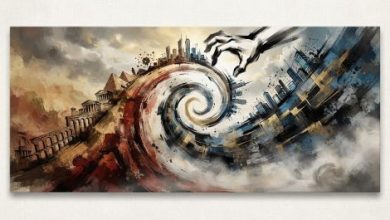
“No” becomes the language of psychological economy: conserve energy, reduce risk, avoid loss. Yet civilizations do not advance on conservation alone.
By: Raphic Burdo
In a small workshop near the edge of a quiet town, an old carpenter once built a door that would not open. It was not defective in the usual sense. The wood was strong, the frame precise, the lock functional. Yet every time it was installed, it behaved like a wall. Visitors would push, hesitate, and eventually turn away, assuming it was meant to remain shut. The carpenter observed this without surprise. The problem, he said, was not the door. It was the hinge.
A door does not become a passage by virtue of its material. It becomes a passage because of a small, almost invisible mechanism that determines whether it yields or resists movement. Without the hinge, the most elegant structure is only a barrier disguised as possibility. Human lives operate on a similar architecture. Two people may possess the same intelligence, education, or opportunity. One moves through life as though doors are openings. The other experiences the same world as a sequence of sealed barriers. The difference is rarely external. It is a mental hinge.
Some minds are “No”-hinged: they pivot quickly toward limitation, risk, and closure. Others are “Yes”-hinged: they acknowledge constraint but orient themselves toward possibility. Civilization itself appears to advance through the accumulation of such “Yes” moments, when individuals refused to accept the apparent finality of impossibility. Human beings are not naturally engineered for boldness. They are engineered for survival. For most of evolutionary history, caution was not a personality trait but a biological necessity. A rustle in the grass might have been wind, or a predator. Those who assumed danger survived more often than those who assumed opportunity.
Modern behavioral science confirms this inherited asymmetry. Daniel Kahneman, describing cognitive bias in decision-making, famously observed: “Losses loom larger than gains.” The emotional weight of losing something is typically stronger than the pleasure of gaining something of equal value. This imbalance produces a structural bias toward avoidance. When applied to life decisions, the consequences are profound. A potential entrepreneur sees not just opportunity but bankruptcy. A researcher sees not discovery but wasted years. A writer sees not creation but rejection.
William James captured a deeper layer of this mechanism when he wrote: “Believe that life is worth living, and your belief will help create the fact.” Belief is not passive. It actively shapes perception and behavior. If one believes outcomes are predetermined by risk, action diminishes before it begins. Viktor Frankl, reflecting on human behavior under extreme suffering, observed that even when external conditions are fixed, internal orientation is not: “Everything can be taken from a man but one thing: the last of human freedoms—to choose one’s attitude.” In environments of constraint, attitude becomes the hinge itself. Layered on top of evolutionary fear is another cognitive trap: status quo bias. Humans tend to prefer existing conditions even when alternatives are objectively better. Change is experienced not as opportunity but as disruption. Finally, there is learned helplessness. Repeated exposure to failure or lack of control conditions individuals to stop trying. The absence of results is misinterpreted as absence of possibility. The result of these combined forces is predictable. Most people, when confronted with uncertainty, default to “No.” Not because they are incapable, but because their mental system prioritizes safety over expansion.
“No” becomes the language of psychological economy: conserve energy, reduce risk, avoid loss. Yet civilizations do not advance on conservation alone. If “No” is the language of survival, “Yes” is the language of creation. Psychologically, “Yes” does not mean naïveté. It means agency, the belief that action matters. Carol Dweck’s research on mindset distinguishes between fixed and growth orientations. A fixed mindset assumes ability is static. A growth mindset assumes it can be developed. The latter does not deny limitation; it treats limitation as material to work with rather than final judgment. Angela Duckworth, studying long-term achievement, identified “grit” as a combination of passion and sustained effort. In her framework, persistence is not emotional intensity but directional endurance. Nassim Nicholas Taleb extends this further with the concept of antifragility: systems that do not merely withstand stress but improve because of it. In such systems, uncertainty is not an enemy but a training mechanism. Within this framework, “Yes” is not agreement. It is engagement. A “Yes”-hinged individual does not say, “This will work.” They say, “Let us find out what would make this work.” This shift transforms uncertainty from threat into laboratory.
Consider a simple contrast:
- The “No”-hinged investor sees volatility as danger.
- The “Yes”-hinged investor sees volatility as information.
- The “No”-hinged employee sees constraints as blockage.
- The “Yes”-hinged employee sees constraints as design parameters.
- The “No”-hinged thinker asks, “Why is this impossible?”
- The “Yes”-hinged thinker asks, “What conditions would make it possible?”
Over time, this orientation compounds. Small experiments accumulate into expertise. Small risks accumulate into knowledge. Small attempts accumulate into breakthroughs. As Goethe reportedly observed: “Whatever you can do, or dream you can, begin it. Boldness has genius, power, and magic in it.” The emphasis is not on success, but on initiation. The critical point is that “Yes” does not eliminate risk. It repositions it. Risk becomes something to be understood, managed, and sometimes embraced. This is why innovation clusters around “Yes”-hinged minds: they are willing to enter domains where outcomes are not yet known.
Civilization can be read as a sequence of refusals to accept finality. The Wright brothers faced widespread skepticism in the early 20th century. Many experts believed powered flight was impossible. Yet they approached the problem as engineers rather than skeptics, asking not whether flight could happen, but how control could be achieved in the air. Marie Curie entered scientific territory that was poorly understood and physically dangerous. Her work with radiation required not only intellectual curiosity but willingness to inhabit uncertainty. Her persistence redefined physics and medicine. Abraham Lincoln operated in a political environment fractured by civil war. His leadership was not the absence of doubt but the discipline of decision under extreme ambiguity. His famous words during crisis capture the ethos of possibility under pressure: “The best way to predict the future is to create it.”
Steve Jobs, reflecting on innovation, emphasized selective acceptance of possibility. His philosophy was not openness to everything, but focus on what mattered. The idea that “people who are crazy enough to think they can change the world are the ones who do” reflects a “Yes” oriented toward vision rather than approval. The Apollo Program represents perhaps the most literal embodiment of “Yes”-hinged thinking. When President John F. Kennedy declared the goal of reaching the Moon, the technological path did not yet exist. Yet the commitment preceded capability, forcing capability into existence. Thomas Edison, often misunderstood as purely technical, articulated a more nuanced principle of persistence: “I have not failed. I’ve just found 10,000 ways that won’t work.” Failure was not negation; it was iteration. Each of these examples shares a structural pattern: refusal to treat current limitations as final boundaries. They did not deny constraints. They reorganized thinking around them.
Yet “Yes”-hinged thinking does not imply constant agreement. In fact, many of history’s most successful individuals were highly selective in their refusals. Warren Buffett’s success is often attributed not to what he invested in, but to what he refused. His principle of focus reflects disciplined exclusion rather than indiscriminate inclusion. Peter Drucker emphasized effectiveness through prioritization. His insight that “there is nothing so useless as doing efficiently that which should not be done at all” reframes productivity as selection rather than activity. Marcus Aurelius, writing from the Roman throne, repeatedly emphasized control over attention. Stoic discipline is, at its core, the management of internal assent. What deserves a “Yes” and what must receive a firm “No.” This reveals an important correction: successful people are not “Yes” to everything. They are “Yes” to the right things. The hinge metaphor becomes clearer here. A hinge does not open indiscriminately. It determines directionality. It enables movement where movement matters. Strategic refusal is therefore part of possibility thinking. Every meaningful “Yes” requires a thousand invisible “No”s supporting it.
Civilizations do not fail because people lack intelligence. They fail because imagination becomes constrained. When “No” becomes the default response, systems stabilize but cease evolving. When “Yes” becomes structured and disciplined, systems begin to expand beyond prior limits. The central insight of this essay is not that optimism guarantees success. It does not. Many who attempt fail. Many who believe do not achieve their goals. The deeper truth is asymmetry: without “Yes,” nothing begins. Without beginning, nothing can succeed. A life governed by “No” is optimized for safety. A life governed by disciplined “Yes” is optimized for possibility. Over time, this difference compounds. Careers diverge. Institutions diverge. Nations diverge. Destiny, in this sense, is not a single decision but a pattern of small mental pivots repeated over time. Every time a person asks, “Why not?” instead of “Why?” the hinge shifts slightly. And over decades, those shifts determine not only what a person achieves, but what kind of world they inhabit.
In the end, the most important doors are not external. They are internal structures of perception. Some minds remain closed rooms, no matter how many opportunities stand outside. Others become passageways. And between those two states lies the smallest of mechanisms, the hinge upon which an entire life quietly turns.
Read: Shah Latif -The Poet of Life
_______________________
Raphic Burdo is a student of Literature, Psychology, Public Policy and Entrepreneurship. He writes on the subjects where all four intersect.