Justice or Revenge? A Painful Dilemma
The tragedies of Waseem Abbas and Laiba Ejaz expose a painful dilemma

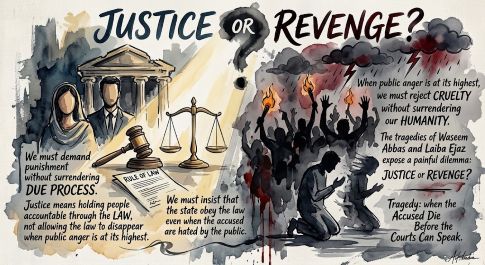
Justice means holding people accountable through the law, not allowing the law to disappear when public anger is at its highest.
We must reject cruelty without surrendering our humanity. We must demand punishment without surrendering due process. And we must insist that the state obey the law even when the accused are hated by the public.
By Abdullah Usman Morai | Sweden
There are moments when society finds itself trapped between two painful realities. On one side are victims whose lives have been destroyed by alleged cruelty, deception, and exploitation. On the other is a justice system that often moves so slowly that families lose faith in its ability to deliver punishment. Between these realities stands a dangerous temptation: to celebrate the death of an accused person as if it were the same as justice.
Recent cases reported in Punjab and Islamabad have brought this dilemma into sharp focus. The tragic deaths of Waseem Abbas, a teenage orphan from Multan, and Laiba Ejaz, a young student whose dream of studying in the United States reportedly ended in financial fraud and profound distress, have shaken public conscience. Yet the subsequent deaths of the principal suspects have raised another disturbing question: are we seeking justice through courts, or accepting a system in which suspects may die before their cases are properly tried?
Two Victims, Two Devastated Futures
Waseem Abbas was reportedly just 15 years old. According to media reports, he was learning electrical work under a contractor, Tauqeer Nazir, when a dispute arose, and the boy attempted to leave. CCTV footage reportedly showed a vehicle pursuing and striking him, causing fatal injuries. The incident prompted widespread outrage, particularly because Waseem was an orphan and depended on adults for protection and guidance.
According to Dawn newspaper, on October 21, 2026, police reported that Tauqeer Nazir had died in an alleged encounter with Punjab’s Crime Control Department near Bahawalpur. The police account stated that he had escaped custody and that an exchange of fire followed an attempt to stop two motorcycle riders. These are official claims that require independent scrutiny, not conclusions that the public should accept without question.
The second case concerns Laiba Ejaz, a talented student whose ambition was to pursue higher education in the United States. According to reports, she was defrauded of approximately Rs5 million by an agent accused of supplying fake admission and travel documents. Her family reportedly sold land and jewellery to finance the dream. The devastating financial and emotional consequences were followed by Laiba’s death, reported as an apparent suicide. Her story is a reminder that fraud is not merely a financial crime: it can destroy a family’s security, a student’s confidence, and the future around which loved ones have built their hopes.
Dawn newspaper Reports published on October 20 and 21 stated that the principal suspect, identified as Nauman, was killed after being shot by alleged accomplices in Islamabad. That account differs from the suggestion that he was killed in a police encounter. The circumstances, the involvement of other suspects, and the wider fraud network require a thorough investigation.
The distinction matters. We must not merge separate accounts into one narrative simply because public anger is intense.
These Crimes Demand Accountability
If the allegations in these cases are established, the conduct involved is profoundly cruel and deserves serious legal consequences. Deliberately harming a child, if proven, is indefensible. Fraudulently taking a family’s savings through fabricated educational and visa documents is also a grave abuse of trust.
No one should use poverty, a child’s dependence, a student’s ambition, or a family’s sacrifices as an opportunity for exploitation.
Waseem deserved the chance to grow up, learn a profession, and build a life. Laiba deserved an honest opportunity to pursue her education, free from deception. Their families and communities deserve answers, accountability, and meaningful support.
But outrage must not make us abandon the very principles that protect victims and innocent citizens alike. Even a person accused of a terrible crime has the right to a fair trial. This is not an endorsement of the alleged crime; it is a rejection of punishment without lawful process.
The Dangerous Logic of the Police Encounter
When police announce that a suspect was killed after allegedly escaping custody or exchanging fire, the public deserves more than a brief official statement. There must be reliable evidence, an independent investigation, and an opportunity for the facts to be tested.
If authorities can decide, in practice, that an accused person should die rather than stand trial, what happens when they make a mistake? What happens when an innocent person is wrongly accused? What happens when a powerful individual can influence the police to target an enemy? And what protection remains for an ordinary citizen who has neither money nor connections?
These questions are not excuses for criminals. They are questions about the limits of state power.
The Human Rights Commission of Pakistan has previously called for an independent judicial inquiry into deaths arising from CCD operations, raising concerns about alleged staged encounters and extrajudicial killings. Such concerns make independent scrutiny especially important.
A police officer’s responsibility is to enforce the law, protect life, arrest suspects, preserve evidence, and present cases before the courts. The use of lethal force must be governed by law and necessity, not by anger, public pressure or a desire to appear tough on crime.
Police must remain police; they must not become investigators, prosecutors, judges, and executioners all at once.
The Catch-22 of a Slow Justice System
Yet it would be unfair to dismiss the public’s frustration. Many people have waited years for justice. Cases are adjourned, witnesses withdraw, evidence weakens, complainants face pressure, and influential defendants may exploit their resources to delay proceedings. Some cases end in compromise, sometimes freely chosen, sometimes under pressure.
For the families of victims, this can feel unbearable. They may see a suspect walking freely while they continue to live with grief. They may fear that money, political influence, or intimidation will defeat the law. When people believe that courts cannot deliver timely justice, an extrajudicial killing can appear to them as a shortcut to punishment.
That is the Catch-22: people lose faith in the courts because justice is delayed, but accepting killings outside the judicial process weakens the very institutions that must provide lasting justice.
The answer is not to romanticize either extreme. We cannot accept endless delays and impunity. Nor can we accept death as a substitute for a verdict.
A suspect who is killed cannot be questioned in open court, challenged by defence counsel, or convicted through a reasoned judgment. Potential accomplices, financial trails and institutional failures may remain undiscovered. The victim’s family may never receive a complete account of what happened.
Swift death is not necessarily meaningful justice.
Reform the System, Not the Principle
Pakistan needs a justice system that works with urgency and integrity. Investigations must be professionally conducted, forensic evidence preserved, witnesses protected, and prosecutors adequately supported. Courts should have sufficient resources to hear serious criminal cases without unnecessary adjournments. Allegations of custodial escape and police killings should be investigated independently, with findings made public wherever legally appropriate.
Fraud involving overseas admissions and visas also demands stronger action against organised networks. Authorities should trace the money, identify accomplices, verify forged documents, and provide clear ways for students to check admission offers directly with legitimate institutions. Families who have suffered fraud should receive practical guidance and access to lawful remedies.
Child protection must also be strengthened so that vulnerable children are not left dependent on adults who may exploit them. Every child learning a trade should have a safe environment, a way to report abuse, and access to responsible guardians or protection agencies.
Justice must be accessible to the poor as well as the powerful. Otherwise, public confidence will continue to collapse.
A Society Must Think Beyond the Moment
It is understandable to feel anger when a child is killed, or a student’s future is destroyed through fraud. It is equally understandable to want the accused to face punishment. But supporting a system that can kill suspects without a proper trial means accepting a power that may eventually be used against anyone.
Today, the target may be someone widely believed to be guilty. Tomorrow, it could be a person wrongly accused, a rival, a witness, or an ordinary citizen caught in the wrong place.
The test of justice is not whether the public feels satisfied for a day. It is whether the truth is established, responsibility is proved, the law is applied fairly, and future victims are protected.
Waseem Abbas and Laiba Ejaz deserve more than headlines, anger and arguments over the deaths of suspects. Their cases should compel us to demand credible investigations, accountable policing, effective courts and protection for vulnerable people.
We must reject cruelty without surrendering our humanity. We must demand punishment without surrendering due process. And we must insist that the state obey the law even when the accused are hated by the public.
Justice means holding people accountable through the law, not allowing the law to disappear when public anger is at its highest.
Read: Social Media, Freedom and the State
_____________
 Abdullah Soomro, penname Abdullah Usman Morai, hailing from Moro town of Sindh, province of Pakistan, is based in Stockholm Sweden. Currently he is working as Groundwater Engineer in Stockholm Sweden. He did BE (Agriculture) from Sindh Agriculture University Tando Jam and MSc water systems technology from KTH Stockholm Sweden as well as MSc Management from Stockholm University. Beside this he also did masters in journalism and economics from Shah Abdul Latif University Khairpur Mirs, Sindh. He is author of a travelogue book named ‘Musafatoon’. His second book is in process. He writes articles from time to time. A frequent traveler, he also does podcast on YouTube with channel name: VASJE Podcast.