Bangladesh’s poet and writer’s journey from Village Childhood to Pen Fight
The city children used to call us Geyo, which means village people. That’s when I understood what the difference was between rich and poor and between city and village people. The socio-economic inequality hurt me. Since then, I have tried to write about social inequality – Shakil Kalam
Interviewed by Angela Kosta
You began writing as a child, and today your work spans literature, governance, economics, and social issues. What was the first wound, question, or injustice that transformed writing from a personal form of expression into an inner necessity?

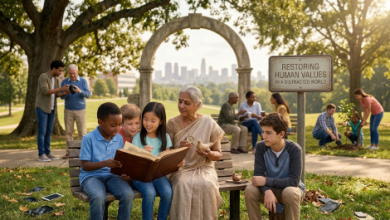
I have been writing since my boyhood. Nature attracted me greatly. I started writing about the environment after being fascinated by its natural beauty. I grew up in a rural environment. At that time, Bangladesh was one of the poorest countries in the Third World. During that period, the rural economy was very weak. The common people in the village could not afford to eat three meals a day. However, those who had land were somewhat better off. Our family was fairly prosperous. Poor children would go to people for two handfuls of rice. Their begging for rice used to bother me a lot.
Since then, various questions arose in my mind. It made me think: Why is there such economic inequality among people? Very few boys studied with me. I admitted myself to a town school after completing my primary education in the village. I was surprised by the clothes of the town’s children. I used to think that they were wearing such beautiful clothes—pants, shoes, and socks—while I couldn’t even wear a shirt and a pair of sandals properly. The city children used to call us “Geyo,” which means village people. That’s when I understood what the difference was between rich and poor and between city and village people. Thus, the impact of socio-economic inequality hurt me. Since then, I have tried to write about social inequality and children. This is how I made my debut as a child-litterateur.
Your writings openly address inequality, hypocrisy, suffering, discrimination, and the erosion of moral values. When you observe a society marked by such contradictions, do you feel a stronger need to denounce what is happening, or to understand why human beings ultimately accept it?
As I grew up, I began to notice political, economic, and social inequality—alongside human suffering, despair, lamentation, hypocrisy, violence, hatred, deceit, and the decline of moral and social values among political leaders and the public. To protest all this, I started writing for newspapers. At the same time, I became involved in leftist student politics. But I saw nothing good there either; everyone was preoccupied with their own interests. They kept advancing by deceiving the people, all fixated on seizing national power. This situation created a dilemma within me: should I pursue politics, or should I devote myself to writing? In the end, I chose to focus on writing. To this day, I have continued my pen fight against unprincipled politics, administrative corruption, nepotism, dictatorship, undemocratic rule, bureaucratic red tape, state and corporate exploitation, the lack of rule of law and accountability, elite looting, and the abuse of power.
Your experience at the central bank and your academic work in governance have allowed you to observe economic and institutional mechanisms from within. How has this experience changed the way you look at humanity, power, and social responsibility?
Bangladesh Bank is the central bank of Bangladesh. It reviews the government’s economic activities and provides guidance and advice. Its main functions include: formulating and implementing monetary policy; printing and circulating currency and notes, and managing the money supply; controlling inflation and sustaining economic growth; generating employment; providing loans to the government to cover budget deficits; managing foreign exchange and reserves; maintaining accounts of government revenue and expenditure; acting as an intermediary between the government and the public; supervising and regulating the country’s government-owned, private, and financial institutions; serving as the lender of last resort for banks; preventing money laundering and suppressing financial crimes; and inspecting commercial banks and financial institutions. In essence, the central bank serves as the banker to the government and the regulator of scheduled banks and non-banking financial institutions, as an officer and policymaker at the central bank, I am responsible for formulating policies, rules, regulations, and circulars on various issues. This process requires careful consideration and review of public opinion from all walks of life across the country. In this capacity, I bear a significant social responsibility. It is from this sense of duty that I incorporate themes of humanity, human dignity, and broader social concerns into my writing.
The Liberation War of Bangladesh has become one of the central themes of your literary work. What does it mean to you to preserve and reinterpret that memory through poetry and literature, especially for younger generations who did not experience that history firsthand?
You have asked a wonderful question. We achieved independence on December 16, 1971, when the Pakistani occupying forces surrendered, following a nine-month armed struggle and a sea of bloodshed. I was a child during the Liberation War, but I still retain some memories of the events that unfolded at the time, and I have learned more through later study. During the war, the Pakistani forces brutally oppressed and tortured the innocent people of Bangladesh. They violated the dignity of mothers and sisters, burned down houses and factories, and looted homes and businesses. In short, the occupiers pursued a “scorched earth” policy. As a result, the Liberation War has become a central theme in my writing.
Poets and writers have produced stories, poems, rhymes, novels, essays, plays, and memoirs about the Liberation War. However, writing the true history of a country truly takes at least a century. Yet fifty-eight years have passed since our independence, and the complete history of Bangladesh has still not been written. For this reason, the new generation must research various movements—such as the Tebhaga movement, the partition of India and Pakistan, the Bengali language movement, the Liberation War, and all subsequent democratic struggles—in order to write a full and accurate history of the liberation war. They must also compose a comprehensive history of Bangladesh and give due prominence to the nation’s literature and culture.
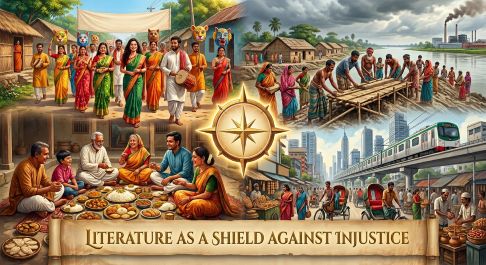
Your writings also offer sharp criticism of politics, the lack of democratic values, and failures of good governance. Do you believe literature can reach places where politics and institutions have failed? If so, what responsibility should a writer assume?
Transparency and accountability in politics, democratic values, culture, the establishment of institutional democracy, good governance, the rule of law, social values, moral degradation, and the fight against corruption all depend on an elected democratic government and its governance system. As a writer, however, I am deeply influenced by all these issues. There is a proverb in our country: “The pen is mightier than the sword.” I have adopted this saying as my ideal. Therefore, I believe it is my moral responsibility as a writer to continue the pen fight in order to establish the above mentioned principles at both the national and social level

Your poetry has been translated into more than 45 languages and has reached readers from very different cultures. When one of your poems is translated into a language far removed from Bengali, what do you hope remains untouched: the meaning, the emotion, the imagery, or the soul of the poem?
Every language has its own essence. The language of every country or nation carries its own themes, similes, imagery, canvas, emotions, feelings, rhythm, and resonance, as well as reflections of that country’s culture, social conditions, movements and struggles, and governance. When a translator renders a text from a foreign language, they try to adapt elements of their own country’s overall context to those of the original text. As a result, the original themes or meanings of the translated text are not fully preserved. In particular, the imagery, similes, canvas, emotions, and meanings are altered.
You are simultaneously a poet, translator, researcher, author of children’s books, and specialist in governance and internal audit. Are these different identities, or is there any invisible thread connecting all of them throughout your journey?
I am a creative professional recognized as a children’s writer, poet, story writer, essayist, columnist, translator, and researcher. The experience I have gained across various departments in my professional career has also earned me recognition as a specialist in corporate governance, internal audit, and inspection. The invisible thread you mentioned does indeed exist—I have already discussed the connection between my professional and writing life in my responses to earlier questions. This bond has fused my professional and literary pursuits into a single, unified whole.
Your books on corporate governance and Bangladesh’s financial sectors are used as reference texts in universities. How do you feel knowing that ideas born from your research have become tools for educating and shaping future generations?
My books on corporate governance and Bangladesh’s financial sector are currently used as reference texts in some universities and are taught to students. This brings me great joy and satisfaction and happiness. If the knowledge that students gain from them can play even a small role in Bangladesh’s economic development, I will consider my writings to have fulfilled their purpose.
In recent years, spirituality has taken an increasingly important place in your writing. Was it your understanding of the world and its contradictions that led you toward spirituality, or was it spirituality that changed the way you interpret the world?
The world has become a turbulent and unstable place, marked by wars, conflicts, shifting tensions between faith and disbelief, rivalry among superpowers, the oppression of the weak by the strong, efforts to expand dominance, and ethnic cleansing. In the face of such turmoil, the people of Bangladesh—a developing nation in the Global South—turn to the Creator alone for help and protection. Perhaps this very environment has shaped and influenced my writing.
You have received significant international recognition, and your works have appeared in numerous publications and anthologies across different countries. Which recognition has left the deepest mark on you not because of its prestige, but because of what it represented personally?
I’m not sure what you mean by “international recognition.” However, a significant number of my stories, poems, essays, articles, research papers, and interviews have been published in newspapers and magazines across the world. My poems and stories have also been included in roughly 100 anthologies. I truly appreciate that my work has appeared in several notable international publications. I see my presence in the global literary scene as a way of representing Bangladesh on the international stage.
You founded the literary community SahityaPata and the Social Development Research Foundation, bringing together culture and social engagement. If you could leave one single idea with the next generation of Bangladeshi writers and intellectuals, what would it be, and why?
My advice to budding poets, writers, and intellectuals, in the words of the great philosopher Socrates, is first to “know thyself” and pursue knowledge. Then, read—and read deeply. After that, try to write with vivid understanding, and write again and again. One should also cultivate a clear empathy for the history, time, and turning points of the language in which they choose to write. I offer these ideals as a legacy for future generations.
Your future projects include a collection of children’s stories, a selection of poems, and critical essays on literature, cultural studies, and contemporary discourse. If you could entrust these three works with one message for the future, what would you want readers to discover between their pages?
Through my three projects, future generations will gain a proper understanding of Bangladesh’s contemporary art, literature, culture, politics, and socioeconomic conditions, history of movements and struggles, and traditions. As a result, they will be equipped to build a Bangladesh rooted in human dignity and grounded in equality.
Read: Feminization of Poverty in New Era
_____________
 Angela Kosta was born in Elbasan (Albania) and has lived in Italy since 1995. She is Executive Director of the magazine MIRIADE, translator, essayist, journalist, literary critic, publisher and promoter. She has published over two dozen books: novels, poems and fairy tales in Albanian, Italian, Arabic, French, Korean, Turkey, Spanish and English.