Today is the marriage of the Iron Princess Didda to Kshemagupta. Every corner of the Lohar Dynasty’s mountain kingdom has been decorated with golden and yellow drapes.
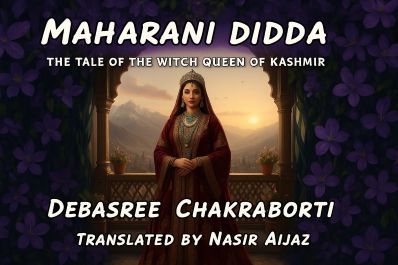
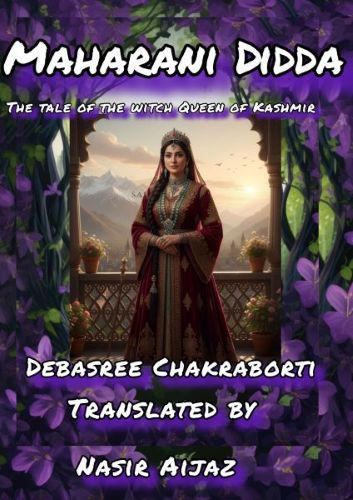
Maharani Didda: Witch Queen of Kashmir
By Debasree Chakraborti
Today is the wedding of Didda, the Lohar Princess; perhaps that is why nature itself has adorned itself like a new bride. With the arrival of spring in the valley, an extraordinary harmony of multicoloured flowers and fresh buds seems to have woven a bridal attire. The cooing of cuckoos from tree to tree appears to be invoking Madan, the god of love. With the advent of spring, the sky has taken on a deep blue hue.
 The presence of the Sun God’s light in the sky is reflected upon the distant snow-white mountain peaks and spreads all around.
Today is the marriage of the Iron Princess Didda to Kshemagupta. Every corner of the Lohar Dynasty’s mountain kingdom has been decorated with golden and yellow drapes; both sides of the roads are adorned with garlands of yellow and red flowers. In every Shiva temple of the kingdom, the Mahamrityunjaya Mantra is being chanted for the well-being of the princess. The resonance of this mantra has enveloped the surroundings in a strange spiritual aura. From the palace of the Lion King, situated atop a distant mountain, the plaintive notes of the shehnai drift through the air. Even before morning has fully dawned, the worship of Gauri has begun.
Within the linga of Kapileshwar, the clan deity of the Lohars, there is a Neelkanth gem installed. It is said that Lord Krishna himself had once gifted this gem to Abhimanyu. After many ages, the gem came into the possession of the King of the Lohars, who enshrined it within his clan deity. The deity was established in the temple in such a manner that the first rays of the sun would reflect upon this Neelkanth gem and spread in all directions. Every morning, the light of the Sun God is reflected first in this Neelkanth gem.
Today, beside this Kapileshwar deity, the idol of Mother Gauri was installed, and with the worship of Gauri, the auspicious commencement of Princess Didda’s marriage took place. Dressed in white silk garments, adorned with diamond jewellery and garlands of white flowers, Princess Didda sat for the Gauri Puja. Bhalaga sat at a little distance, watching the princess. Today, in her eyes, Didda appeared like Mother Sharada herself.
Didda’s maternal and paternal cousins—who had, since childhood, looked upon Didda with hatred—were now seated around her, rejoicing wholeheartedly in her wedding. Today, a flood of joy seemed to flow through the Lohars’ palace. Ordinarily, on such a day, a shadow of melancholy hangs over the bride’s home; but in Didda’s case, the picture was completely the opposite. The brothers who had once refused even to speak to Didda, displaying the utmost arrogance, were today beside her, intoxicated with joy.
Yet, though joy filled everyone’s hearts, both Didda and Bhalaga sat with deeply sorrowful faces. From the moment of her birth, Princess Didda had grown up spreading her branches upon Bhalaga’s bosom; in that sense, Bhalaga was her mother. Thus, the daughter’s marriage marked the beginning of a vast change in Bhalaga’s life. Her daughter was about to enter a new life, and countless anxieties regarding that life arose in her mind. For so long, Didda had been emotionally dependent upon her; moreover, Didda’s temperament was unlike that of ordinary girls. How would she manage alone in a new environment? This question gnawed relentlessly at Bhalaga.
On the other hand, Didda was attentively and correctly reciting the mantras as instructed by the priest. She felt as though she had been carrying a terrifying, cursed life since birth—a life in which, except for Bhalaga, she had no one of her own. The family into which God had sent her, that family……she had remained an unwanted person forever. A place where no one ever considered her their own. It seemed to Didda that each of these mantras was like a step of a staircase—by advancing step by step through their correct recitation, she would be freed from this accursed life.
When the worship ended, the maidservants came and led Didda to her private chambers. Bhalaga went with them. Years of military training had given Didda a distinctly masculine bearing; Bhalaga herself was also strongly masculine in nature. With Vikramasen and Bhalaga, Didda felt a joy she had never experienced with anyone else—certainly never with women. Other princesses had many companions, but Didda had none except Bhalaga—an unlikely companion of mismatched age, who was at once her foster mother and her guru. In other words, Bhalaga was the most important person in Didda’s life. The catalyst behind the formation of such a nature in her was this accursed life itself.
For the turmeric ceremony, Didda was adorned in yellow garments and jewellery made of red roses, and she appeared exquisitely dressed. Didda’s complexion was golden-hued, and it always seemed as though a radiant glow emanated from her body. Her hair was brown, and her two eyes were deep and pure like the lake of Satisar. In the yellow garments and red floral ornaments, today she looked like the goddess Kheer Bhavani herself made manifest. Bhalaga felt that her own gaze might cast an evil eye upon Didda, and so she herself applied a touch of kohl to one corner of Didda’s cheek.
The place chosen for Didda’s turmeric ceremony was decorated with golden cloth and red roses. A low wooden stool made of gold was placed there, and Didda was seated upon it. Around this spot, four banana trees were erected like pillars, and across those pillars a Banarasi cloth intricately worked in yellow and gold was draped. Beneath it, Didda’s turmeric ceremony was to be performed. The priest arrived and began chanting the mantras; now the turmeric would be applied to Didda. But nowhere were her father or mother to be seen. At that moment, when one of her female relatives came forward to apply the turmeric to her, Didda suddenly spoke up, saying, “Let me first be anointed by “If anyone has the sole right to anoint me with turmeric, then that person is Bhalaga.”
Hearing these words, tears welled up in Bhalaga’s eyes. What an immense honour this was—she had never imagined she would receive such recognition. Her love for Didda had always been completely selfless; she had never expected anything in return for herself. All her life, she had wished only for Didda’s well-being.
Bhalaga stepped forward and applied turmeric to Didda’s hands, feet, and face. After that, the others came forward to do the same. Those relatives from whom she had faced neglect all her life now stepped up to anoint her with turmeric. The absence of Didda’s father and mother did not surprise Bhalaga, for she knew very well that to Didda’s family she had long been a heavy burden; the sooner this burden could be lifted from their heads, the better it was for them. For a long time, Didda had been regarded as a curse by the Lohar royal family.
Sacred water from the Krishnaganga was brought to bathe Didda. After mantras were chanted over the water, she was bathed. Preparations then began to proceed toward the wedding pavilion. Didda was dressed in a tawny-gold silk garment, worked with gold and emerald embellishments. Her entire body was adorned with jewellery of gold set with emeralds, and her head was covered with a yellow, gold-embroidered veil. She was garlanded with dark crimson rose flowers. Through all these moments, Bhalaga remained beside Didda like a shadow.
A short while before evening fell, Kshemagupta arrived to marry Didda, accompanied by a grand procession. The maidservants of Didda’s chambers all rushed out to see the groom. At that moment, only Valaga and Didda remained there. Bhalaga led Didda to the balcony, from where the magnificent wedding procession could be seen. The members of the procession had arrived on horseback, while Kshemagupta himself came in an exquisitely decorated horse-drawn carriage. From above, little else could be seen clearly.
Just then, Didda’s two paternal cousins came and embraced her from either side. They had never spoken to Didda before; from a distance they used to mock her with laughter. At one time, the mere sight of them filled Didda with terror, for such hatred and contempt she had never………bear any longer. Yet Didda herself had never behaved badly toward them.
The two girls came and, with great enthusiasm, praised Kshemagupta’s appearance. They said that never before had their family had such a handsome son-in-law. After a while, two maidservants came to inform Didda how joyfully Queen Shreelekha had welcomed her son-in-law, and how Didda’s two brothers, holding Kshemagupta on either side, led him into the palace, as conch shells sounded on both sides of the path and elderly women showered rose petals from above. Several more maidservants came to Didda and said, “Princess, your fortune is truly wonderful. So many beautiful princesses never get such a handsome groom, and yet you have!” Didda’s sisters spoke among themselves in tones of amazement—such an extraordinary wedding arrangement! Who would ever have imagined that her wedding would be celebrated with such splendor?
Neither Bhalaga nor Didda responded to any of these words that day, for they both knew very well that Didda’s relationship with these people would last only a few more moments; after that, perhaps they would never meet again.
The mournful sound of the shehnai drifted into Didda’s chambers, weighing heavily upon the atmosphere. Sitting inside these chambers, it was impossible to grasp any of the events taking place outside, for Didda’s quarters were like an isolated island, cut off from the rest of the palace. Didda sat silently with Bhalaga, counting the passing moments.
Just then, the sound of wedding music slowly began to approach her chambers. Bhalaga understood that the time had come for Didda to go to the wedding pavilion. She quickly stood up, gripped Didda’s shoulder firmly, and said, “Do not be afraid. I am always with you.” Didda rose to her feet. Bhalaga took her hand and moved forward; Didda’s sisters and the maidservants followed them.
After they had gone a short distance from Didda’s chambers, an exquisite decoration of red roses began. Along the path that Didda walked, red rose petals had been strewn. The wedding pavilion was adorned with yellow flowers, and there Kshemagupta stood, waiting for Didda. Just then…At that moment, Didda stepped forward and stood before Kshemagupta, meeting his gaze directly. The radiance of Didda’s beauty spread all around and was reflected in Maharaja Kshemagupta’s eyes as well. At the sacred moment of accepting Didda as his bride, he was filled with immense joy, and that happiness was clearly visible in his eyes and on his face. Didda was a highly intelligent woman; she easily understood the feelings in Kshemagupta’s heart and was deeply delighted. From this supreme moment of marriage, it seemed as though all the sorrow and suffering of her life had come to an eternal end.
With great joy, Didda placed the garland around Kshemagupta’s neck. After the garlanding ceremony was completed, the two came and sat side by side in the pavilion. Through Vedic mantras, the various rites of the wedding were performed. Now the ritual of kanyadaan was to begin, and so the Lion King arrived. Ordinarily, at the moment of kanyadaan, a daughter’s father is overwhelmed with sorrow. But seeing the radiance and cheerfulness on Singharaja’s face, even a man like Kshemagupta was astonished. That a father could feel such joy at the moment of giving away his daughter was beyond his comprehension. To Singharaja, this seemed like the supreme moment of release from a curse, and so he became exuberant with happiness.
For the first time, Didda had the opportunity to come so close to her father; for the first time, her father touched her hand. Tears welled up in Didda’s eyes. She looked at her father for a long while, but her father did not look at her even once. When the kanyadaan ritual was completed, Singharaja departed. After this, the ritual of applying sindoor was performed. Kshemagupta had brought with him the sindoor from the worship of Mother Kheer Bhavani, and he applied it to the parting of Didda’s hair.
At that moment, Bhalaga stood behind Didda. When the sindoor ritual was completed, Bhalaga drew the veil over Didda’s head with the ceremonial cloth and placed a deep kiss upon the center of her head.
Bhalaga knew very well that at this moment Didda would become intensely emotional. This was the moment of her liberation from that terrifying life of the past; therefore, a flood of emotion was bound to appear in Didda’s eyes and on her face. But Bhalaga did not want anyone else to witness this scene, because not a single member of this family was capable of understanding the worth of Didda’s tears.
The queen felt the stream of Didda’s tears fall upon her feet, yet she did not place her hand upon Didda’s head to bless her. In truth, it was a habit formed over many years—whenever she saw this daughter, she would withdraw into herself. Didda did not wait any longer and took her leave.
After the wedding, festivities continued throughout the night in the palace of the Lohars. Kashmiri… Folk music and dance filled the night, and Didda’s brothers and sisters together formed lively gatherings of merriment. All night long, Didda remained united with Kshemagupta, experiencing each moment with full awareness. In this way, dawn arrived before anyone realized it. When everyone grew weary from the night’s exertions, the moment of Didda’s departure arrived.
Queen Shreelekha was seated alone in her chambers, lost in thought, her eyes moist with tears. At that moment, her two sons entered. Seeing tears in their mother’s eyes, they said, “Mother, at such a moment of joy, why are you sitting here saddened? What are you thinking about?”
Queen Shreelekha replied, “Didda is our only daughter, yet from the day of her birth until today, I have done nothing for her. I have always kept her at a distance from myself. Now, at the moment of her departure, I feel that as a mother I have completely failed.”
One of the queen’s two sons said, “You have fulfilled your duty perfectly. Think about it—if Kshemagupta had not married her, she would never have been married at all. And if parents fail to give their daughter away in marriage, they are destined for hell. You and Father have been saved from a curse—consider it that way.”
Just then, as the queen wiped her eyes and looked ahead, she saw Didda standing there with Bhalaga. Didda had heard everything that had been said. As Queen Shreelekha rose upon seeing her daughter, her sons turned back and saw Didda standing there. They too turned toward Didda quite naturally. From their body language it was clear that they believed they had done nothing wrong; what they had said, in their view, was perfectly natural.
Didda stepped forward and touched her mother’s feet in reverence. The queen felt the stream of Didda’s tears fall upon her feet, yet she did not place her hand upon Didda’s head to bless her. In truth, it was a habit formed over many years—whenever she saw this daughter, she would withdraw into herself. Didda did not wait any longer and took her leave.
Outside her mother’s chambers, she met her father, Singharaja. After touching her father’s feet in reverence, she stood there for a while, but from her father too she received no blessing. Now…As Didda stepped slightly aside, Bhalaga moved forward and said to the Maharaja, “From the moment of Didda’s birth, raising her properly and nurturing her became the sole purpose of my life. Didda is now my everyday existence. Wherever she is, there I am. Therefore, alongside Didda, I too have come to take my final leave of you and the Lohan royal family.”
The Maharaja raised no objection. He said, “Bhalaga, I and my family shall remain eternally grateful to you. Wherever you go, may you live in happiness—there is no objection from my side.”
Now Didda and Kshemagupta together came to take leave of Didda’s grandfather, Bhimraja. Bhimraja presented Didda with a golden sword and said, “Didda, to give a brave woman like you jewellery or other precious gems would only prove my own foolishness. This sword is a fitting gift for you. It is a symbol of the honour of the Hindu Shahi lineage. I hope you will restore the lost honour of my dynasty.”
Ordinarily, granddaughters are especially dear to their grandfathers. But Didda had never received affection from Bhimraja; in her presence he would always give importance to his other grandchildren. Yet today, at the moment of farewell, receiving such a great honour from her grandfather, she could no longer control herself. Resting her head upon Bhimraja’s chest, she began to weep. Embracing her, Bhimraja said, “Vikram has told me everything. Victory will surely be yours.”
After this, he placed into Kshemagupta’s hands a wooden chest filled with coins and said, “I entrust you with priceless diamonds. The responsibility of safeguarding this jewel of the Lohar family with due honour now rests with you.”
Queen Shreelekha, carrying the welcoming platter, joined the other elderly women to receive and bid farewell to the bride and groom. When Didda offered the ritual kanakāñjali, she became overwhelmed with emotion. Bhalaga stepped forward, lowered the veil over Didda’s head, and covered her face. Then, holding her hand, she performed the kanakāñjali and led Didda and Kshemagupta out of the palace, bidding the Lohars an eternal farewell.
Bhimraja had arranged two magnificent elephants for his granddaughter and grandson-in-law. Kshemagupta mounted one elephant, and Didda, along with Bhalaga, mounted the other. These two elephants proceeded ahead, and behind them followed another hundred elephants carrying the gifts presented by the Lohars to their daughter. Thus, on that day, bidding farewell to the Lohars, Didda moved forward toward her new life, where many new relationships awaited her call. (Continues)
Click here for Part-1, Part-2, Part-3, Part-4, Part-5, Part-6, Part-7, Part-8, Part-9, Part-10, Part-11, Part-12,
_____________________
 Debasree Chakraborti is a renowned novel writer of Bengali language. Based in Kolkata, West Bengal, India, she has done Master’s in Modern History from the Kolkata University, and authored some thirty books, mostly the novels, with historical perspective and themes. Her novel is ‘Maharaja Dahir’ that covers the history of Sindh from 662, the year of first attack on Sindh by the Arab armies till date, was published last year and translated by Nasir Aijaz into Sindhi language.