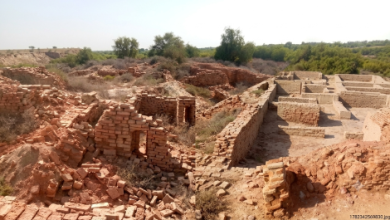
The site suffered extensive damage during the catastrophic floods of 2010 and 2022
- Today, this significant archaeological site—Pir Lakho, the contemporary counterpart of Mohenjo-daro—remains neglected and abandoned.
By Aziz Kingrani
Pir Lakhio or Pir Lakho, is an archaeological site discovered by N.G. Majumdar during his explorations between 1927 and 1929. The original name of the site remains unknown. Following its discovery, Majumdar named the site Pir Lakhio after a local saint whose shrine is situated nearby. He documented the site extensively under the name “Pir Lakho” in his publication ‘Explorations in Sindh’, where he described it as “the second station of Mohenjo-daro.”
Pir Lakho is located approximately 15 kilometers south of Johi town, near the edge of Manchhar Lake, within the jurisdiction of Johi Taluka in the Dadu District of Sindh. It lies about 4 kilometers northeast of the historical site of Luhori (or Lohri). The site is also near the former Western Nara Canal—later known as the Nara Valley Drain, and currently referred to as the RBOD (Right Bank Outfall Drain)—which drains into Manchhar Lake.
Unlike Mohenjo-daro, Pir Lakho does not take the form of a large mound but is situated on slightly elevated terrain. The site, associated with the Indus Civilization, yielded a range of artifacts similar to those found at Mohenjo-daro, Chanhudaro, and Ali Murad’s Daro. These included a terracotta figurine of a mother goddess adorned with a necklace, terracotta bulls, toys, bullock carts, pottery vessels, and other items typical of the Indus Civilization.
Majumdar noted that significant relics comparable to those of Mohenjo-daro were discovered at Pir Lakho. The terracotta figurine of the mother goddess—characterized by an elaborate headdress, cup-shaped ears, necklaces, and a garment—reflects the religious practices of the time, highlighting the worship of the mother goddess by the inhabitants.
According to Majumdar, several artifacts found at Pir Lakho closely resemble those at Mohenjo-daro more than at any other Indus site, suggesting that Pir Lakho dates to the same historical period. It thus appears to be one of the most prominent Indus Civilization sites in Sindh, second only to Mohenjo-daro.
Regrettably, the site suffered extensive damage during the catastrophic floods of 2010 and 2022. Today, this significant archaeological site—Pir Lakho, the contemporary counterpart of Mohenjo-daro—remains neglected and abandoned.
Read: Exploring The Neroon Fort
______________
 Aziz Kingrani, hailing from village Haji Manik Kingrani, Johi, Dadu District, Sindh, Pakistan, is poet, short story writer, playwright and a researcher. He has been contributing in the fields of history and literature. He has served as a professor as well. His 17 books are published in English and Sindhi language.