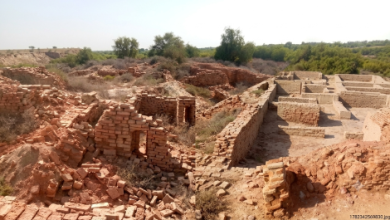
Meaneh, an unexcavated archaeological site, is situated in the Nara Desert within Thar, a region of Sindh
Syed Ali Shah Lakyari
Meaneh (مياڻي), an unexcavated archaeological site, is situated in the Nara Desert within Thar, a region of Sindh, Pakistan demonstrably rich in human history. The broader area exhibits a remarkable chronological span of human occupation, evidenced by archaeological sites dating from the Paleolithic, Mesolithic, Neolithic, and Indus Valley Civilization (IVC) periods, alongside remnants of later Hindu and Buddhist influence.
The discovery and systematic documentation of sixty-six Mesolithic sites in the nearby Khairpur Mir’s desert, classified by their lithic assemblages, underscore the archaeological potential of the region. While prominent Sindh sites like Mohenjo-Daro and Amri are intrinsically linked to the Indus River, the presence of many other sites along the Nara Canal (identified as the ancient Hakro) and historical trade routes are not fully explored.
 The unique topographical setting of Meaneh, located on the shore of the dried lake, presents an intriguing parallel to the site distribution around Manchar Lake, where a continuum of sites from lithic periods to complex civilizations is observed. However, the Meaneh’s lake history, environmental dynamics and water management strategies for its ancient inhabitants is not clear yet. This is a key factor for future archaeological interpretation.
The initial discovery of Meaneh in 1993 by Mr. Rudolf Dellmour, an Austrian geologist, during OMV company fieldwork, marked its entry into the archaeological consciousness, his initial assessment of the mound as an IVC site was a crucial early identification. The revisiting of the site thirty-two years later, in Ramzan 2025, by a specialized team including Zooarchaeologist Syed Ali Shah (Pakistan), Mr. Garba Roman (Czech Republic). Roman is archaeologist and specializes in dating methods applied in archaeology and geosciences. He is director of ARDUQ (Archaeological landscape and environmental dynamics of Duqm and Nejd) in Oman. The original discoverer geologist Rudolf Dellmour (Austria) guided team to the location for initial assessment of Meaneh. The site’s remote location, approximately 2.5 hours from Khairpur Mir’s and 1.5 hours from Chondiko, on a route connecting Chondiko to Ghotki, emphasizes the logistical challenges and the commitment required for its investigation.
 The widespread distribution of pottery shards and bricks on the surface provided diagnostic material. Of particular archaeological significance are the “zigzag-type outer walls resembling bastions, which could indicate defensive architecture or complex civic planning, characteristic of mature IVC urban centers. The presence of fire-baked mud bricks measuring 7x14x28 further reinforces the IVC hypothesis. Sir Rudolf’s claim is particularly strengthened by the identification of black-on-red ware pottery, a hallmark ceramic tradition of the Indus Valley Civilization. While these surface finds provide compelling preliminary evidence, the precise chronological placement and cultural affiliation of Meaneh will ultimately depend on controlled excavation and radiocarbon dating of organic materials, such as charcoal samples. We refrained from surface scraping at the site due to the presence of reptiles; traces of snakes were observed. Therefore, we limited our activities to surveying only. During the survey, we documented the presence of well-type bricks (similar to those used in the wells at Mohenjo-daro), wall bricks, pottery shards, perforated pottery, pottery with depictions of sea creatures, shell fragments, and various stone tools & we found a brick with some markings that we initially thought might be a form of language, but did not make any final determination.
 The hypothesis proposed by Mr. Garba Roman regarding the potential destruction or abandonment of Meaneh due climate change landscape aridification draws a parallel with theories surrounding the decline of Mohenjo-Daro
This proposition highlights the critical interplay between environmental factors and human settlement in the arid and semi-arid regions of the Indus Valley. Such environmental hypotheses necessitate palynological studies, sediment analysis, palaeoclimate reconstruction, and geomorphological investigations during future fieldwork research to reconstruct past environmental conditions and their impact on the site’s occupants.

The call for the Sindh Exploration and Adventure Society, in collaboration with their Pak-American team (who have been actively conducting surveys and excavations in Sindh under the supervision of Dr. Kaleemullah Lashari for the past three years), to re-survey and excavate Meaneh is a crucial step for its formal archaeological investigation. Such an undertaking would not only validate the preliminary findings but also significantly contribute to the documented count of IVC sites in the Nara Desert, potentially revealing new insights into regional variations, settlement patterns, the effect of climate change, and the socio-economic organization of this vast ancient civilization. The archaeological excavation of Meaneh holds the promise of expanding our understanding of the Indus Valley Civilization’s spatiotemporal dynamics and adaptability within diverse ecological zones.
Read: Geoarchaeology: Harnessing the Heritage
_____________
Syed Ali Shah completed his BS in Zoology & Masters in Wildlife from Karachi University. After completing the degree work in Karachi Zoo as Research Associate, he did courses in archeology under the supervision of Dr. Jonathan Mark Kenoyer in KPK. He is working as Zoo archaeologist with Dr. Kaleemullah Lashari, Dr. Asma Ibrahim & Dr. Mark Kenoyer at different sites of Indus valley civilization in Sindh and Balochistan.