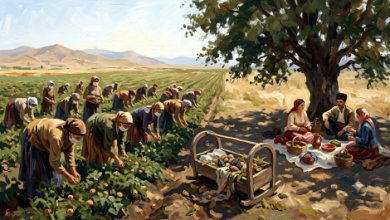
Popular proverbs are a form of cultural heritage, widely circulated on people’s tongues
- In every nation, proverbs represent the essence of its experience, the product of its knowledge, ideas, and aspects of life
Souad Khalil | Libya
Popular proverbs are a form of cultural heritage, widely circulated on people’s tongues, and considered one of the most important means of preserving experiences and wisdom and transmitting them across generations. At the same time, they are also employed in narrative, reflecting lived experiences.
In every nation, proverbs represent the essence of its experience, the product of its knowledge, ideas, and aspects of life. For this reason, the study of popular proverbs has attracted literary research for the benefit and wisdom they contain.
Many writers, scholars, thinkers, and linguists across the ages have addressed popular proverbs, their study, and the historical periods in which they were coined. Within this article on popular proverbs in the Arab narrative tradition, as a secondary literary form, I was particularly intrigued by what Dr. Luay Hamza Abbas wrote.
 Perhaps understanding the literariness of the old narrative text was influenced by many factors, among them significant scholarly efforts, in the field of Arabic narrative studies. These focused on specific forms that, according to their orientation, played a central role in exploring narrative and examining its effectiveness within the framework of Arab-Islamic culture. This, in turn, contributed to deducing the narrative structures of the Arab storytelling heritage, within specific conditions, while excluding those narrative legacies that, to varying degrees, had helped prepare for the emergence of fictional genres which scholars later sought to analyze and identify their structural features—even if indirectly, through the treatment of issues of authorship and the degree of presence of the imaginary.
Dr. Abbas states:
Declaring the existence of major fictional genres and complete narrative works by contemporary narrative scholars logically requires that Arab culture, in its early formative stages, must have contained secondary, incomplete types. These, from the perspective of later narrative structures and their dynamic components, exhibited narrative features in a simple form, separated in their presence and in the organization of their elements from the realities of their own age and cultural contexts. Two major aspects of Arab culture played a decisive role in their production:
The Historical Aspect
This stems essentially from the sensitive historical position of these texts between the eras of pre-Islam and Islam, with all their diverse contexts and their religious, ethical, or social contradictions. Such a context opened the way to evaluating the sincerity of their attempts and the truths they contained in expressing glimpses of presence—most of whose features and traces were reoriented to align in some way with the realities of the new age. In the process, they were subjected to many pressures, displacements, and exclusions that transformed them from their original oral form into a second written form, one that responded to the requirements of documentation and, in another sense, to the strategies of the new era that embraced them for multiple purposes and aims.
Thus, the historical reception of proverbial texts was confronted with two opposing critical perspectives, shaped by decades of studying heritage texts and seeking to build a scientific, methodological vision of the problems they posed:
The first perspective: Expels proverbs from Arabic artistic prose and relegates their study to philological inquiry. In this view, proverbs serve as a measure for studying language, short-sentence structures, and particularly the creative play of peoples with words and meanings. Yet this perspective restricts their literary study, given the difficulty of verifying the authenticity of pre-Islamic proverbial texts.
The second perspective: Regards proverbs as a distinct form of pre-Islamic prose and considers them a valuable source for studying Jahili literature, especially prose. Compared with pre-Islamic poetry, proverbs were less subject to alteration and distortion, and their anonymity made them less tempting for fabrication. Although meager in volume—a “meager treasure,” to use Blachère’s expression—they reveal many secrets about the mentality of that period, often overshadowed by the resounding voices of poets.
Both perspectives influenced the study of proverbs. As a result, the artistic aspect did not receive the attention it deserved, in contrast with historical, linguistic, psychological, and social studies that sought to trace the objectivity of the proverb, to establish its authenticity, and to determine its role in its dialectical relationship with its society. Proverbs, thus, played a dual role: as a mirror reflecting reality, and as an active agent directing the course of that reality. In both cases, studies focused on the external manifestations of this relationship, whereby the text, with all its elements, was seen merely as a screen reflecting events.
The Expressive Aspect
This aspect is connected to the rise of literary authorship. The compilation of early books of proverbs, beginning in the mid-second century AH, contributed to the production of the first models of Arabic literary writing. These works were preceded throughout the first Islamic century by records that were not yet considered literary compositions but provided suitable raw material for these later books. They drew on pre-Islamic oral traditions and opened the way for their effectiveness to be recognized within the broader cultural context of the new era, giving secondary and marginal themes and genres the opportunity to appear in dedicated works.
Although primarily intended to serve the Arabic language—such that the study of proverbs was considered the starting point for the classification of Arabic lexicons—they played a vital role in the recording of words and their arrangement in early compilations.
The compilation of books of proverbs in its earliest stages represented an important opportunity for the Arab-Islamic cultural system to embrace a distinct type of work. These were not primarily concerned with analyzing written records in depth, but rather, under the efforts of linguists, focused on collecting proverbial expressions and working to codify them. This prepared the ground, under purely linguistic aims, for nurturing “literary” seeds by preserving exemplary proverbial forms. According to the classification of Dr. Safa Khulusi, proverbs during their periods of production developed along three main directions:
- Popular proverbs, which ended in the pre-Islamic era.
- Newly created (muwallad) proverbs, which emerged during the Abbasid period.
- Mythical and formulaic concise proverbs, which extended from the pre-Islamic period into the Abbasid period.
I add my own perspective based on what I have read and studied in the expressive aspect.
This mythological dimension of proverbs, as manifested in the stories associated with them, played a vital role in the continuity of the Arab narrative heritage. By embracing mythological and symbolic features, proverbial texts not only preserved fragments of cultural memory but also enriched the literary imagination of later eras.
 These tales, often brief and formulaic, formed bridges between oral and written traditions, helping transform fleeting popular proverbs into more elaborate narrative forms. They also demonstrate how proverbs operate on multiple levels—linguistic, cultural, social, and literary—while embodying the collective consciousness of Arab society across different historical stages.
The presence of myth, metaphor, and imaginative narrative in proverbial narratives highlights their contribution to the development of Arab narrative forms. They were not merely records of wisdom or linguistic products, but rather dynamic cultural expressions that contributed to shaping and reshaping the Arab narrative heritage over the centuries.
This framework invites us to consider the theme of the popularity of proverbs and their specificities within one of the main directions of Arabic proverbial forms. Since meaning changes with time and experience, there are ancient meanings alongside new or innovative ones. Yet popularity has remained a significant feature, preserving an essential aspect of proverbs across all stages. These differ in their sources and causes of origin, whether they are intellectual proverbs rooted in wisdom and maxims, derivative proverbs drawn from poetry, or Qur’anic proverbs.
Perhaps, in Dr. Khulusi’s classification, popularity takes on a particular meaning, especially when he points to its end in the pre-Islamic era. This reveals the features of the second direction—mythical and formulaic concise proverbs—which continued into the Umayyad and Abbasid periods. These provided an important moment of transformation, when orally transmitted proverbs were gradually turned into written records that gave attention, to some extent, to their textual space. Such compilations combined prose and verse, highlighting both the narrative dimension and the storytelling function of proverbs. They often included tales attached to proverbs, which contributed—at varying levels—to nurturing the mythical model and creating a suitable context for amusing tales, whether through transmission and recording, intuition and conjecture, or the invention of fictional and mythical stories. These narratives sought to lend credibility to the occurrence of the proverb and to elevate it from being merely abstract expressions to fully formed narrative structures, rich with sensory imagery.
The process of reviving myth or embedding it within proverbial texts helped preserve part of the narrative heritage and carry it through secondary and marginal genres during the first and second centuries AH into later stages that witnessed significant narrative maturity. During this period, the narrative model developed noticeably, supported by multiple factors that allowed the expansion of its imaginative worlds and the diversification of its textual levels within their historical contexts, foundations, and narrative systems.
The mythical features of proverbial stories can be summarized as follows:
- Stories about animals.
- Tales of vanished peoples.
- The mythological roots of certain characters.
- The contrast between the moral and physical traits of well-known figures, whether in their transition from one text to another or in the extension of their proverbial forms within a single text.
- The reliance of many texts on anonymous characters, without names or attributes, and without precise temporal or spatial references—except what is suggested by the story of the proverb itself, where the character becomes “the daughter of the event,” or the human embodiment of the proverbial form.
 We observe the importance of the presence of myth within proverbial texts—not as an independent narrative genre in itself, but through its contribution to the formation of narrative types that deviate from strict truth-telling, instead engaging with the imaginative and the fanciful through stories and accounts. These did not necessarily provide themselves with the authoritative framework of attribution, where a statement is linked to its original speaker. Rather, they relied on a pre-Islamic tradition to justify their appearance and their transition from early records to written books, through their close association with proverbial forms. In this way, myth became a central pillar of the proverbial story.
Perhaps proverbial forms received particular attention in early records and books precisely because of their connection to tales that carried mythical features and echoes, making them suitable material for ‘asmaar’ (nightly entertainment gatherings). Later compilers of proverbial books, however, became increasingly aware of the presence of myth in earlier works and adopted a strict stance toward it. Their approach reflected a methodological orientation, attentive to the demands of scholarly classification, selection, and organization.
For example, al-Maydani, in his discussion of the sources of his work ‘Majma‘al-Amthal’ (“The Collection of Proverbs”), mentions that he borrowed material from Hamzah ibn al-Hasan’s book into his own, except for what was narrated as akhrazāt al-raqqī (embellished fables) and the myths of the Bedouins, without, however, providing a precise definition of the discarded “myth.”
Even before al-Maydani’s reference, there were indications that reports contradicting reason and logic were considered fabrications. This is seen in al-Mubarrad’s book ‘al-Kāmil’, where he devoted an entire chapter under the title “From the Falsehoods of the Bedouins.” In it, we find some tales that originally contained proverbial forms, and which also appear in collections of proverbs—particularly those connected with characters of mythological origin.
Read: Eastern Influence on the Western Literature
_________________
 Souad Khalil, hailing from Libya, is a writer, poet, and translator. She has been writing on culture, literature and other general topics.