We saw ourselves as two strangers in this fascinating land, eager to explore, learn, and enrich ourselves—not necessarily in wealth, but through experiences and discoveries
By Abdullah Usman Morai
Our journey continued towards Granada. Just near Ronda, the water tank of our camper was about to run out, so we needed to refill it as well as empty the wastewater tank. We arrived at a gas station where there was a machine for filling water, but the card payment system seemed to be malfunctioning. So, we went inside the shop and used Google’s voice recorder to explain that we needed water but didn’t have coins.
 The shop attendant said that since the card machine wasn’t working, only coins would be accepted. We told him that we didn’t have cash and asked if he could help us by letting us pay by card at the shop instead. He explained that the accounts for the shop and the water system were separate. Then Zeeshan recorded a voice message saying, “Look, it’s extremely hot, and water is essential for our survival.” Hearing the translation, the shopkeeper laughed and said, “I won’t take any money; I’ll just give you direct access to the pipe so you can fill your tank.” We thanked him for his kindness, filled our water tank, and moved on.
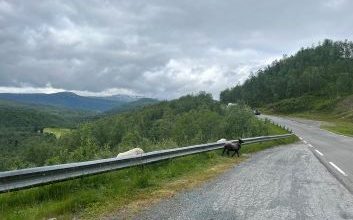
 As we traveled, we saw vast golden fields of ripe wheat. Men dressed in pants and shirts, possibly shepherds or farmworkers, were herding their livestock across the road, occasionally causing minor traffic delays, but watching them was a pleasant sight. The region we were passing through was full of crops but had fewer regular trees. It was slightly hilly, and further ahead, we saw large, neatly planted groves of olive trees. The sky was clear and bright blue, with no clouds in sight. Occasionally, we saw large farmhouses among the wheat fields.
 Along the way, we came across a man who had parked his van near a windmill and set up a stall selling fresh fruit. We turned our vehicle toward him and exchanged greetings. We wanted to buy some fruit but were still facing the issue of not having cash. However, the man kindly told us to take whatever we needed for free. We picked some fruit and, in return, gave him sunscreen, which made him happy.
We took the wrong exit at a roundabout and had to circle back. On our way, we noticed a signboard for a small town and decided to head there to buy supplies and withdraw some cash from an ATM. We reached the small Spanish town of Ardales at around 8 PM. Due to summer, it still felt like late afternoon. Young people were playing football in the streets.
 We entered a small shop where an elderly shopkeeper, wearing a t-shirt and short, greeted us warmly and asked something in Spanish. We responded in English, requesting the items we needed, which he provided. In small towns like this, people know each other well. While we were in the shop, a couple of women and a few men entered, all of whom seemed familiar with the shopkeeper and each other, engaging in casual conversations. After buying our essentials, we said “Gracias” and left to withdraw money from an ATM.
As we were leaving town, I noticed that the young men were still playing football. I wondered if any of them might become a famous football player in the future. We returned to the fruit vendor and paid him for the fruit we had taken earlier, purchasing some more as well.
 Getting lost had led us to this small Spanish town, where our destined sustenance was waiting for us in a tiny shop. Indeed, what is written in our fate will always find its way to us. Along the road, we also saw a pivot sprinkler irrigation system in use for watering the fields.
Around 11 PM, we entered Granada and hoped to find parking near the Alhambra Palace. Luckily, we found a spot. Since we planned to visit the Alhambra in the morning, we took a moment to relax, cooked dinner, drank a couple of rounds of tea, and enjoyed the view of Granada from our parking spot. The city below sparkled with lights, creating a mesmerizing sight.
Young couples sat together on the hillside, chatting, drinking beer, and admiring the city view. Occasionally, their laughter echoed in the night. This continued until late at night. Meanwhile, we turned our parking spot into a makeshift laundry station, washing our shirts and shorts and hanging them on a clothesline to dry.
After dinner, we took a short walk around. The air was pleasantly cool. Late into the night, we finally fell asleep. By morning, we woke up early, freshened up, and got ready to head toward the famous Alhambra Palace, which was very close by.
 Upon arrival, we found it crowded with tourists from all over the world. At the ticket counter, two beautiful young women informed us that all tickets for the day were sold out. We then asked which parts of the Alhambra were open to the public without tickets, and they marked them on a map for us.
The area around the Alhambra was lush with trees and greenery. In some spots, small streams of water were visible. We took a detour and ended up in the city, where we walked through narrow alleys paved with stone slabs. From certain points in the city, the towers of the Alhambra were visible.
In the city center, the streets were paved with marble and were exceptionally clean. We wanted to explore the other side of the Alhambra but also take a stroll through the city. Most tourists were concentrated around the Alhambra. The sun shone brightly.
During summer in Spain, many cafés and restaurants have compact machines to extract fresh sugarcane juice. We entered one such café and enjoyed a refreshing glass of sugarcane juice. The café was beautifully decorated.
We returned to the Alhambra and explored the publicly accessible areas. The irrigation system for watering the plants, trees, and flowers was impressive. As the temperature rose, we sat under a tree to rest, where a cat approached us. We petted it, and then it refused to leave our side.
 After browsing through some souvenir shops and purchasing a small keepsake, we decided to move on. We returned to the camper van parking area, retrieved our now-dry clothes from the clothesline, took in the daylight view of Granada from the hill, snapped a few memorable photos, and prepared to leave.
Granada was a fascinating city. One unique aspect was the large overhead shades suspended above the pedestrian streets, providing relief from the sun’s heat. We bid farewell to Granada around noon and set off toward our next destination—Cordoba.
The journey was a mix of plains and hills, dominated by olive groves. For lunch, we decided to eat at a restaurant in a small town called Alcalá la Real. We placed our order through Google Translate with a young waiter. When she asked what we wanted to drink, we said “Fanta.” she then asked, “Limón or Naranja?” That’s when I realized that in Spain, oranges are called “Naranja,” a word similar to its Sindhi counterpart. I immediately replied, “Naranja.”
 We sat outside on the terrace. The restaurant owner, who had large, curled mustaches, sat drinking white wine with a friend. The waiter frequently brought them small snacks. The owner’s mustaches reminded me of a character from my childhood in the town of Moro—a man named mr. Jumo Navall, who ran a tea shop and had similarly curled mustaches. He, too, would sit idly while his workers managed the shop. It was surprising how a person from thousands of kilometers away could resemble someone from my childhood.
After finishing our meal and tea, the restaurant owner’s friend got up, went to his jeep, and returned with a bag of fresh cherries, placing it on their table and offering us some as well. We were surprised by his generosity. The young waiter shouted from a distance that these cherries were “ecological.” We thanked her as well.
This man was a local landowner who spent his leisure time at his friend’s restaurant. Before leaving for Cordoba, we stopped at a nearby petrol station for a quick freshen-up.
After some time on the road, the heat increased, and we felt drowsy from our meal. We parked our camper under the shade near a railway station in a small town named Luque, surrounded by vast olive groves, and rested for an hour.
Around 6 PM, we reached Cordoba. Our main goal was to visit the Mosque-Cathedral. We parked nearby and started exploring on foot. To help tourists avoid the heat, horse-drawn carriages were available for hire. We passed by a monument of the Muslim philosopher Ibn Rushd, who was from Cordoba.
As we entered the mosque-cathedral complex, we saw its massive walls, wooden ceilings, and numerous archways.
The system for watering the trees was well-organized. The water from the fountains was drinkable. A pond also enhanced the beauty of the entire complex, with people sitting around its edges. There were also palm trees inside.
 There was an entry ticket for the mosque, but they had stopped selling tickets by the time we arrived because it was close to closing time. So, I moved ahead a little while Zeeshan spoke to the security guard, explaining that we had come from Sweden just to see this mosque. Since tickets were no longer available, he requested if we could visit it as long as it remained open. The guard granted permission, and Zeeshan quickly called me to come over. Thanks to this, we managed to enter the mosque, and a few other tourists also took advantage of the opportunity. The mosque was grand, and its intricate arches gave it a magical feel. It was a wonderful experience, and I truly enjoyed it.
Even Allama Iqbal had visited this mosque, and he wrote poetry about it, which is considered one of his masterpieces.
After visiting the mosque, we wandered through the city streets and eventually arrived at the Roman Bridge over the Guadalquivir River, which provided a spectacular view of the river and the mosque-cathedral. There was quite a crowd of tourists there as well. The bridge’s pillars housed birds’ nests, and the birds seemed to be protecting them. Seeing the doors of the bridge reminded me of the Sukkur Barrage in Sindh. At the end of the bridge stood the Torre de la Calahorra, also known as the Córdoba Tower, which contained a museum. This Islamic-era tower resembled a fortress, giving it an imposing look.
Palm trees were also visible in Córdoba. We stopped to take a break at a café, where having tea was essential. The café was run by young women. From my experience traveling in different countries, I have noticed that if you ask to use the restroom at a restaurant, some places allow it while others insist that the facility is only for customers, meaning you have to purchase something. However, in Spain, people happily grant permission wherever you go.
During the nighttime drive, we repeatedly listened to the sufi song by singer Saif Samejo, Naal Mahi O Tedi Lagan Diliyan, which felt even more mesmerizing in the darkness of the night.
We kept exploring until around 9:30 PM and had dinner at a Moroccan restaurant in Córdoba, where I noticed geckos on the walls. Seeing geckos and sugarcane juice reminded me of Sindh—perhaps geckos and sugarcane juice are common in warm climates. Since childhood, I have had a fear and dislike of geckos. When Zeeshan found out, he teased me, saying, “Abdullah Bhai, the gecko has jumped off the wall and climbed the tree above you!” That gave me a fright, and we all had a good laugh.
After sunset and the Isha prayer, we left Córdoba at around 10:45 PM, crossing the Abbas Ibn Firnas Bridge and heading straight toward Málaga. During the nighttime drive, we repeatedly listened to the sufi song by singer Saif Samejo, Naal Mahi O Tedi Lagan Diliyan, which felt even more mesmerizing in the darkness of the night.
 Late at night, we parked our campervan in a designated parking area where we had to return it in the morning. The next day, we woke up, had breakfast, cleaned the campervan, and returned it. We also left behind some of the items we had purchased so that other travelers could use them. Nearby, an Austrian couple was also cleaning their campervan before returning it. We exchanged experiences with them—they had mostly stayed in coastal areas, while we had explored the mountainous regions. Their sun-tanned skin suggested that they had spent a lot of time swimming in the sea and sunbathing.
The campervan company’s representative inspected our vehicle and confirmed that everything was in order. He thanked us for booking with their company. Before we left, he asked if we needed a taxi to the airport, and we accepted his offer.
Within an hour, we arrived at Málaga Airport for our flight back to Stockholm.
Grateful to the Almighty for showing us new places, introducing us to new people, and allowing us to experience new adventures. (Ends)
________________
Abdullah Soomro, penname Abdullah Usman Morai, hailing from Moro town of Sindh, province of Pakistan, is based in Stockholm Sweden. Currently he is working as Groundwater Engineer in Stockholm Sweden. He did BE (Agriculture) from Sindh Agriculture University Tando Jam and MSc water systems technology from KTH Stockholm Sweden as well as MSc Management from Stockholm University. Beside this he also did masters in journalism and economics from Shah Abdul Latif University Khairpur Mirs, Sindh. He is author of a travelogue book named ‘Musafatoon’. His second book is in process. He writes articles from time to time. A frequent traveler, he also does podcast on YouTube with channel name: VASJE Podcast.
All photos provided by the author