Today she was not the Queen Mother; today she was simply a mother, rejoicing wholeheartedly in her son’s wedding. Even at her own wedding, Didda had never danced like this.
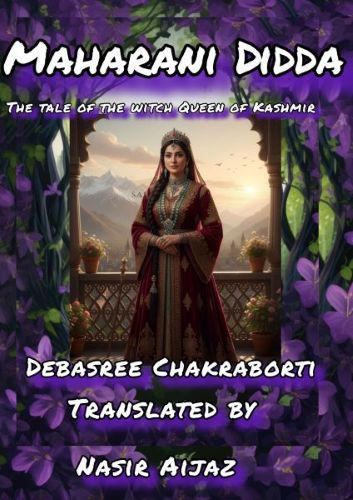
Maharani Didda: Witch Queen of Kashmir
By Debasree Chakraborti
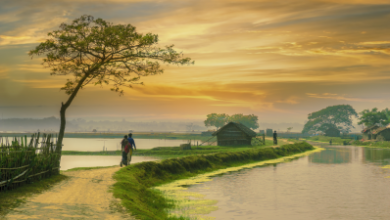
Today is Abhimanyu’s svayamvara. Kings from far and wide have arrived in Kashmir with their daughters. Abhimanyu stands before the open window of his palace, watching the preparations. The royal palace is being decorated with yellow roses; on one side of the palace lies a vast lake, and its banks are being adorned with flowers and leaves of many colors. Torches have been arranged along the edge of the lake for illumination at night.
 Abhimanyu gazes at the blue waters of the lake. Today, the lake seems to have turned into the mirror of his life; within it, he can see images from different moments of time—from the past to the present.
He never received a father’s affection in his life; his father died before Abhimanyu could even form memories. Thereafter, under the loving shelter of his grandmother and Bhalaga, he slowly grew up. In a life surrounded by guards and strict security, the sovereign presence over Abhimanyu’s existence is his mother. Yet even a mother’s affection he never truly received. His mother is like their clan deity, Goddess Bhavani—visible, but untouchable. With his mother’s blessings, there is no lack of anything in his life, and yet he is terribly lonely. He has never found a truly intimate friend—someone who would understand him deeply, or before whom he could lay bare his heart. At times, this guard-ringed life becomes unbearable.
From different parts of the palace, the sounds of the shehnai and wedding music drift in, stirring Abhimanyu’s heart with restlessness. Today, a completely new woman will enter his life—one who will come as his life partner. How he will adapt to this new chapter of life is what he is pondering now. He loves gazing into the blue waters of the lake; with this lake and the nature beyond the window, he feels a sense of oneness. Today, he misses his grandmother deeply; it had been her dream that he would become the king of Kashmir.
She could not live to see his coronation. As Abhimanyu is absorbed in these ruminations on the past, Queen Mother Didda enters the palace, the guards When the arrival of Queen Mother Didda was announced, Abhimanyu became alert and returned from his reverie to the hard ground of the present. Queen Mother Didda came up to Abhimanyu, took his hand, and led him to the place prepared for the gaye holud ceremony. Within Abhimanyu’s own palace chamber, a space had been decorated with yellow roses and red Banarasi scarves for the ritual.
Abhimanyu was dressed in a yellow silk dhoti and a white uttariya. The bright rays of the sun reflected off his body and spread all around, making it seem as though a celestial being was being anointed with turmeric. Didda lifted the bowl of turmeric, sat before Abhimanyu, and applied turmeric to him first. On Didda’s face and in her eyes appeared a strange expression of motherhood. In her smile and in her gaze, Abhimanyu felt an unfamiliar sense of fulfillment. This was the first time he was seeing such a look in his mother’s eyes. His mother always seemed to keep herself enclosed within a hard armor, making her true self impossible to discern. Today, it was as if she had stepped outside that rigid shell.
After Didda, Bhalaga applied turmeric to Abhimanyu. Renowned singers and dancers of the kingdom of Kashmir had come to attend Abhimanyu’s wedding. The singers sang, and the dancers performed, circling Abhimanyu as they danced. Queen Mother Didda sat beside her son, watching the performance. When the dancers came forward, took her hand, and invited her to dance, she offered no resistance and began dancing with them. Holding Bhalaga’s hand, Didda danced with her.
Today she was not the Queen Mother; today she was simply a mother, rejoicing wholeheartedly in her son’s wedding. Even at her own wedding, Didda had never danced like this. Everyone present was astonished to see this side of her. Abhimanyu himself watched his mother’s joy with amazement. Laughing freely as she danced, tears streamed down from Didda’s eyes.
Then the maidservants brought water in golden pitchers. First, Abhimanyu was bathed with milk, honey, and rose water, and then he was bathed with plain water. As Abhimanyu’s grandfather and grandmother were in very poor health and could not attend the wedding ceremony, they had sent Abhimanyu’s wedding attire through Didda’s brothers. The garments were of white silk, upon which Kashmiri artisans had crafted intricate designs using gold and diamonds.
The footwear that Abhimanyu’s maternal uncles brought for him was also adorned with intricate work in diamonds and gold. Once Abhimanyu was fully prepared, dressed in his wedding attire, Didda arrived with Abhinavagupta and performed a special ritual. Abhinavagupta was the principal architect of Abhimanyu’s coming into this world; therefore, no auspicious rite in Abhimanyu’s life could be completed without him.
When the ritual was concluded, Abhinavagupta departed. At that moment, there was no one left in the chamber except Didda and Abhimanyu. Didda kissed her son on the forehead and said, “My son, today many princesses have come to participate in this svayamvara. Each one of them is exceptionally accomplished, each excelling in her own way. I desire a daughter-in-law who has come to marry you out of love alone, not out of greed for the power and prestige of Kashmir.”
Abhimanyu replied very softly, “Mother, how will I understand that? I have never met anyone in this manner before; so for me, it is simply impossible.”
A gentle smile appeared on Didda’s lips as she tried to grasp the depth of her son’s words.
Abhimanyu was of a very calm nature and found it difficult to speak at length. After a pause, he said, “Mother, you are the sovereign of my life. Please shoulder this responsibility yourself. Who has come prepared to marry me out of love—only you can understand that; no one else can.”
Hearing what was in Abhimanyu’s heart, Didda felt that she had not lost. It was as though the severe penance she had been undertaking since Kṣemagupta’s death had borne fruit today. Her son had placed her in the position of the sovereign of his life. From all sides, the shehnai and wedding music burst forth. Bhalaga entered Abhimanyu’s chamber along with the guards. Then, accompanying Abhimanyu, they set out for the svayamvara assembly.
On a vast field by the banks of the Vitastā, the svayamvara had been arranged. The field was decorated with red roses. A lavish arrangement had been made for the hospitality of the guests. In the center of the grounds, small artificial fountains had been created, where peacocks danced, spreading their plumage. The guests…a s the guests arrived, they were presented with precious Kashmiri garments and various fragrant gifts. On one side, the princesses sat with their fathers, waiting for Abhimanyu, while on the other side a wedding pavilion had been erected. The chief—and sole—priest of this wedding was Abhinavagupta. On another side of the grounds, a variety of Kashmiri dishes were being prepared and served to the guests. At the time of Abhimanyu’s arrival, trumpets were sounded to announce his entrance.
Abhimanyu walked in along a red silk carpet, while showers of flowers fell upon him from both sides. All around, people raised cries of victory for Abhimanyugupta, the Lord of Kashmir. Didda always kept her sixth sense alert. Walking beside Abhimanyu, she cast her gaze over the assembled princesses and their fathers. Then, one by one, all the princesses were introduced to King Abhimanyugupta. Didda carefully read the body language of each princess, yet she could not find a place beside Abhimanyu for any of them.
Then, at the very end of the assembly, one princess caught her attention—she was gazing steadily at Abhimanyu. In that gaze and in the smile on her face, Didda sensed a deep attachment toward her son: a longing solely to have Abhimanyu himself, with no greed for anything beyond him. It was a love she had once seen in Kṣemagupta’s eyes; Naravahana’s love for her had been just as selfless. The girl’s father stepped forward with her and stood before Abhimanyu. Didda could see the shy smile on the girl’s lips; the girl now stood with her head bowed.
The announcer proclaimed their identity: “The ruler of Himbata, Maharaja Adityaraj, has arrived with his daughter, Vasundhara.” Didda observed that this girl was distinctly different from the other princesses—there was no trace of arrogance or vanity in her. Without wasting any time, Didda removed the precious diamond necklace from her own neck and placed it around Vasundhara’s. Instantly, the shehnai resounded on all sides, and everyone present burst into cheers of joy. The announcer declared the name of the young Queen of Kashmir.
Didda and Bhalaga then led Abhimanyu and Vasundhara toward the banks of the Vitastā, to a canopy adorned with white roses, where…After Vasundhara and Abhimanyu placed garlands of red roses around each other’s necks, their marriage was solemnized under the priesthood of Abhinavagupta.
On the night of the wedding, torches were lit all around the lake in front of the palace. Throughout the night, Kashmiri folk singers sang in the palace courtyard. Abhimanyu’s palace was decorated all around with white and red roses; the fragrance of roses and the scent of musk mingled and became one. Earthen lamps were lit along the walls of their bridal chamber, while the rest of the palace was kept in darkness. The flower-bed was adorned with many kinds of perfumes and red rose blossoms. In this palace, now, no one remained except the guards.
Abhimanyu and Vasundhara sat facing each other. Abhimanyu had never been in such a situation before. A young woman was sitting before him, and he could not quite understand what kind of words one ought to speak in such a moment. Abhimanyu did not need to say anything; Vasundhara herself began to speak. For her, speaking for the first time to a completely unfamiliar man was extremely easy and natural. She said, “Tell me something—why is there so much security in your palace? I have been seeing guards surrounding you all day; it feels very strange to me.”
In the manner of Vasundhara’s speech, Abhimanyu sensed a deep warmth. It felt to him as if he had known this woman for a long time. Moreover, no one had ever spoken to him so simply and openly before. Abhimanyu said, “Actually, since my birth there have been several attempts on my life. That is why I have to live under strict security.”
Vasundhara exclaimed in great surprise, “Why would anyone want to kill you? No, I don’t believe any of this. These are all just illusions of your minds.”
Hearing Vasundhara’s innocent words, Abhimanyu laughed, and then said, “Let these things rest for today. Come, let us talk about something else.”
Laughing, Vasundhara replied, “What would you like to hear? Shall I tell you about our Himbata?”
Vasundhara’s childlike simplicity put Abhimanyu even more at ease. He was just about to…He had been exhausted all day and could not sit for long, so he lay down on the bed and, laughing, said, “Yes, tell me then—Himbata is close to Tibet, isn’t it? You can tell me about Tibet as well.”
Laughing merrily once again, Vasundhara began telling stories of Himbata.
Just as a sweet, honeyed bond was beginning to form between Abhimanyu and Vasundhara, a little distance away from that palace Didda and Bhalaga sat side by side, watching the torchlights along the edge of the lake. Both were extremely tired, yet a strange peace rested on Didda’s face. Almost as if speaking to herself, she said, “Bhalaga, I cannot even explain how peaceful I feel today.”
“I observed Vasundhara carefully, understood her well, and only then took the decision about this marriage. My son has found a worthy life partner.” Though Didda was very happy, there was no calm in Bhalaga’s eyes; dark clouds of worry seemed to have settled over her face. After remaining silent for some time, she suddenly said very quietly, “I can see clouds of destruction gathering in the sky of Kashmir, which appears calm for now.”
Bhalaga had not even finished speaking when lightning flashed between two mountains on the far side of the lake in front of the royal palace. Its reflection fell upon the surface of the lake. Didda looked at Bhalaga; it was as if an explosion had occurred in her eyes. Bhalaga kept staring at the lake. Within moments, in the gusty wind, the torches along the lake’s edge began to go out one by one. As if foretelling the future, Bhalaga said, “A terrible cataclysm is imminent.” (Continues)
Click here for Part-1, Part-2, Part-3, Part-4, Part-5, Part-6, Part-7, Part-8, Part-9, Part-10, Part-11, Part-12, Part-13, Part-14, Part-15, Part-16, Part-17, Part-18, Part-19, Part-20, Part-21, Part-22, Part-23,
_______________________
 Debasree Chakraborti is a renowned novel writer of Bengali language. Based in Kolkata, West Bengal, India, she has done Master’s in Modern History from the Kolkata University, and authored some thirty books, mostly the novels, with historical perspective and themes. Her novel is ‘Maharaja Dahir’ that covers the history of Sindh from 662, the year of first attack on Sindh by the Arab armies till date, was published last year and translated by Nasir Aijaz into Sindhi language.