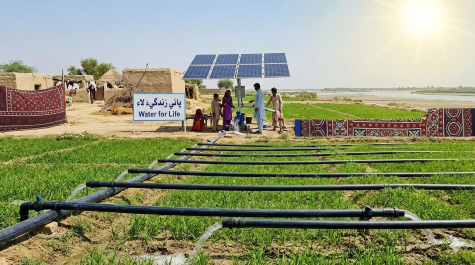
The theme for 2026, “Water and Gender: Where water flows, equality grows,” expands the discussion beyond mere access, urging the world to recognize how water scarcity disproportionately affects women and girls
- Frequent and prolonged droughts have become more common, particularly in arid regions such as Tharparkar. Reduced rainfall and unpredictable weather cycles further strain already limited water supplies.
Ali Nawaz Rahimoo
Every year on March 22, the world comes together to observe World Water Day, a global initiative established by the United Nations in 1993. The day highlights the critical importance of freshwater and advocates for its sustainable management. More than a symbolic observance, World Water Day is a powerful reminder that water is essential not only for survival but also as a fundamental human right, a driver of economic growth, and a cornerstone of peace and equality.
The theme for 2026, “Water and Gender: Where water flows, equality grows,” expands the discussion beyond mere access, urging the world to recognize how water scarcity disproportionately affects women and girls. Past themes, such as “Leveraging Water for Peace,” emphasized the role of equitable water distribution in preventing conflict and fostering cooperation. Together, these themes reinforce a vital truth: water is deeply connected to human dignity, justice, and global stability.
Water is the foundation of all life on Earth. It sustains ecosystems, supports agriculture, industry, and human health, and shapes every aspect of daily life. The human body itself is approximately 60% water, and no organism can survive without it. Yet, access to safe and clean water remains a distant dream for billions of people worldwide. According to global estimates, over 2.2 billion people lack safely managed drinking water, and nearly 3.5 billion lack safely managed sanitation. These figures highlight a crisis that is as humanitarian as it is environmental.
Water scarcity results from a complex mix of natural and human-induced factors. Climate change is among the most significant contributors. Rising global temperatures accelerate the melting of glaciers and snowcaps, which serve as essential freshwater reservoirs. Although this initially increases water flow, it ultimately leads to long-term shortages as these reserves shrink. Frequent and prolonged droughts have become more common, particularly in arid regions such as Tharparkar. Reduced rainfall and unpredictable weather cycles further strain already limited water supplies.
Industrial pollution is another major challenge. Factories often release untreated waste into rivers and lakes, contaminating freshwater sources. Agricultural runoff, laden with pesticides and fertilizers, further pollutes water, making it unsafe for human consumption and harmful to aquatic ecosystems. The consequences of water scarcity are profound. Lack of clean water and sanitation spreads water-borne diseases such as Cholera, Typhoid, and Diarrhea, causing millions of deaths annually. Children under five are especially vulnerable, with diarrheal diseases remaining one of the leading causes of mortality. Women and girls bear a disproportionate burden, often traveling long distances to fetch water, which limits time for education, economic activities, and personal development.
Economically, water scarcity slows growth and development. Agriculture, which consumes roughly 70% of global freshwater, suffers greatly during shortages, resulting in lower crop yields, food insecurity, and rising prices. Industries reliant on water face production disruptions, threatening jobs and economic stability. In regions where water is scarce, competition over resources can escalate into conflict. Communities, regions, and even nations may clash over access to shared water sources, making water both a resource and a potential source of tension.
Shared water management is therefore critical. Rivers, lakes, and aquifers often cross political boundaries, requiring cooperation among regions and countries. Managed equitably, water can become a tool for collaboration and peace building. By 2030, global water demand could exceed supply by 40%, potentially displacing up to 700 million people. Nearly half of the world’s population may live in water-stressed areas, while 75% already reside in water-insecure regions. Successful examples of transboundary water agreements show that cooperation is possible, with countries sharing resources, knowledge, and technology to ensure sustainable use while avoiding conflict.
The 2026 theme, “Water and Gender: Where water flows, equality grows,” highlights an often-overlooked issue. Around the world, women and girls are primarily responsible for collecting household water, spending 250 million hours daily in many regions to walk long distances for this essential task. Lack of access to water and sanitation reduces educational and economic opportunities for women and girls and impacts school attendance, especially during menstruation. Empowering women in water governance is not only a matter of fairness—it is essential for sustainable solutions. Studies show that water projects involving women in decision-making are more effective and better maintained. Women’s knowledge, experience, and leadership drive inclusive approaches to water management. Investing in women’s education and participation in water governance benefits entire communities, enhancing social, economic, and environmental outcomes. Addressing the global water crisis requires action at all levels individual, community, national, and international. Unsafe water causes millions of deaths annually. A child dies every two minutes from water-related diseases. Poor water and sanitation directly affect nutrition, education, and life expectancy.
Simple actions can make a difference. Turning off taps while brushing, fixing leaks, and using water-efficient appliances saves hundreds of liters monthly. Greywater from washing vegetables, clothes, or dishes can be reused for gardening, while rainwater harvesting reduces reliance on groundwater. Industries must adopt cleaner production methods and treat wastewater before discharge, and farmers can implement efficient irrigation techniques, grow drought-resistant crops, and improve soil management.
According to the UNICEF, 2.1 billion people lack safely managed drinking water, 785 million lack even basic water access, and 106 million rely on untreated surface water. Additionally, 3.4 billion lack safely managed sanitation, 1.7 billion have no basic hygiene facilities, 354 million practice open defecation, and 646 million children lack hygiene services at school. Children in crisis-affected countries are 20 times more likely to die from unsafe water than from violence.
World Health Organization reports that 2 billion people lack basic handwashing facilities at home, while unsafe water, sanitation, and hygiene cause over 1 million deaths annually, including 297,000 children under five.
Water is not infinite. Climate change, population growth, and unsustainable practices continue to strain supplies. If current trends continue, nearly half of the world’s population could live in water-stressed areas by 2030. Urgent action is needed. Governments must prioritize water management, allocate resources, and cooperate internationally to address transboundary challenges and share best practices. World Water Day is not just about awareness it is a call to action. Water symbolizes life, peace, equality, and sustainability. The themes of recent years remind us that water connects humanity, transcending borders, cultures, and generations. As we observe March 22, let us commit to protecting this precious resource. Let us ensure that every person, regardless of gender or geography, has access to safe and clean water. Where water flows, life thrives, and where equality grows, the future becomes brighter for all.
Read: The Sanitation Crises in Sindh
_______________
 Ali Nawaz Rahimoo, based in Umerkot, Sindh is a social development professional. He can be contacted on anrahimoo@gmail.com