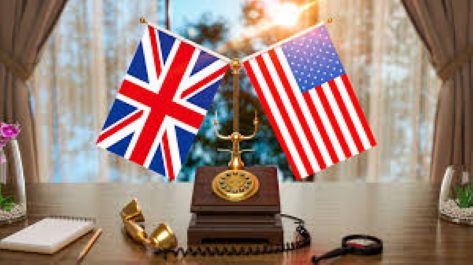
The phrase “Special Relationship” was coined by Winston Churchill in postwar triumph. It survives today’s strain.
By Tom Arms | London
The phrase “Special Relationship” was coined by Winston Churchill in postwar triumph. It survives today’s strain.
The call for Britain and America to continue their wartime alliance was a clarion call to defend against Soviet aggression.
It worked. The West won the Cold War and in the post-Cold War years the two countries have seen advantage – Britain more than the US—in continuing to cooperate in military and intelligence matters to counter terrorism and rogue states such as Afghanistan.
Of course, over 80 years, the “Special Relationship” has had its ups and downs. At the moment, it is having a serious down. King Charles’s successful visit has done little more than apply a sticking plaster to the widening transatlantic gulf.
However, the ties between Britain and the United States are more than political. As I make clear in my book “America Made in Britain” (note subtle plug), they cover the entire gamut of human relations and include language, trade, finance, philosophy, religion, law, sport, theatre, publishing…. The fact is that the two countries are joined at the historical hip and not even Donald Trump or JD Vance can change the past.
The political, military and intelligence ties that politicians call “The Special Relationship” would not be possible without our shared history.
Let us start with the law—the bedrock on which every nation is built. Every American state’s legal system is based on English common law. There is one exception—Louisiana’s French history means its legal system is based on the French. The federal courts and the Supreme Court use English common law and regularly refer to the Magna Carta medieval English court cases in their judgements.
Almost all the major American religions—Methodists, Episcopalians, Presbyterians, Quakers, Unitarians, Congregationalists, and Baptists—started in Britain before crossing the Atlantic. Roman Catholics secured their foothold in Maryland which was designated as a haven for Britain’s Catholics.
Britain and America are each other’s biggest foreign investor. American investment in Britain is $900 billion and creates 1.6 million jobs. Britain has $800 billion invested in the US and creates 1.4 million jobs.
Read: The future of the ‘special relationship’: What can Britain offer America?
America’s Declaration of Independence and constitution are the political expression of the English Age of Enlightenment. Sir Isaac Newton laid the foundations of the enlightenment in his 1687 “Principia” when he shifted the balance of society so that it was no longer based on faith and belief but on scientific observation and logically determined mathematical formulae.
Newton was followed in 1698 by John Locke who echoed the future words of Thomas Jefferson when he wrote in his “Two Treatises of Government that under “natural law” all people have the right to “life, liberty and property.” He further argued that that the governed have the right to overthrow incompetent rulers.
The lawyer William Blackstone was at the tail end of the English Enlightenment. His 1771 legal compendium “Commentaries” became the bible of constitutional law on both sides of the Atlantic. It was Sir William who established the systems of checks and balances which are at the heart of the American political system. All the basic tenets of America’s Bill of Rights were first enunciated in Blackstone’s “Commentaries.
It is one of history’s greatest ironies that England’s Age of Enlightenment found its ultimate expression in a successful rebellion against English authority.
It was not just noble thoughts that shaped America. British Wars, clearances, enclosures, the slave trade and political repression all contributed to the country’s demographic makeup. An estimated 42 million African-Americans—14 percent of the population—are descended from slaves who were transported across the Atlantic in British ships. Some 20,000 Irish prisoners of war were transported to America as indentured servants. A similar fate was suffered by about 10,000 Scots. More Scots followed Jacobite rebellions in 1715 and 1745 and after the Highland clearances forced them out of their crofts. And, of course, the major Irish migration followed the potato famine. There are about 40 million Irish-Americans and nine million Scots-Americans who live in America because of past British actions. Interesting enough, only seven million Americans claim descent from English stock.
The people traffic was two-way. During the English Civil Wars about a quarter of New Englanders sailed back to England to support the parliamentarians. Among them was an early Harvard graduate George (later Sir George) Downing. When Cromwell died, he switched sides to support the restoration monarchy and in the 1680s he went into the property business and built Downing Street. Sir George was later appointed British ambassador to the Netherlands and helped to lay the financial foundations of the British economy. Samuel Pepys said he was an unpleasant man.
In sport, baseball owes its existence to cricket and rounders. Boxing is based on rules set down by the Earl of Queensberry. Golf has its roots in Scotland. Tennis is quintessentially English and American football is linked to rugby, which was more popular and, in the US, won Olympic gold in the sport in the 1920 and 1924 Olympics.
Both American and British theatre are descended from the Shakespearean tradition as are its offshoots radio, television and films. Radio was something of an international cooperation venture, but the scientific foundations are British. Television is very British. It was invented by John Logie Baird and Britain might have dominated the industry if World War Two had not intervened. As it is, British actors regularly cross the Atlantic to appear on the American stage, in films and on television.
The English language is the strongest tie between the countries, despite efforts on both sides of the Atlantic to misunderstand each other. The common language means strong educational links, a transatlantic publishing industry and, of course the entertainment industry referred to above.
Churchill’s politically based “Special Relationship” was not created out of the ether. It was the fruit of ties going back to the first settlers in the thirteen colonies. The “Special Relationship” may currently be down. It may be going through a period of reassessment and readjustment. But history dictates that it can never be dead.
Read: Observations of an Expat: Energy Security
______________________
 Tom Arms is foreign editor of Liberal Democrat Voice. He also contributes to “The New World” magazine and lectures on world affairs. He is the author of “America Made in Britain,” two editions of “The Encyclopedia of the Cold War” and “The Falklands Crisis.”