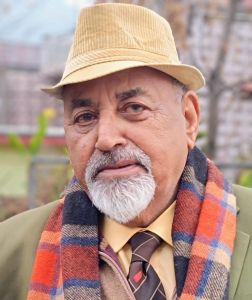
Dr. Lalit Mohan Sharma, Himachal’s poet paints with words, not colors
- When poetry becomes a passion with a poet, life begins to flow and flower through his pen and consequently life and poetry merge into one single whole.
Dr. M P Azad | Karnal, Haryana
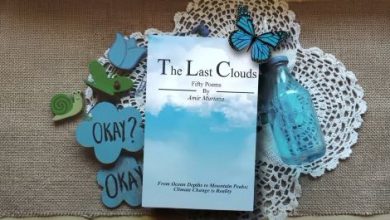
Dr. Lalit Mohan Sharma, born in 1952, has served in Himachal Pradesh Education Department in various teaching and administrative capacities till he retired as Principal of Government College, Dharamshala. He is a prolific poet, translator and author. A good measure of his creative passion and literary productivity is demonstrated in the publication of 15 books of English poetry, two anthologies of Hindi poems, a monograph entitled as Another Gandhi, a freedom fighter and ‘A Three- Step Journey’, and English translation of Zahid’s Urdu poems.
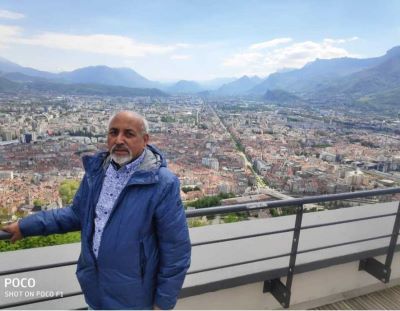 His poetry, mostly in English, is comparable to the best of established writers in contemporary world of poetry. His extraordinarily creative sensitivity is so alive and quick that not a single thing around him goes unregistered on his keenly observing mental screen. His fertile mind and creative impulses couple together with electric speed in germinating, capturing and putting on paper the common happenings and events of daily life in the form of images in a way that the most ordinary things begin to glow under his lens and assume a significance of their own. Lalit’s mastery of English idiom, phraseology, skill and ease in weaving together into tapestries of varied ideas is marvelous. It is rare joy to watch a poet creating through words visual pictures of ideas and perceptions and forging a collage in beautiful colors on his canvas.
To evaluate Lalit Mohan Sharma’s literary talents and his place in the overall context in modern English poetry is an arduous task because we are generally tempted to judge a writer by placing him alongside similar categories of writers of the past and thus evaluate him with the yardstick of comparisons and contrasts on the lines of Matthew Arnold’s ‘touch-stone’ thesis. Instead we better look at a given poet objectively as an independent artist of unique talents who is writing in a particular age and milieu.
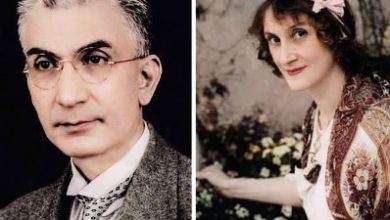
Though Lalit Sharma, as a poet, refuses to be categorized in such a bland manner, I find his poetry, in style and manner, closest to that of Robert Burns. There is a striking similarity between the two. In the introduction to “Poems: Robert Burns” (1907 Everyman edition), James Douglas writes “Robert Burns has no rival in the art of singing the soul into song and setting the heart to music. His poetry is pure passion….His note falls like the note of the lark straight from the throat of life. It is not an imitation of life, but life itself running into laughter and tears. Being life, it is not a grey moral thing, but a lovely riot of good that is not wholly good and evil that is not wholly evil.”
Life in all its hues and shades is what Lalit Sharma writes about. When poetry becomes a passion with a poet, life begins to flow and flower through his pen and consequently life and poetry merge into one single whole. Like Robert Burns Lalit Mohan Sharma does not care much about social and cultural taboos, nor does he give undue importance to the so called social morality if they come in the way of a direct unalloyed expression of life in the form of poem. For him the loyalty to the subject matter and the religion of art that serve life and its wonderful and human existence is supreme. His presentation of ideas and emotions reflects a strong affiliation to Burns’ methods when we look at his ease and spontaneity at handling the interplay between language and his art.
Let me take as sample a few of Lalit Sharma’s poems, picked up randomly from his more than a dozen of books/collections. This will sufficiently give us a clue to his stance towards life in general and a peep into the wide-ranging panoramic vision and artistic approach to his poetic world.
The poem entitled “Caught Between’, from his latest book, ‘On the Edge’, demonstrates the grip and power of the poet on all the levers of equipment that go into the making of great poetry. The opening line at once draws our attention to the creative urge stirring within the poet’s heart, gradually developing and gathering a momentum to the extent that he begins to wonder as to how he can channelize this irrepressible surge of emotions to write something appropriate to his feelings. The emotional stirrings agitating his inner self want to flow out like a molten liquid of lava out of the narrow mouth of a volcano. He wants to write but the question that haunts is: to what purpose?
Thus poet caught between the dilemmas of ‘to write or not to write” ponders on giving a voice to his inner churning. As soon as he puts his finger on the keyboard the answer starts flowing spontaneously as if explaining itself:
“To write poetry like keeping a journal
Look at mind as the thoroughfare of ideas,
Record contrary demands each choice has
To negotiate, the breaking and billowing
Waves reach out to mind’s shore, leaving
A wetness which dries up rather too soon.”
With a single stroke of the pen, (metaphorically speaking) the poet unwinds with a calming ease the otherwise tightly held material in his mind and heart and begins to exhale his relief in the next lines:
“The act catharts the piled up sensations,
Restores equanimity in the felt- emotion”.
The poem not only displays its literary merits in its form of constitution and the weight of its contents but also sets out to be a sort of a lesson-guide on the art and craft of how to write a good poem. Like James Joyce’s self-reflexive novel ‘A Portrait of the Artist as an Artist’ in which Joyce narrates biographical details of the life of the protagonist Stephen while simultaneously showing to the reader the art of writing a powerful novel. With an artistic poetic knack Lalit Mohan Sharma’s poem “Caught Between” gradually develops as a self-reflexive piece on the lines of Joyce’s novel. It ends with a masterstroke of a quartet:
“Agony and ecstasy move on like the phases
Of the moon… the mind caught between”
Desire and the destined” like a swinging pendulum “from imagination to the actual”
The poet, as reflected in his the textual contents, has a laser vision to perceive the life around him deeply enough to make a meaningful sense out of the chaos.
There is hardly any aspect of life that remains untouched by Sharma’s creative imagination His roving eyes capture every activity of human life in thorough details. His aesthetics immaculately observes every movement of the object of his focus. If, for example, he looks at a beautiful human face a thing, every facet of grace comes alive in his description,. Without a hint of sentimentality or desire of possession of the object of beauty he graciously amplifies every nuance of the subject in hand.
Look at this poem entitled “Joy- in -Life” in his 2022 collection ‘There is No Death’:
Hair in gracious waves
And perfect lazy curves
As if frame her face
Eyes and nose are
In tune with rhythm;
Her lips do rhyme with
Ambience of her form.
What moves the poet to all of these details of facial and physical features of the gracious looks of the portrait being sketched here is reinforced by dynamic dimension in the body that enhances its overall physical impact:
“A tender tilt of her head
Tells of her life-in joy
Earrings, the nose ring
Lyrical ensigns of beauty.
Joy-in-life is nourished
With smiles in her eyes,
Nursed by a gentle laugh
In full bloom at her mouth.”
Lalit Sharma describes in a musical tenor and tone the facial aspect of the graceful lady, as if painting on the canvas a vivid image with a single move of long hand in charismatic colors. The poem recreates itself in the form a painting that you can safely hang on the walls of an art gallery.
To place this poem alongside a poem entitled “The Lass of Cessnock Banks” by Burns will instantly show a striking similarity between the two poets:
“She is sweeter than the morning dawn,
When rising Phoebus first is seen,
And dew-drops twinkle o’er the lawn,
An’ she has two sparkling roguish een.
She is stately like yon youthful ash,
That grows the cowslip braes between,
And drinks the stream with vigour fresh;
An’ she has two sparkling roguish een”
Written in the eighteenth century. Burns’s poetry has a rustic touch of the soil and air of the England of those years, while Lalit’s carries the scent and touch of the rural countryside of Himachal Pradesh. The portraits of the damsels in their poems sit comfortably with each other.
Another comparison with the poem “Life in Joy “can be Lord Byron’s celebrated poem, “She Walks in Beauty “:
“She walks in beauty, like the night
Of cloudless climes and starry skies;
And all that’s best of dark and bright
Meet in her aspect and her eyes;
Thus mellowed to that tender light
Which heaven to gaudy day denies …”
A similar effect of vivacious joy in beauty is reached in Sharma’s poem “Joy-in-life and “life -in-joy”
Another poem “Voids of Silence” from the book with the same title is worth a brief analysis. Imagination and language seem to be blended, melding and finally merging into each other to give the reader as if in a piece of cake of life. In just three compact, clean and complete stanzas the poet captures not only the intertwined subtlety of living life but also gives a peep into life’s magic in motion.
“Words pause at the threshold as if
A gesture tiptoes on my very tongue;
I look up, am pleased to usher them in
Setting in the rhythms of a sentence,
Meaning blinks and winks in mischief.
A sentence, a para, a stanza carry credits
For the truth suggested in the hints given,
Yet the fulcrum is held in the balance by
The natural piety of gathered syllables,
In the order of the emotion acclaimed.”
There is a mesmerizing rhythmic use of alliteration, consonants and vowels in the line “Call it scent, perfume or the fragrance “
Images float and dance on the waves of symbols and metaphors steaming out of Sharma’s poetic smithery as if an adept surfer dances effortlessly on the wild and cruising currents and waves of the sea waters.
“Call it scent, perfume or the fragrance,
Each word is ingrained with color and
Form, it’s journey with poets, prophets,
It’s resonance with the ear and breathing,
It’s stirring presence in the voids of silence.”
Nothing speaks louder than silence. Even perfect language can only capture only a fraction of rhythmic dance of life. No emotion or feeling can stand at the cusp of a void and summon courage enough to call out at a thing that invites man jump over and kiss staring vacuum.
The poem becomes that potent force that evokes all these layers of life.
Images float and dance on the waves of symbols and metaphors steaming out of Sharma’s poetic smithery as if an adept surfer dances effortlessly on the wild and cruising currents and waves of the sea.
 The poetry of Lalit Sharma represents any number of topics that one can take from the stuff called life, but a few major aspects stand out in his motley mixture of themes and motifs. One prominent and recurring theme is the personal suffering versus the impersonal social turmoil. The poet is dogged and relentlessly pursued by his personal loss, pains, agonies, sufferings and bewildering feelings of desperate isolation caused in his own life by inevitable turbulences and ups and downs of personal life. In the following poem Lalit Sharma very effectively successfully uses his creative faculties to negotiate with these ship-wrecks and problems. During a hugely gruelling long struggle and fight with a fatal ailment of his spouse that left him completely devastated and shattered, the poet in him continued to draw strength by a minute chronicling of each moment’s pain. This creative process of expressing personal pain through art became for him a cathartic therapeutic means of surviving the irreplaceable loss and regaining strength to move on in life. Dozens of poems scattered in his recently published books is evidence of this chronicling and recording of the innumerable moments, hours and days of painful journey of life. A poem that subtly chronicles his daily battle of life is “Accepting Absences” (taken out from his recent book of the same title). Here we can see how the man in the poet deals and negotiates with the inner turmoil and how the poet in man at the same time transforms his suffering into an therapeutic art instrument to regain his hold on day to day life:
“Mourning demise of a spouse remains
A private matter, a happening never so
Common yet a part of the cycle of life.
What helps man not so much as the words
Of comfort from friends and the relatives,
But his own inner resilience and strength.”
And reconciling with the imminent truth of death, the poet in him goes on to muse:
“Death is like a fire no tears can douse,
Falls noiseless and yet leaves a void,
Not a shred survives its tornado impact”.
And finally the poet reaches the final surrendering and acceptance mode in the following words:
“Battle in the outer has to be fought within,
Not to seek the illusion of a presence but,
An absence one must settle and accept.”
______________