Stories of Karachi’s Taxi Drivers from 1993 to 2000
Zaffar Junejo
[Author’s Note: I joined a non-government organization in mid-1993. In those days, we were frequent travelers to other Asian countries, and during that period I maintained a diary. I once showed the notes to Muhammad Ibrahim Joyo — the legendary scholar, translator, and intellectual giant of the Sindhi world — who suggested categorizing the entries by theme and getting them published. He recalled that long ago, perhaps in 1955, the Sindhi journal Mehran had launched a similar idea titled ‘Hik Deenh Ji Ghaleh’ (The Story of a Day), even offering a prize for it. He himself had submitted the first story, he told me with a smile, just to set a standard for other writers. Later, Maulana Ghulam Muhammad Girami, a scholar of high standing and journalist; Shamsher ul Haidri, a distinguished Sindhi poet, journalist, and playwright; and Siraj ul Haq Memon, an iconic novelist, linguist, and journalist, all contributed their observations of a single day. These writings were published until 1968.
I agreed with Joyo Sahib that I would group the write-ups by subject and get them published, but I failed to do so. Recently, I sat down to organize my notes. I found various entries about the taxi drivers of Karachi city. Some were very brief and incomplete; others were short but held a finished truth. I have chosen five stories from each year, all of them gathered from the drivers of those cars. In total, there will be thirty-five stories covering the period from 1993 to 2000.
On the surface, these pieces appear to be simple narratives. However, beneath the prose, they depict the complex socio-political and cultural landscape of Karachi during those turbulent days. They are the echoes of a city in motion.]
What the Meter Counts
The rain had stopped, but the asphalt at the NIPA intersection was still black and slick. I hailed a yellow cab. The driver pulled over.
“Clifton,” I said as I settled into the back seat. “My office is there.”
The driver nodded without speaking. He reached forward and pushed down the mechanical flag. A red light on the meter began its steady blinking. The car smelled of old vinyl and tobacco. He glanced over his shoulder.
“Which way do you want to go? Shahrah-e-Faisal, or past Quaid-e-Azam’s Mazar through Saddar?”
“You choose,” I said. “You know the roads better than I do.”
He looked ahead through the windshield. “Shahrah-e-Faisal is better.”
He turned south and joined the main road. Traffic moved steadily. For a while, there was only the hum of tires on wet asphalt. I watched the back of his neck. The skin was dark and lined from years in the sun.
“Why did you ask me about the route?” I said. “You drive these roads every day.”
He looked at me in the rearview mirror. “It is better to ask.”
“Why?”
“There is a reason,” he said. “Let me tell you a story.”
I waited.
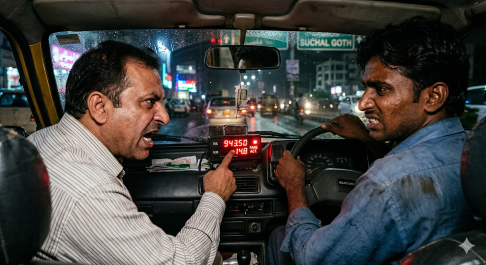
“Last night, a passenger sat where you are sitting now. We took Shahrah-e-Faisal. He did not look at the city; he only watched the meter.”
Traffic thickened as we approached the Hotel Mehran. Cars slowed and then stopped.
“We got stuck in a jam,” the driver continued. “Ten minutes passed. The car did not move, but the red light on the meter kept blinking.”
He shifted gears as the line of vehicles crept forward.
“The passenger kept staring at the numbers. He became angry. Finally, he shouted at me. ‘The car is standing still,’ he said. ‘Why is your meter still running? You are stealing from me.’”
The driver shook his head slightly.
“I told him, ‘It is the machine. The company makes it that way. When the wheels stop turning, the clock takes over. In a traffic jam, fuel does not stop burning, and time does not stop passing.’”
The driver fell silent for a moment.
“But the passenger did not care about that. He asked me to stop the taxi. He paid the fare and left without another word.”
Outside, horns sounded. Rickshaws rattled past.
“That is why I ask passengers about the route, Saeen,” the driver said. “A traffic jam is not the driver’s fault. But when the meter moves and the car does not, people feel cheated.”
I looked at the blinking red light. The numbers climbed slowly.
Soon we reached Clifton. I paid the fare shown on the meter. Before leaving, I thanked him.
“For what?” he asked.
“For teaching me how a taxi meter works.”
He looked at me but said nothing.
“I learned that the meter counts the fare in two ways,” I said. “When the taxi moves, it charges for distance. When it slows down, stops at a signal, gets stuck in traffic, or waits, it charges for time.”
He listened quietly. Then he nodded and summed it up in two short sentences.
“The meter counts how far the taxi travels,” he said, “and how long the taxi waits.”
He took the money.
“Allah Hafiz.”
“Khuda Hafiz,” I replied.
I stepped out into the Clifton air. The yellow cab merged back into the stream of traffic, its meter reset, waiting for the next passenger.
***
Three Acres of Land
I hired a taxi at the Kala Board stand in Gulshan-e-Iqbal. My destination was Sachal Goth, a Sindhi settlement near the Ojha Campus of the Dow University of Health Sciences and the headquarters of the Space and Upper Atmosphere Research Commission (SUPARCO). I sat in the front seat.
The driver was young.
“What is your name?” I asked.
Instead of giving his first name, he replied, “Sahito.”
It was a respectable surname from the Sahiti region of Sindh.
“Where are you from?”
“Naushahro Feroze,” he said.
He had completed his intermediate education. His father was a farmer.
“Why did you stop studying?” I asked.
“I have not stopped,” he said, his voice firm. “I will study more.”
“How did you come to Karachi?”
Sahito seemed ready for the question. He adjusted his grip on the wheel.
“My father has four sons. We own three acres of land and sharecrop another eight acres belonging to a Syed landlord. I am in Karachi because of my father’s advice.”
He shifted gears and continued.
“One day, we were having lunch under a neem tree in our field. We had bread, lassi, and lentils. My father looked at us and said, ‘A porhiyat can never live a decent life.’”
Sahito glanced at me. “Do you know what a porhiyat is?”
“A laborer,” I said. “A man who sells his sweat to earn a living.”
“Yes,” he replied.
“Why did your father say that?”
“A laborer earns well when he is young and strong,” Sahito said. “Then he grows old. The work stops. The money stops.”
He looked at me to see if I understood. I nodded.
“My father explained it this way,” he continued. “If a man wants only a simple life, he can be a laborer. But he should not marry. If he wants a moderate life and a family, he should get a government job. But if he wants a truly comfortable life, he must become a businessman.”
“So you came to Karachi to become a businessman?”
Sahito smiled. “Not a businessman. Just to have my own setup.”
We passed the walls of SUPARCO. The entrance to Sachal Goth was not far away. I felt the story was nearing its end.
“So that is why you came to Karachi,” I said.
Instead of answering, he asked me a question. “What do you do in Karachi?”
“A job,” I said. “A private job.”
Sahito fell silent and did not reply. Perhaps he thought I had chosen the wrong path. Perhaps he was simply thinking about his father’s words. I could not tell.
He did not speak again until we reached the gates of Sachal Goth. I paid the agreed fare and stepped out. He nodded once, then drove away.
___________________
 Dr. Zaffar Junejo has a Ph.D in History from the University of Malaya. His areas of interest are post-colonial history, social history and peasants’ history. He may be reached at junejozi@gmail.com