Stories of Karachi’s Taxi Drivers from 1993 to 2000
Zaffar Junejo
[Author’s Note: I joined a non-government organization in mid-1993. In those days, we were frequent travelers to other Asian countries, and during that period I maintained a diary. I once showed the notes to Muhammad Ibrahim Joyo — the legendary scholar, translator, and intellectual giant of the Sindhi world — who suggested categorizing the entries by theme and getting them published. He recalled that long ago, perhaps in 1955, the Sindhi journal Mehran had launched a similar idea titled ‘Hik Deenh Ji Ghaleh’ (The Story of a Day), even offering a prize for it. He himself had submitted the first story, he told me with a smile, just to set a standard for other writers. Later, Maulana Ghulam Muhammad Girami, a scholar of high standing and journalist; Shamsher ul Haidri, a distinguished Sindhi poet, journalist, and playwright; and Siraj ul Haq Memon, an iconic novelist, linguist, and journalist, all contributed their observations of a single day. These writings were published until 1968.
I agreed with Joyo Sahib that I would group the write-ups by subject and get them published, but I failed to do so. Recently, I sat down to organize my notes. I found various entries about the taxi drivers of Karachi city. Some were very brief and incomplete; others were short but held a finished truth. I have chosen five stories from each year, all of them gathered from the drivers of those cars. In total, there will be thirty-five stories covering the period from 1993 to 2000.
On the surface, these pieces appear to be simple narratives. However, beneath the prose, they depict the complex socio-political and cultural landscape of Karachi during those turbulent days. They are the echoes of a city in motion.]
The Good Story
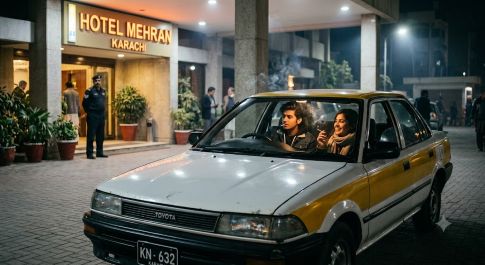
The dining hall doors closed behind me. The NGO banners hung inside against the velvet drapes, smelling of chicken tikka and heavy cologne. I stepped onto the driveway. The concrete felt cold through my thin soles. No yellow cabs waited under the porch lights. Turning right, I walked fast toward the Metropole roundabout. The air carried a sharp chill, unique to Karachi nights when the breeze shifts from the sea. Shadows stretched long against the high wall of the Military Officers Mess.
Four taxis idled in the dark near the petrol pump.
A young man leaned against the front fender of the first car. He wore tight jeans and a loose linen shirt, the top two buttons undone to the chest. He shifted his weight from one foot to the other, his shoulders square, his hair slicked back high in the style of the cinema actors. I stopped two paces away.
“Gulshan-e-Iqbal,” I told him.
He looked me over, his eyes wide and clear, measuring my stance. “Five hundred rupees.”
I nodded, gesturing toward the passenger side. “Open the door.”
I took the seat beside him. He slid his key into the ignition, then paused. Reaching into his shirt pocket, he pulled out a packet of Gold Leaf, tilting it toward me in a silent offer.
I waved a hand to signal him on. “Go ahead.”
He rolled his window down two inches and struck a match, the small flame lighting his sharp jawline. He drew the smoke in but did not swallow it. He held it in his cheeks, then exhaled slowly in a thin, tight stream. The gray smoke hit the cool air from the window, traveling straight for a second before curling into sharp zigzags under the dashboard light.
I watched the gray line of smoke break apart. “You have a specific way with that.”
He flashed his teeth, white in the dark dashboard glow, and put the car in gear. “The style brings the trouble, sir.”
I leaned back against the vinyl. “Let me know how?”
He shook his head, his eyes fixing on the dark stretch of Shahrah-e-Faisal. “Let it go.” He tapped the plastic stereo console. “Music?”
“Play your favourite.”
He pressed a black Sony cassette into the slot. The tape clicked. The speakers rattled with the high, clear voice of Salma Agha: Chale Aao… Chale Aao. The voice filled the small cabin, heavy with the old rhythm. I watched the streetlights flash across his face.
“A beautiful song for someone waiting,” I observed, turning slightly toward him. “You carry a story behind that shirt.”
He tightened his grip on the wheel, his knuckles squaring off. “Everyone carries one.”
The car rolled past the marble block of the Jaffar Building. The road opened up, wide and empty.
“I stood by Frere Hall last month,” he began, his voice dropping below the steady hum of the engine. “Just opposite the Marriott. The sun was down. I saw a couple by the mosque gate near the hotel. They did not move. They did not speak. The air between them looked hot.”
He flicked the indicator on, then switched it off.
“The woman broke away,” he continued, staring straight through the windshield. “She crossed the road alone. The man stayed by the gate like a stone. She reached my side, waved her arm hard, and shouted, ‘Taxi!’ I flashed my lights to show her I saw. Before I could turn the wheel, she ripped the back door open. She did not look at me. She just barked, ‘Go.'”
He shifted into third gear.
“I thought the man who was standing there was sick,” he said, his fingers restlessly tapping the wheel. “I turned the car toward him anyway. I slowed down near his curb. He stepped forward. She didn’t even glance his way. She just hammered her fist against my shoulder. ‘Go, go.’ Her hand was shaking.”
I leaned slightly forward. “Then what did she say?”
“She spat out one word,” he muttered, his jaw tightening. “‘Bastard.’ The man just remained on the curb. I pressed for a destination. Silence. I checked the rearview glass—the water was running down her cheeks. I let some minutes pass before trying again. She snapped, ‘Just drive.'”
The car passed the Karsaz flyover.
“Shahrah-e-Faisal is long, it kills time,” he went on, gazing into the dark road ahead. “At Star Gate, I warned her the airport was next. She commanded me to turn around and take the same road back. Near Karsaz, she requested a tea stall.”
“Did you find one?” I asked.
He gave a short, sharp jerk of his chin. “The roadside stalls are for labourers. Her clothes were too fine. I took her to the Aga Khan Hospital instead. The canteen stays open.”
He took a slow drag of his cigarette, the cherry glowing bright in the dim cabin.
“She brought two cups of tea and two slices of cake to the car,” he recounted, exhaling slowly. “She sat in the back and questioned my name, my family. I explained that I live in North Nazimabad. Three sisters. I am the eldest. She just nodded.”
“Then?”
“She announced she wanted to meet my mother,” he said, tracing a finger along the dashboard. “Then she stopped herself. ‘Let us go,’ she muttered. We walked out to the parking lot. She did not get in the back this time. She took the front seat. Exactly where you are sitting now.”
He pointed directly at my leather seat.
“She pulled two 555 cigarettes from a silver case,” he whispered, his eyes tracking the memory. “She placed one right between my lips. She struck a lighter, but the breeze from the open door kept killing the flame. I reached out and held her small hand to steady the fire.” He let out a short, hollow laugh. “She looked right into my eyes through the spark. She whispered, ‘Coward.'”
I offered a smile. “A good word, if a beautiful lady says it.”
He ignored the comment, rolling his window all the way down before hurling the cigarette butt into the wind. “She remarked that I smoked like a hero in the movies. Then she struck another match. Before the flame died, she commanded, ‘Mehran Hotel.’ I nodded.”
The car turned toward the Sui Gas head office.
“We reached the porch,” he said, his tone flattening out. “She opened her purse but didn’t hand over a single note. She stepped out, dropped her cigarette on the marble floor, and crushed it with the heel of her sandal. That was when I saw it. A heavy silver payal around her left ankle. It caught the brilliant porch light.”
“Did she speak?” I prompted.
“She stood by the glass doors of the lobby,” he murmured, his voice dropping an octave, heavy with a strange regret. “She looked back and beckoned me with her hand. Just a common sign.”
“And you?”
He gripped the wheel until his knuckles went pale. “I lost my nerve. I waved my hand vaguely, pretending I was just parking the car. Then I rolled the windows tight, threw the gear into reverse, and slammed the gas. I didn’t dare look in the mirror.”
He reached into his pocket, searching for a fresh cigarette to calm his hands.
“Have you seen her since?” I asked.
He stared blankly at the dark dashboard. “Yes.” He paused, his voice breaking slightly. “No.”
The car grew quiet. He held the smoke in his mouth again, letting it out in that same straight, broken line.
The taxi slowed near my block in Gulshan. He pulled the handbrake until it clicked hard, then stared intently at his hands on the wheel.
“Thanks to God,” he whispered, flicking a glance upward in gratitude. “A man stays away from sin. Earned bread is better.”
I handed him the five hundred rupees and stepped out into the cold Karachi night.
I walked toward my apartment building, the sound of my shoes loud on the pavement. I had heard the story five times before from five different drivers, from old gardeners in the colonial bungalows, from the cooks in the defense societies. In all their stories, the madam was rich, the girl was beautiful, and the advance was made by women. And in every story, the poor man kept his hand on the wheel and his eyes on the road, saving his soul.
Fabricated, but a good story. It made the journey shorter.
______________________
 Dr. Zaffar Junejo has a Ph.D in History from the University of Malaya. His areas of interest are post-colonial history, social history and peasants’ history. He may be reached at junejozi@gmail.com