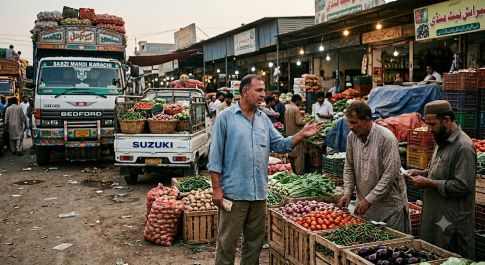
Stories of Karachi’s Taxi Drivers from 1993 to 2000
Zaffar Junejo
[Author’s Note: I joined a non-government organization in mid-1993. In those days, we were frequent travelers to other Asian countries, and during that period I maintained a diary. I once showed the notes to Muhammad Ibrahim Joyo — the legendary scholar, translator, and intellectual giant of the Sindhi world — who suggested categorizing the entries by theme and getting them published. He recalled that long ago, perhaps in 1955, the Sindhi journal Mehran had launched a similar idea titled ‘Hik Deenh Ji Ghaleh’ (The Story of a Day), even offering a prize for it. He himself had submitted the first story, he told me with a smile, just to set a standard for other writers. Later, Maulana Ghulam Muhammad Girami, a scholar of high standing and journalist; Shamsher ul Haidri, a distinguished Sindhi poet, journalist, and playwright; and Siraj ul Haq Memon, an iconic novelist, linguist, and journalist, all contributed their observations of a single day. These writings were published until 1968.
I agreed with Joyo Sahib that I would group the write-ups by subject and get them published, but I failed to do so. Recently, I sat down to organize my notes. I found various entries about the taxi drivers of Karachi city. Some were very brief and incomplete; others were short but held a finished truth. I have chosen five stories from each year, all of them gathered from the drivers of those cars. In total, there will be thirty-five stories covering the period from 1993 to 2000.
On the surface, these pieces appear to be simple narratives. However, beneath the prose, they depict the complex socio-political and cultural landscape of Karachi during those turbulent days. They are the echoes of a city in motion.]
No One Pays for Dead Things
The yellow glare of the streetlights still cut through the grey dawn. The sea breeze blew cold and wet.
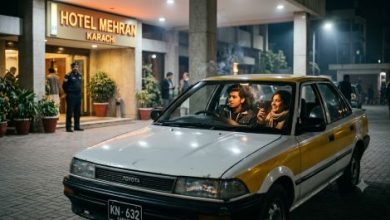
A white Corolla pulled to the curb, and the door opened. The man at the wheel sat straight, his hands relaxed. He wore a clean white shalwar kameez, sported a fresh shave, and carried the scent of cheap cologne and tobacco.
The front door clicked shut.
“Tariq Road, adjacent to the graveyard,” I announced, settling into the vinyl seat.
He gave a short nod, shifted into first, and joined the light morning traffic.
“You take this route every day?” I gestured toward the empty shops rolling by.
He tightened his grip, eyes fixed on the road ahead. “Only the early hours.”
I turned my head, my brow furrowed. “Why only then?”
A long silence filled the cabin. He adjusted the rearview mirror, checking my reflection. “It is a long story.” He cleared his throat, staring into the middle distance. “I got admission into Karachi University.” He paused, his gaze drifting to the horizon. “In the History department. It was nineteen-ninety-something.”
I leaned back, giving him a sideways glance to show I was listening.
“Got a first class,” he added, a small, hard tuck appearing at the corner of his mouth. “I looked for work. A long time.”
I waited, watching his jaw set.
“No luck.”
“All advertisements for jobs,” he spat the words softly, looking down at his own knuckles, “they wanted economics. They wanted science. No one wanted history.”
The truck ahead kicked up a cloud of grey smoke. He overtook it with a sharp, angry jerk of the wrist.
“I thought it was normal at first,” he continued, his eyes narrowing at the road. “Then the others found positions. The private offices shrugged. They asked about typing. They asked about computers and ledger books.” He gripped the wheel. “A historian does not type accounts.”
I looked out at the passing trees. “So, the taxi?”
He shook his head, a quick, dismissive jerk. “The car is a side thing. I am a trader.”
I raised an eyebrow. “What kind?”
“Sabzi Mandi,” his chin lifted with a sudden, sharp pride. “Bulk buying. I sell to the vendors. In the beginning, I had no capital. I paid a token, took the crates, sold them, and brought back the cash. Low margins.” He tapped the wheel rhythmically with two fingers. “Now I pay upfront. Full cash. Better profit.”
The tires hummed against the tarmac.
“Such trips pay for the fuel,” he flicked his eyes down toward the gauge. “I take a fare on my way to the market. Like today.”
I looked at the dashboard, thick with dust. “And the degree?”
He stared straight at the road, his face blank. “It tells me I am educated. It tells me nothing else.”
I shifted uncomfortably in my seat. “The system is wrong.”
He rammed the gear stick into top with a heavy thud. “The universities do not look ahead. They teach the dead things. No jobs in the dead things.”
The shops of Tariq Road appeared around the bend.
I pointed to the curb. “Drop me by the corner.”
He braked, pulling the car smoothly against the concrete. He kept his eyes locked on the windshield, never turning his head. Thank God he did not ask about my degree or my work.
“Three hundred rupees,” his fingers tapped the dashboard expectantly.
I dropped three notes onto the console. The door clicked open, and the morning’s cool, humid air hit my face. Behind me, the white car pulled back into the street, accelerating fast toward Sabzi Mandi.
____________________
 Dr. Zaffar Junejo has a Ph.D in History from the University of Malaya. His areas of interest are post-colonial history, social history and peasants’ history. He may be reached at junejozi@gmail.com