The women of Sindh remain severely restricted by systemic educational neglect. Achieving true regional progress requires shifting from empty rhetoric to equitable planning, starting with urgent, foundational investments in girls’ schools.
Maha Dev Makwano
Today, one can’t deny anymore that a nation can progress without including women. The world’s most developed nations realized early in their journey that women, who make up nearly half of the population, must be given equal opportunities if a nation wants to grow, and match the global standards of the progress and prosperity. Those nations opened doors for women and moved forward successfully, strengthening the women population in many ways.
Likewise, many religions and sacred books have emphasized the importance of women, their rights, and their role in society. History, both old and near past, has many examples of strong women who played key roles in shaping communities and nations.
Like women in many other societies, women in Sindh are an important part of social, cultural, and economic life. Along with managing homes, they also contribute to farming, handicrafts, education, and healthcare. They also play a major role in preserving Sindhi culture, language, and values every day without reward and recognition. Unfortunately, they have not received the respect and recognition they truly deserve, but timely recognition would have a powerful and positive impact.
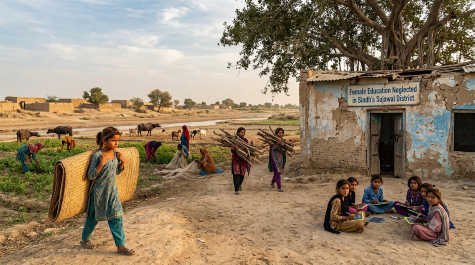
If we take the example of one district, Sujawal, we can better understand the situation. Like many other districts of Sindh, women in Sujawal face hardships and live under limitations. Yet their role in every field appears stronger and more essential than men’s in many ways. Women work side by side with men in agriculture—cultivating land, harvesting crops, caring for livestock, and livelihoods from all means available. Specifically, in the fields they perform more than men, if you go offside the roads you will see only women working in the fields, with the livestock and routine tasks of households.
Along with other all fields in Sujawal, specially, in fishing communities, women support their families by making fishing nets, arranging the raw material, supplies for the nets at the grounds and sometimes direct engagements in the fishing. In some areas, men are only involved in catching fish, while women handle the rest of the work, including weaving nets, cleaning fish, drying fish, and taking it to the market. Despite their hard work, the condition of women’s rights and basic needs remains deeply troubling throughout the district.
Education is the strongest solution to poverty, injustice, poor health, and social inequality. However, in District Sujawal, the education system faces serious challenges. The district has only 19 Higher Secondary Schools, including just 4 girls’ schools, 5 boys’ schools, and the rest co-educational institutions, which are often less acceptable in rural communities. At the same time the acceptance for the coeducation is again a challenge and needs strong and regular mobilization and lobbying on it.
One of the major problems faced by women in Sujawal is access to education. From primary to secondary and higher secondary levels, the number of schools—especially girls’ schools—is alarming. Across Sindh, only 35 percent of all schools are for girls. Whether these schools are functional or not is another issue altogether. This reflects unequal planning from the beginning. If proper facilities do not exist or are not active, efforts for improvement cannot succeed.
Sujawal, with a population of around one million people, has only 974 schools. Out of these, 91 percent are primary schools. This means that after primary education, children have very limited opportunities to continue their studies. Only 9 percent of the schools are available beyond primary level. This shows weak and poor educational planning for the district, and need to be addressed as soon as possible.
Out of the total 974 schools, only 102 are for girls—less than 10 percent of all schools. Among 803 primary schools, only 85 are for girls. Out of 32 elementary schools, only 4 are for girls. There are 17 middle schools, with only 8 for girls. There are 15 secondary schools, of which only 3 are for girls. In the entire district, there are just 5 higher secondary schools, and only 2 are for girls.
With such poor planning, the district’s literacy rate stands at only 37 percent. Male literacy is 47 percent, while female literacy is only 27 percent. If women’s literacy in a district remains just 27 percent today, then there is little more to say. This situation itself is clear proof of society’s attitude toward girls’ education. For the planning agencies, education authorities any further comment would only be empty words.
The condition of primary and middle schools is even more concerning, especially for girls. Many schools lack proper buildings, toilets, clean water, electricity, and qualified teachers. Limited access to girls’ schools, shortage of female teachers, and weak infrastructure are causing high dropout rates.
Even if we leave aside health, skills, and other basic issues, if by 2026 we still cannot plan equally for women’s basic right to education, then in my view, the condition of women in Sindh may remain unchanged even after the next 50 years. This attitude towards the girls’ education and education as a whole is enhancing the child marriages, child labor, basic health issues and many more burden to be addressed in the near future.
District Sujawal urgently needs more girls’ schools, better infrastructure, qualified teachers, and stronger implementation to ensure every child—especially every girl—has access to quality education.
Read: Education: Sindh Govt.’s Tall Claims Stand Exposed
________________________
 Maha Dev Makwano is an author, poet, and development and humanitarian practitioner with expertise in public health, nutrition, non-formal education, and rural development. He is doing MPhil in Rural Development. He can be reached at mahadevmakwano@gmail.com